


When it comes to calculating profits, fees, and logistics, Amazon sellers rely heavily on FBA calculators. While free tools like Amazon’s Revenue Calculator and Inline Revenue Calculator offer basic estimates, they often miss key expenses and lack advanced features.
In this post, we compare Amazon FBA calculator: free vs. paid, highlighting why Seller Assistant’s FBM&FBA Calculator gives sellers a sharper edge. From real-time ROI to VAT and logistics insights directly on product and supplier pages – we’ll show you which tool actually helps you maximize profits and make smarter sourcing decisions.
Amazon Revenue Calculator
Description
Amazon FBA Revenue calculator is a free tool provided by Amazon to help sellers compare fulfillment options – Fulfilled by Amazon (FBA) vs. Fulfilled by Merchant (FBM). It estimates fees, profit, and net margin per unit based on selected fulfillment methods and product data. This tool is primarily used to evaluate which delivery method is more profitable for a particular product.
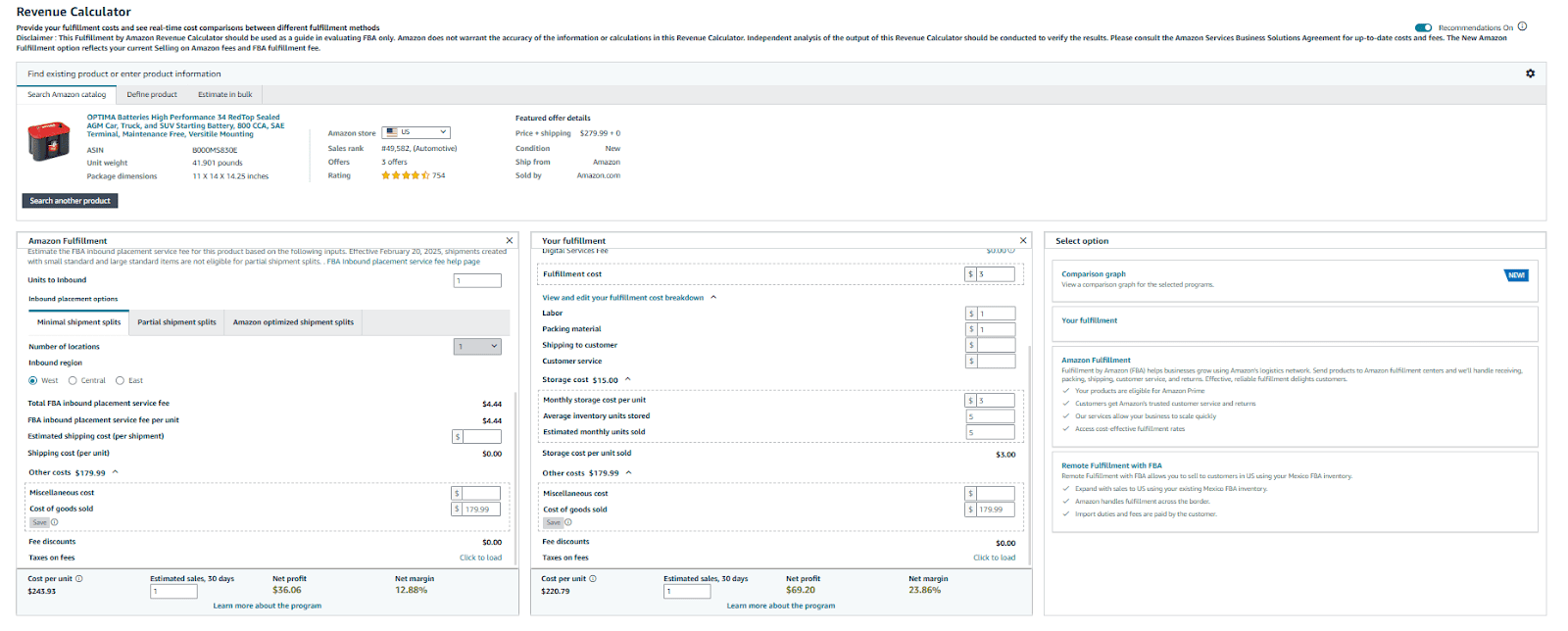
Amazon FBA Revenue calculator
What it does
It calculates core Amazon selling costs such as referral fees, FBA fulfillment charges, and storage fees. Sellers can compare both FBA and FBM models side by side, adjusting variables like shipping costs, cost of goods sold (COG), and inbound placement preferences.
How it works
You can search for an existing product using ASIN or product name, or define a new one by entering dimensions and category. The tool pulls current pricing from Amazon and lets sellers input cost data to estimate profit per unit. The calculator updates profit/loss values in real time when any input field is adjusted.
Fees included in the Amazon Revenue calculator
-
- Referral fee;
- Fixed Closing fee;
- Variable Closing fee
-
Fulfillment costs
- Inventory placement;
- inbound placement service fee;
- Tape;
- Label;
- Bagging;
- Bubble wrap, etc.
-
Monthly storage fees;
-
Estimated cost per unit;
-
Net profit per unit;
-
Net Profit;
-
Net Margin.
Fees not included in the Amazon Revenue calculator
- Monthly subscription fees
- Per-item fees
- Removal order fees
- Return processing fees
- Unplanned service fees
- FBA inventory storage overage fees
- Refund administration fees
- Rental book service fees
- High volume listing fees
- Other less common fees not explicitly listed as included.
How to use it step-by-step
How to use it step-by-step
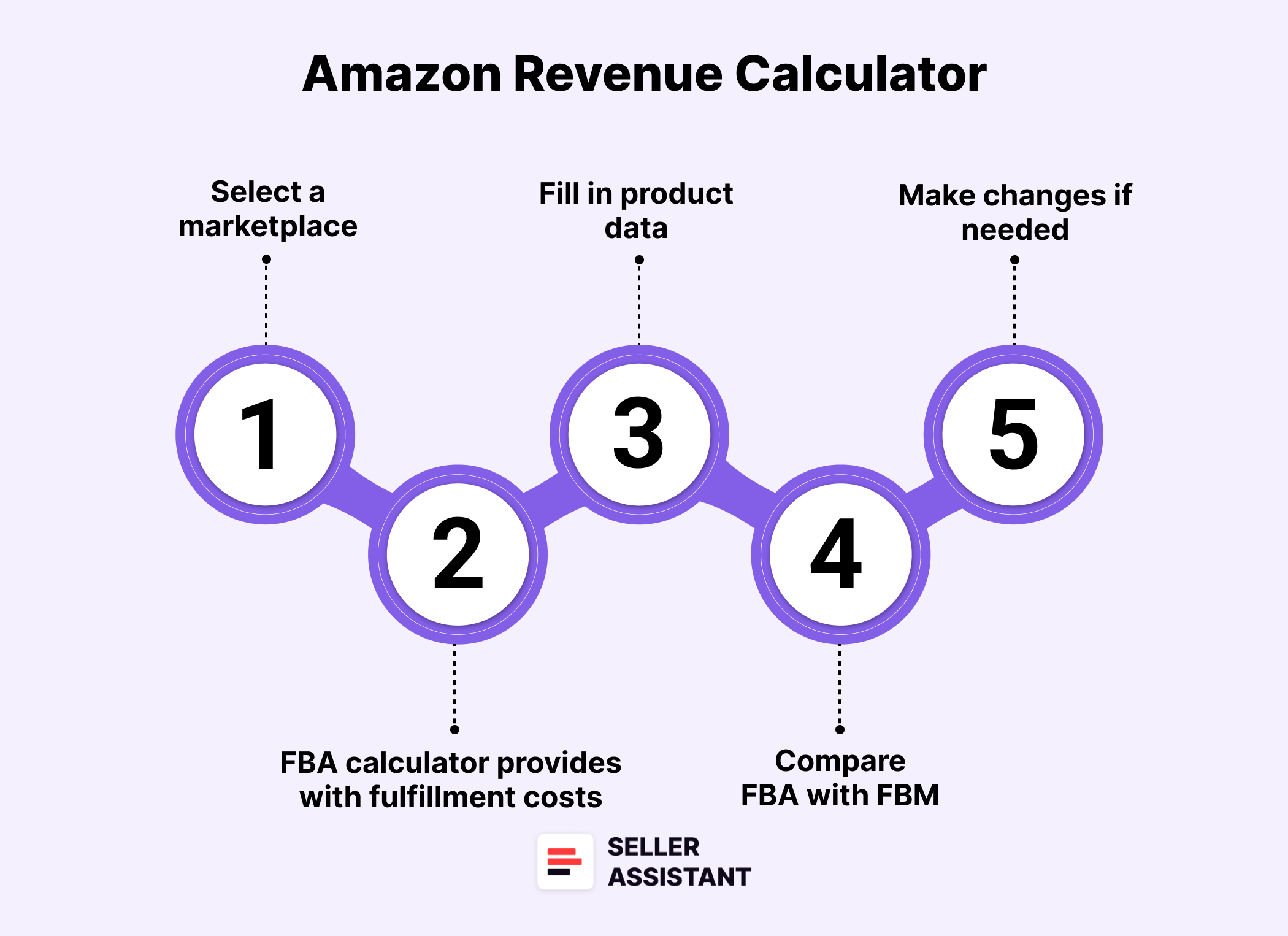
Step 1. Search or define the product
- To begin, search for an existing product by ASIN or product name.
- If your product isn’t listed on Amazon, click Define product and manually enter its dimensions and category. Make sure to select the appropriate country to display the correct fees.
Step 2. Enter price and shipping details
- If you selected an existing product, the calculator will autofill the product data from the Featured Offer.
- For unlisted items, manually input the item price and seller-fulfilled shipping charges.
- You can also enter FBA inbound placement options, including the number of locations and inbound regions.
Step 3. Enter cost estimates
Add your cost of goods sold (COG) for each fulfillment method (FBA and FBM). You may also include other fulfillment-related expenses like bagging, labeling, or additional shipping costs for a more precise profit projection.
Step 4. Compare FBA and FBM options
- Use the fields to simulate different scenarios for FBA and FBM.
- Compare estimated fees, net margin, and total profit for each method.
Step 5. Adjust inputs to refine estimates
Any time you modify a field – such as price, COG, or shipping cost – the calculator will instantly update net profit, margin, and per-unit cost estimates to reflect the change.
Note. Results are only estimates and exclude some Amazon fees like VAT, removal, and return fees.
Price
Free.
Inline Revenue Calculator
Description
The Inline Revenue Calculator is a built-in Amazon tool that gives sellers a quick preview of estimated fees and net profit per unit directly within the Manage Inventory dashboard. It helps evaluate core fulfillment costs for each SKU already listed in your Amazon store. This tool is ideal for day-to-day pricing and profitability checks for active listings.
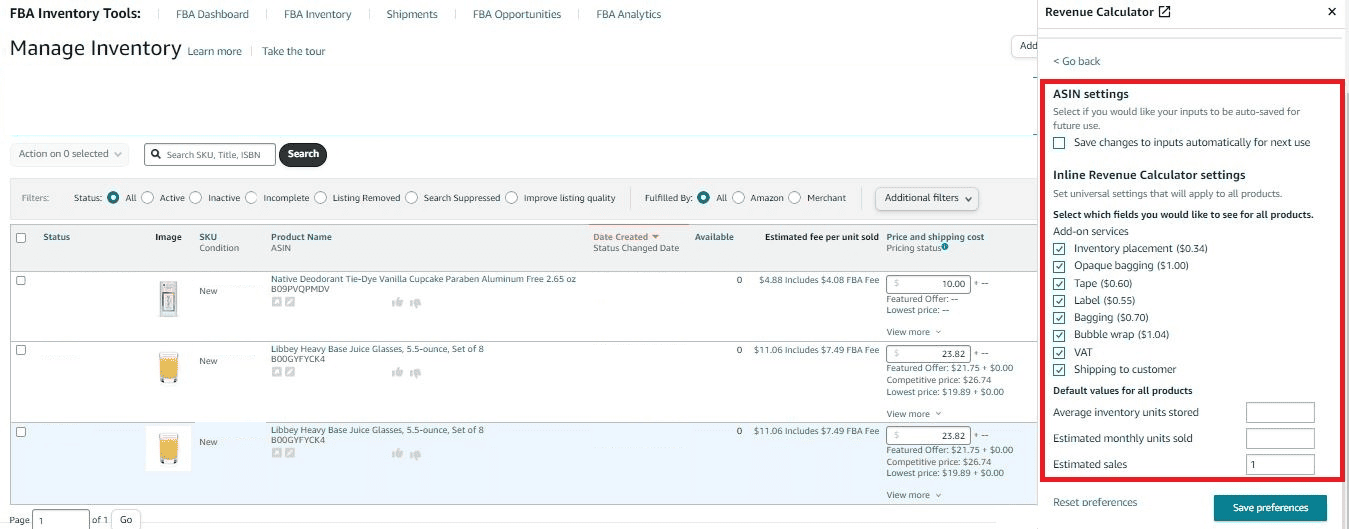
Inline Revenue Calculator
What it does
It estimates FBA-related fees and calculates projected net profit per unit. Unlike the standalone Revenue Calculator, the Inline version is integrated into your inventory view and works with existing SKUs. You can input your cost of goods, shipping, storage estimates, and optional services to refine the projections.
How it works
The calculator displays a clickable fee preview under the “Estimated fee per unit sold” column. Clicking it opens a detailed fee breakdown, including referral, fulfillment, and storage fees. Sellers can adjust additional cost inputs like inbound shipping and cost of goods sold (COG) for more precise net profit estimates.
Fees included in the Inline Revenue Calculator
- Referral fees
- FBA fulfillment fees for items sold in Amazon stores
- FBA inbound placement service fees
- Monthly storage fees
- Long-term storage fees
- Variable closing fees
- Per-item fees
- Optional Service fees
Fees not included in the Inline Revenue Calculator
- Monthly subscription fees
- Removal order fees
- Return processing fees
- Unplanned service fees
- Refund administration fees
- Rental book service fees
- High volume listing fees
- FBA Export
- Prime Wardrobe
- Other less common fees not explicitly listed as included.
How to use it step-by-step
Step 1. Open your inventory in Seller Central
Go to your Amazon Seller Central account and navigate to Inventory > Manage All Inventory to access your product listings.
Step 2. Find the target SKU
Scroll through your inventory and locate the specific SKU you want to analyze or enter product SKU. ASIN, or title in the search field and do search.
Step 3. Click the estimated fee value
In the Estimated fee per unit sold column, click on the displayed fee amount to launch the Inline Revenue Calculator for that product.
Step 4. Review the default fee breakdownView Amazon’s auto-generated breakdown of fees, including referral, fulfillment, inbound placement, storage, and optional service fees.
Step 5. Enter your custom valuesAdd your own cost data to refine the estimate:
- Cost of Goods Sold
- Shipping cost to Amazon
- Estimated storage fees
- Optional service fees
Step 6. Enable tax fields (optional)
If you need to account for taxes on Amazon fees, enable the tax estimate fields to view projected tax liabilities.
Step 7. Review updated net proceeds and profit
Check the recalculated net proceeds and profit per unit based on your input data.
Step 8. Customize visible fields
Click the settings icon in the upper-right corner to choose which cost fields are shown and to adjust default values like storage rates.
Note. Estimates reflect sales in Amazon stores only. Final fees may differ.
Price
Free.
Seller Assistant’s FBM and FBA Calculator
Description
Seller Assistant’s FBM and FBA Profit Calculator is a professional, browser-based profit calculator designed for Amazon sellers who need accurate, real-time insights. Unlike Amazon’s free tools, it works directly on both Amazon product pages and supplier websites, allowing you to instantly evaluate profitability, fulfillment costs, ROI, VAT, and margins – without switching tabs or manually copying data.
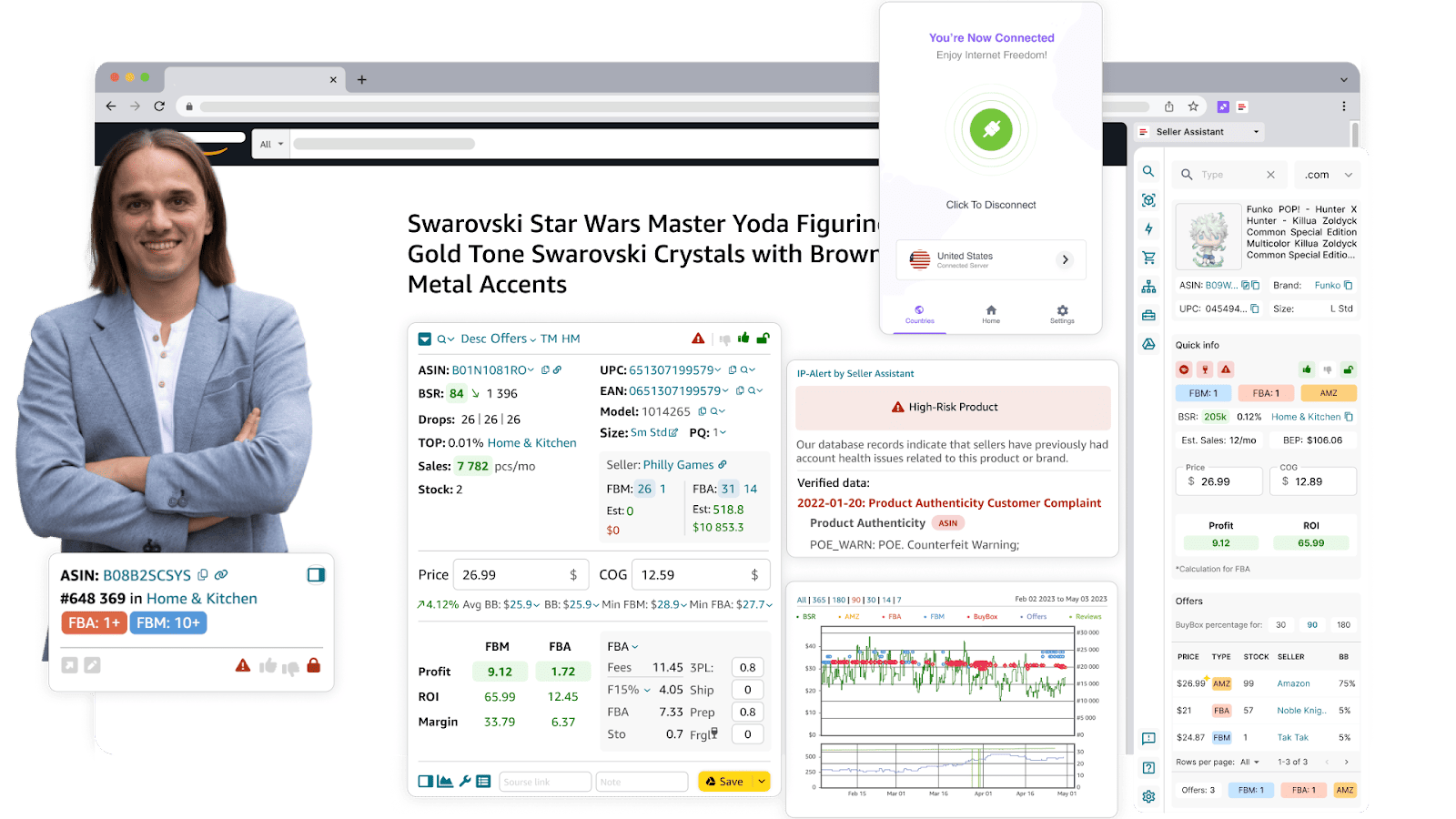
Seller Assistant’s FBM and FBA Profit Calculator
This calculator is part of Seller Assistant Extension, which includes advanced product sourcing features, IP alerts, restriction checks, and competitor analysis for Amazon arbitrage, wholesale, and dropshipping sellers.
Note. Seller Assistant is a comprehensive product-sourcing software that helps Amazon sellers quickly find high-profit deals. It combines three extensions: Seller Assistant Browser Extension, and IP-Alert Chrome Extension by Seller Assistant, and VPN by Seller Assistant, Amazon seller tools: Price List Analyzer, Brand Analyzer, Seller Spy, Bulk Restrictions Checker, and API integrations, and features: Storefront Widget, Side Panel View, FBM&FBA Profit Calculator, Quick View, Stock Checker, IP Alert, Variation Viewer, Sales Estimator, Offers, and Restrictions Checker.
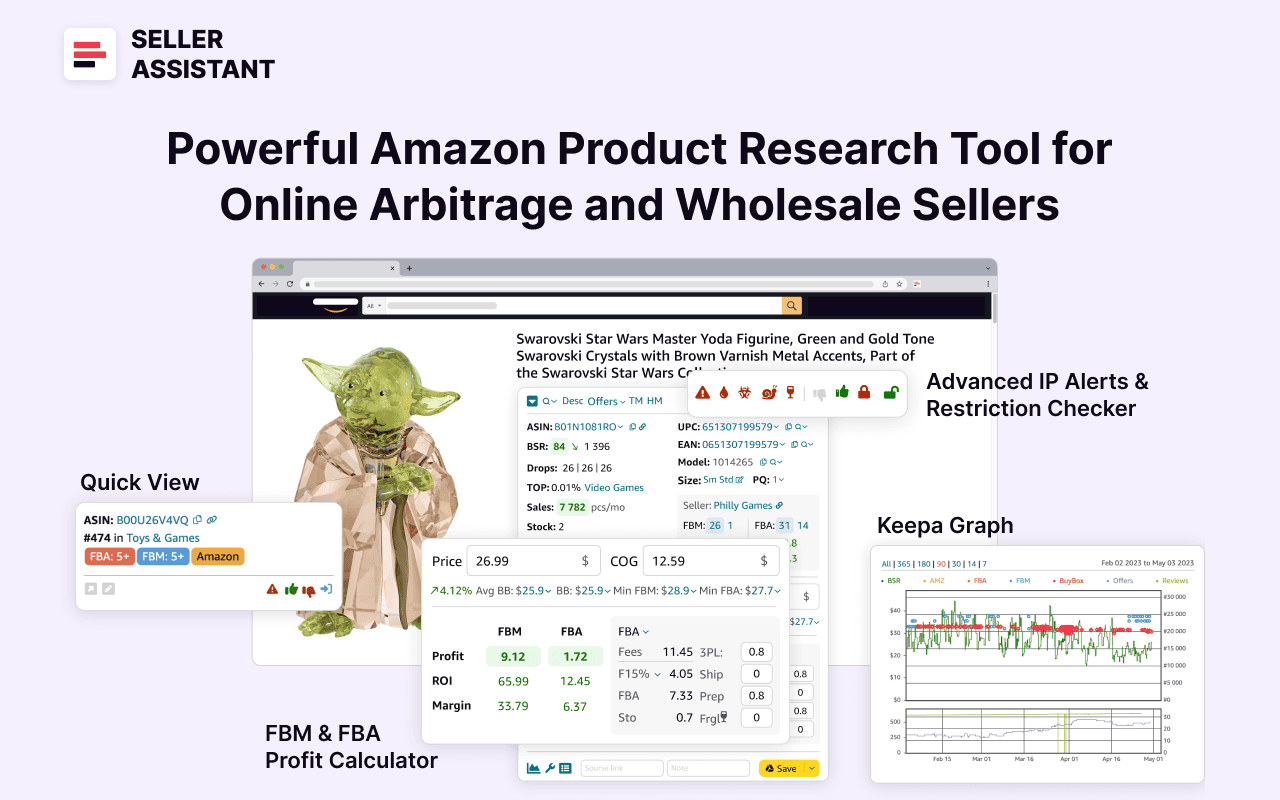
It offers a robust toolkit of over 20 features built to streamline every part of the sourcing process – from bulk scanning wholesale supplier sheets for high-margin leads to deep product research and advanced brand and competitor analysis. By using this FBA and FBM product sourcing software, you can easily identify products that have the potential to be sold well on Amazon.
What it does
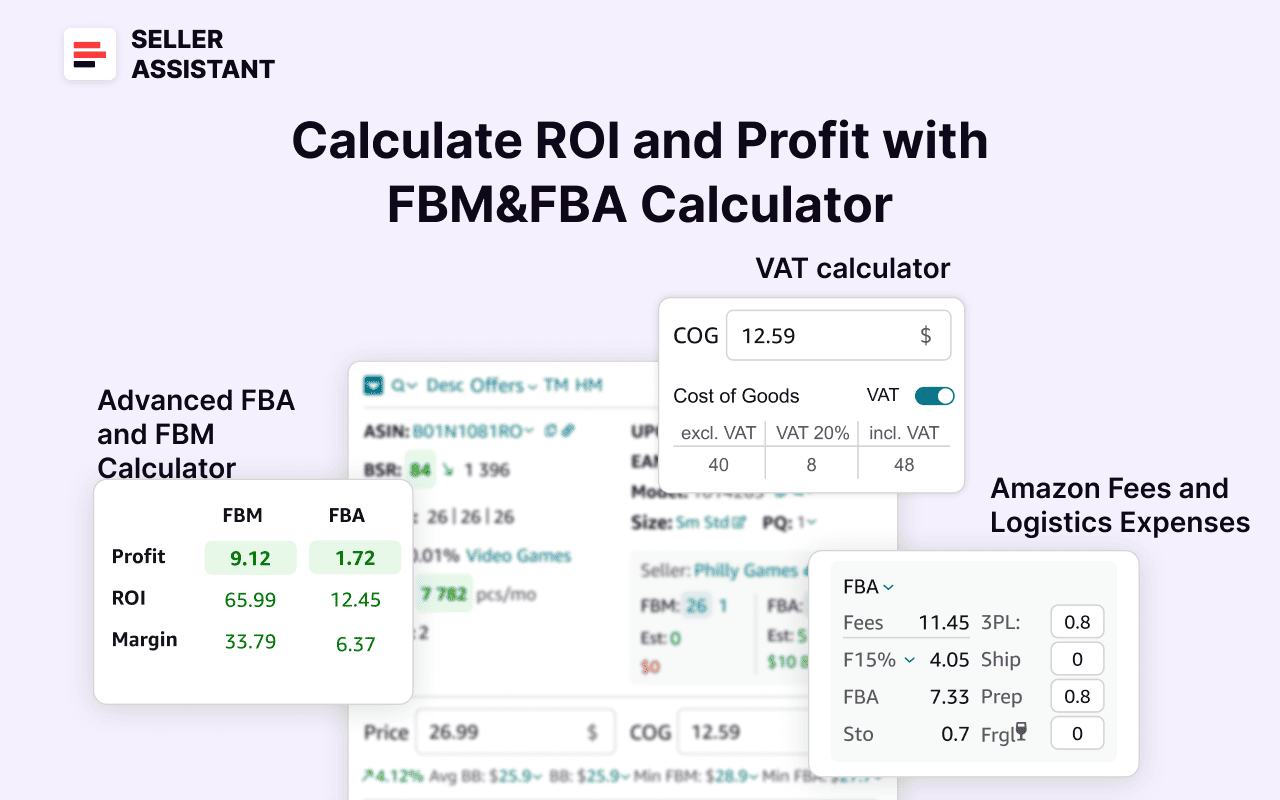
FBM and FBA Profit Calculator
- Calculates total Amazon fees for both FBA and FBM: referral, fulfillment, storage, inbound placement, etc.
- Works on Amazon product pages, supplier sites with side-by-side profit previews, and your competitor storefronts to detect profitable competitor items
- Estimates profit, ROI, and margin in real time
- Computes break-even point
- Customizes inputs like 3PL, shipping, prep, logistics, hazmat, and miscellaneous costs
- Supports US sales tax and European VAT, including multiple VAT schemes
How it works
Once the Seller Assistant Chrome Extension is installed, the calculator appears automatically on Amazon product pages and supplier websites. It extracts product details and overlays the calculator directly into your sourcing workflow.
You can select between FBA and FBM models, enter your Cost of Goods (COG), configure prep and shipping fees, apply taxes, and instantly see your profitability.
On supplier websites, the calculator appears in Side Panel View, allowing you to evaluate potential deals in real time before ever listing or buying the product.
FBM and FBA Calculator data
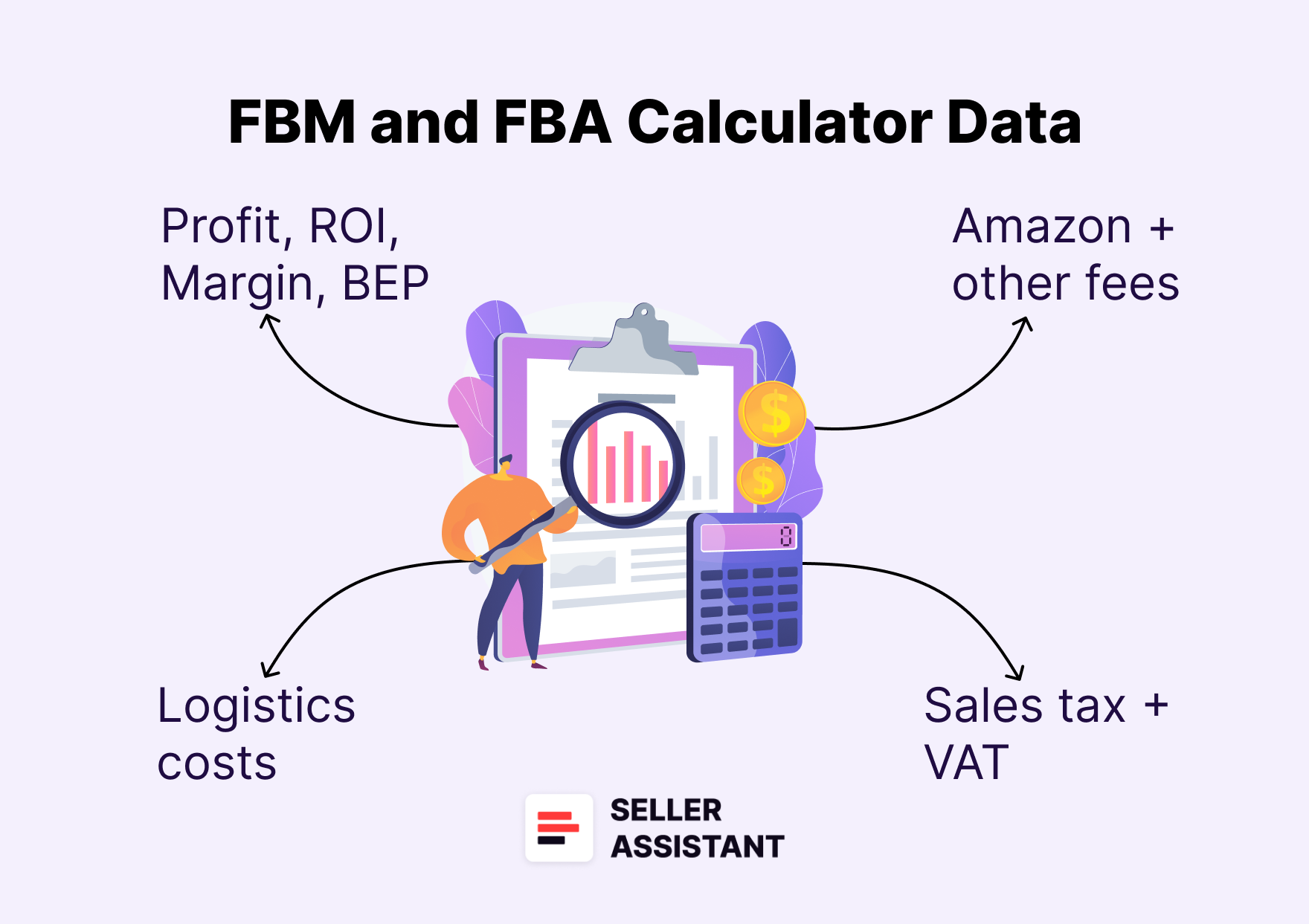
FBM and FBA Calculator data
- Product price
The selling price of the product on Amazon, typically the BuyBox price. If the BuyBox price is unavailable, it defaults to the minimum price (including delivery). Pre-filled by the extension but can be adjusted manually.
- Cost of Goods Sold (COG)
The supplier price of the product, excluding shipping and taxes. Used to calculate profit, ROI, and margin. Must be entered manually.
- Current BuyBox and Historical Pricing
Shows current BuyBox price and compares it to the 90-day average BuyBox price, calculates Buy Box price +2%, +5%, +10%. Automatically populated.
- Minimum FBA price
The lowest price offered by Fulfillment by Amazon seller
- Minimum FBM price
The lowest price offered by Fulfillment by Merchant seller
- Profit
Net earnings after deducting costs like COG, Amazon referral fees, FBA/FBM fees, logistics, storage fees, sales tax, and VAT. Calculated automatically; accurate input of other fields is necessary (logistics costs, ship, and prep).
- ROI (Return on Investment)
A percentage metric showing profitability relative to the investment (COG, tax, logistics). Automatically calculated based on other inputs.
- Margin
The percentage of profit generated from sales relative to the selling price. Automatically calculated.
- Amazon referral fees (R15%)
The fee Amazon charges per sale, typically 15% of the selling price (varies by category). Automatically applied based on the product category.
- FBA/FBM Fees
Costs associated with either Fulfillment by Amazon (FBA) or Fulfillment by Merchant (FBM), including picking, packing, and shipping. Selected from a dropdown based on the fulfillment method.
- Inbound Placement Service Fee (Plmt)
The fee for Amazon’s distribution of inventory across fulfillment centers. Select the placement type (minimal, partial, or optimized).
- Digital Service Fee (DST)
DST applies to selling on Amazon fees (referral fee, fixed closing fee, variable closing fee, and get-paid-faster fee) if you sell in the countries where the fee is paid (e, g. Canada, France, Spain), and FBA fees (UK and France)
- Storage fees
Monthly costs of storing inventory in Amazon’s warehouses, applicable for FBA. Automatically calculated.
- Logistics costs
Includes shipping, 3PL (third-party logistics), and prep center fees. Must be entered manually or pre-configured in the Seller Assistant Extension settings in your personal account.
- 3PL Costs
Costs for third-party logistics providers, covering shipping, preparation, and fragile handling. Must be entered manually unless pre-configured.
- Sales tax
Tax applied to sales, based on regional percentages. Enter the applicable tax rate in settings and enable the toggle.
- VAT (Value Added Tax)
Tax applied to goods sold internationally, varying by country. Select VAT scheme and rate in settings.
- BEP (Break-even point)
The minimum price needed to cover all expenses. Automatically calculated.
How to use it step-by-step
Calculate profitability on the Amazon product pages
Step 1. Open the product page
Navigate to the Amazon or supplier product page you want to analyze. If the Seller Assistant Extension is installed and active, the FBM & FBA Profit Calculator will automatically appear as an overlay.
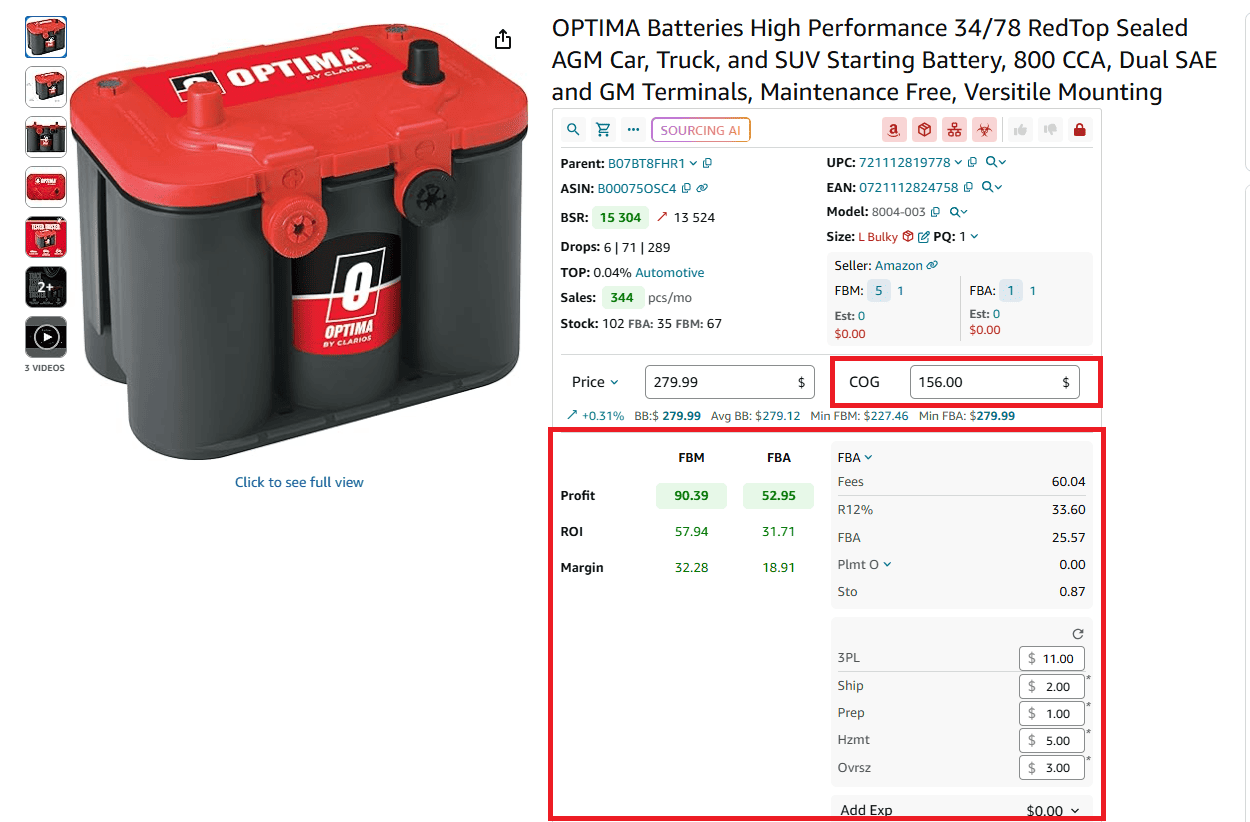
FBM & FBA Profit Calculator will automatically appear as an overlay.
Step 2. Enter your Cost of Goods (COG)
In the COG input field, enter your cost from the supplier. This is the base cost used to calculate profit, ROI, and margin.
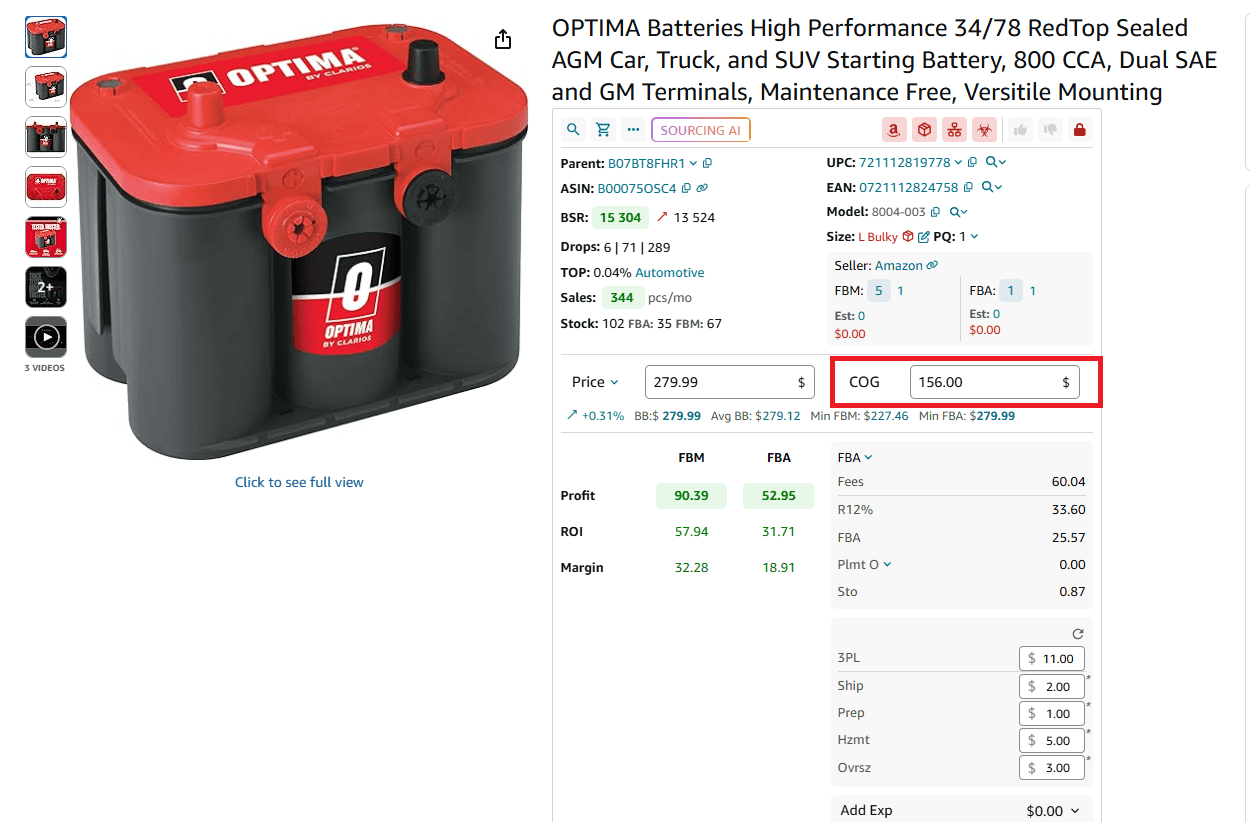
Enter your Cost of Goods (COG)
Step 3. Select FBA or FBM model
Switch between FBA and FBM to compare fulfillment costs. The calculator will update with real-time data, including:
- Fulfillment costs
- Referral fee (R15%)
- Storage fees (Sto)
- Inbound placement service fees (Plmt)
- Digital services fee (if applicable)
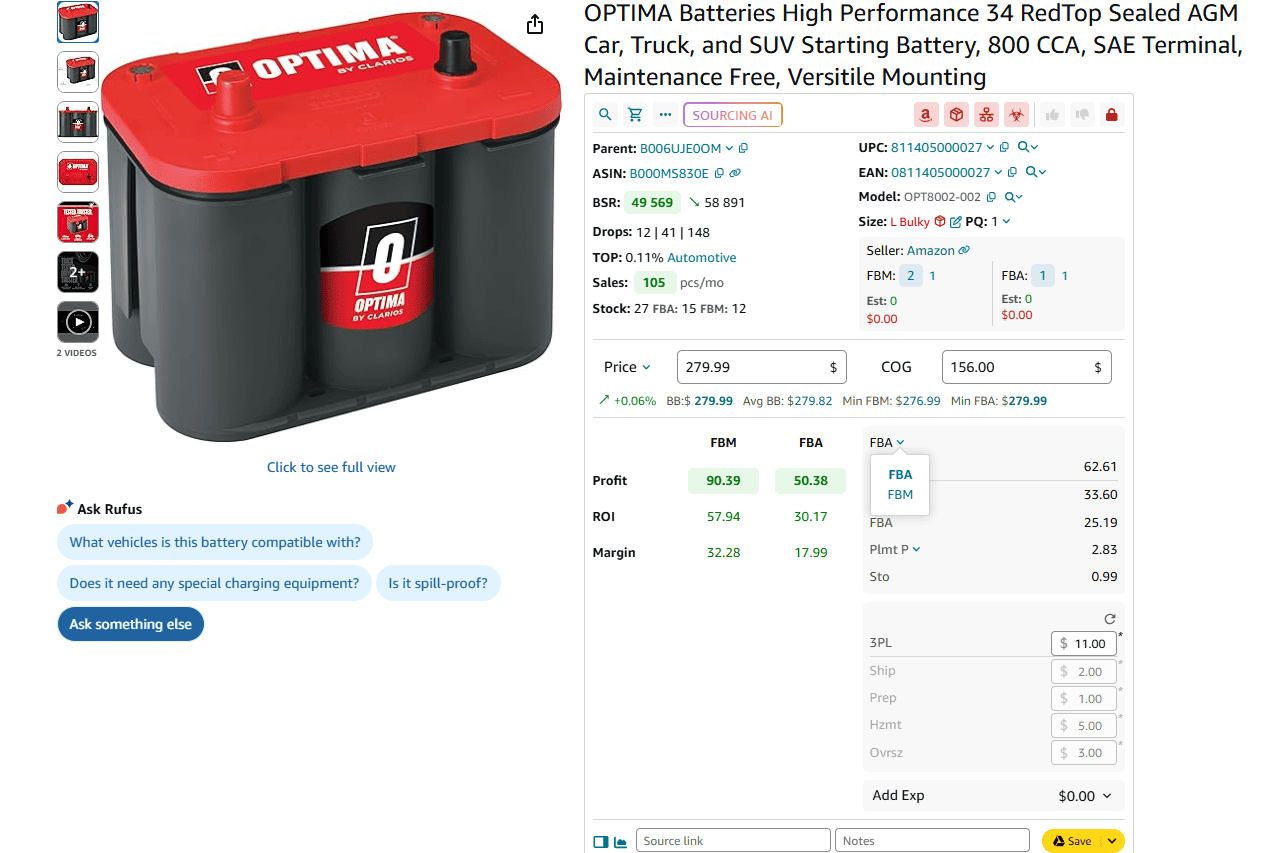
Select FBA or FBM model
Step 4. Add logistics and prep costs
- Enter logistics-related expenses:
- Shipping to Amazon (per unit)
- Prep center costs (e.g., labeling, bagging, bubble wrap)
- Hazmat (dangerous goods) costs
- Oversize prep and ship for gravy and bulky products
- Miscellaneous costs
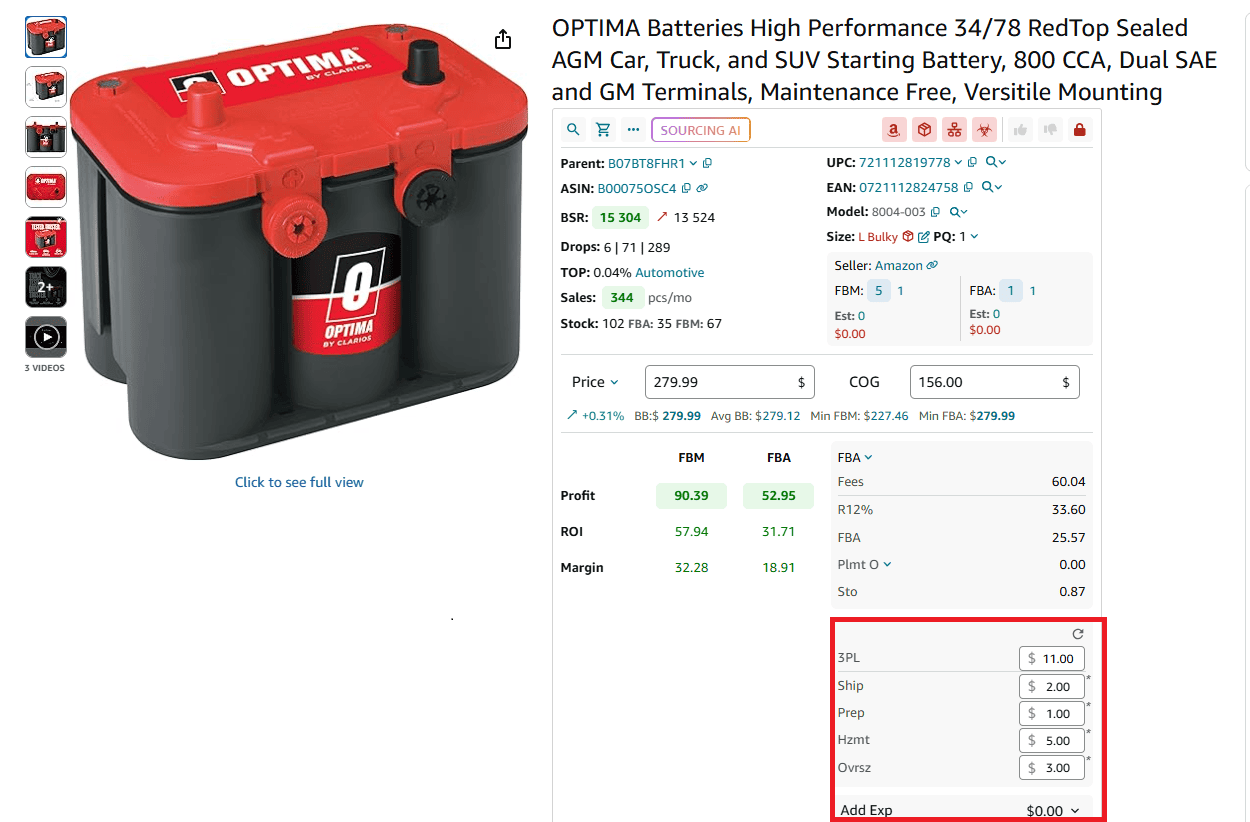
Enter logistics-related expenses
- You can also configure expenses in your Seller Assistant Personal Account settings.
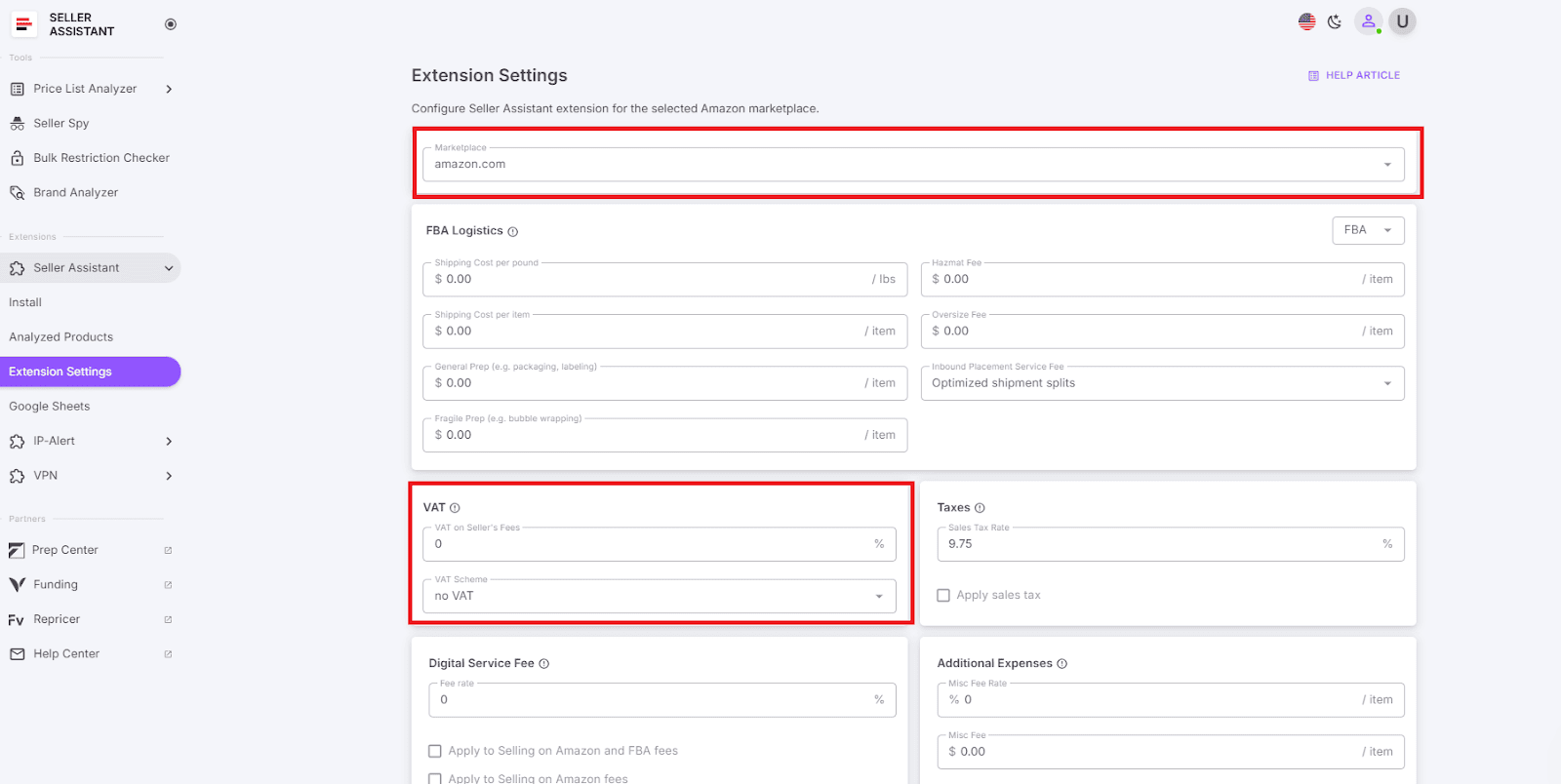
You can also configure expenses in your Seller Assistant Personal Account settings.
Step 5. Apply tax or VAT if applicable
Use the toggle in the COG field to activate:
- Sales tax for U.S. sellers if needed
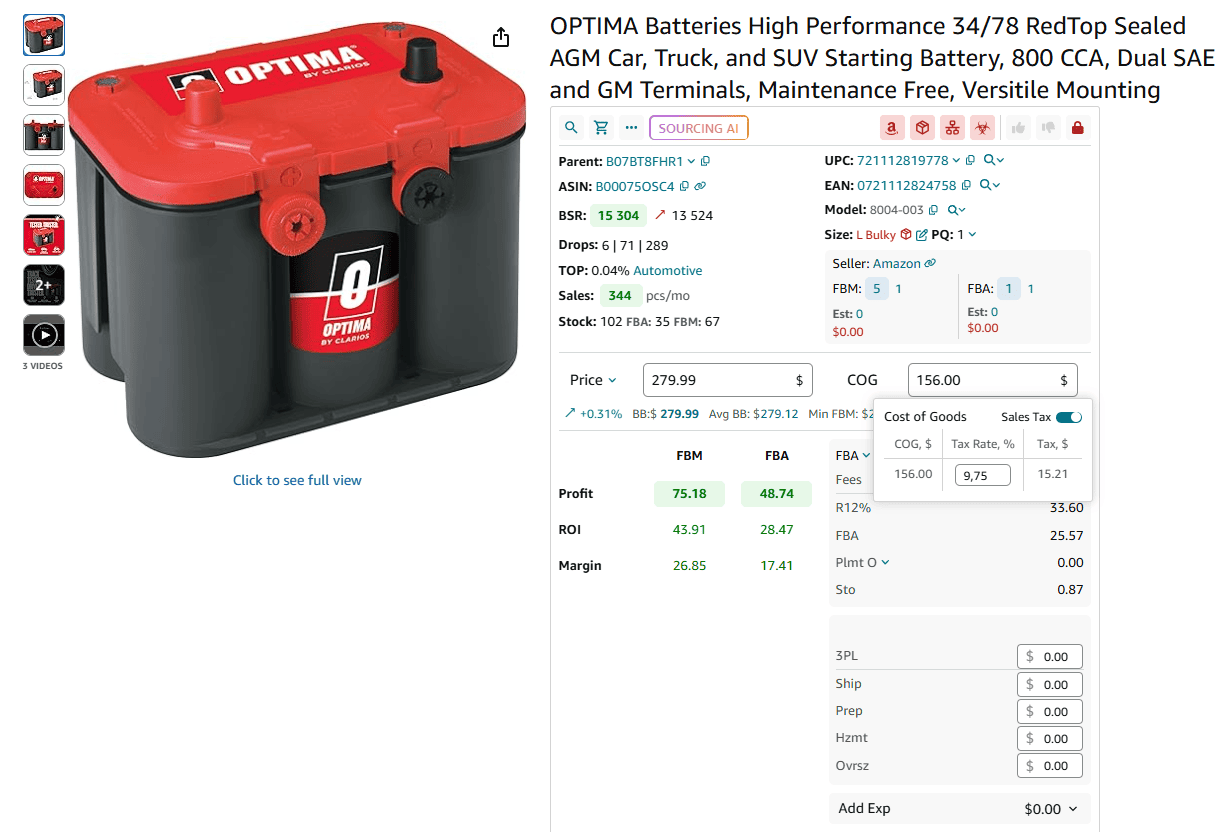
apply sales tax for U.S. sellers if needed
- VAT for EU or international sellers (choose from various VAT schemes)
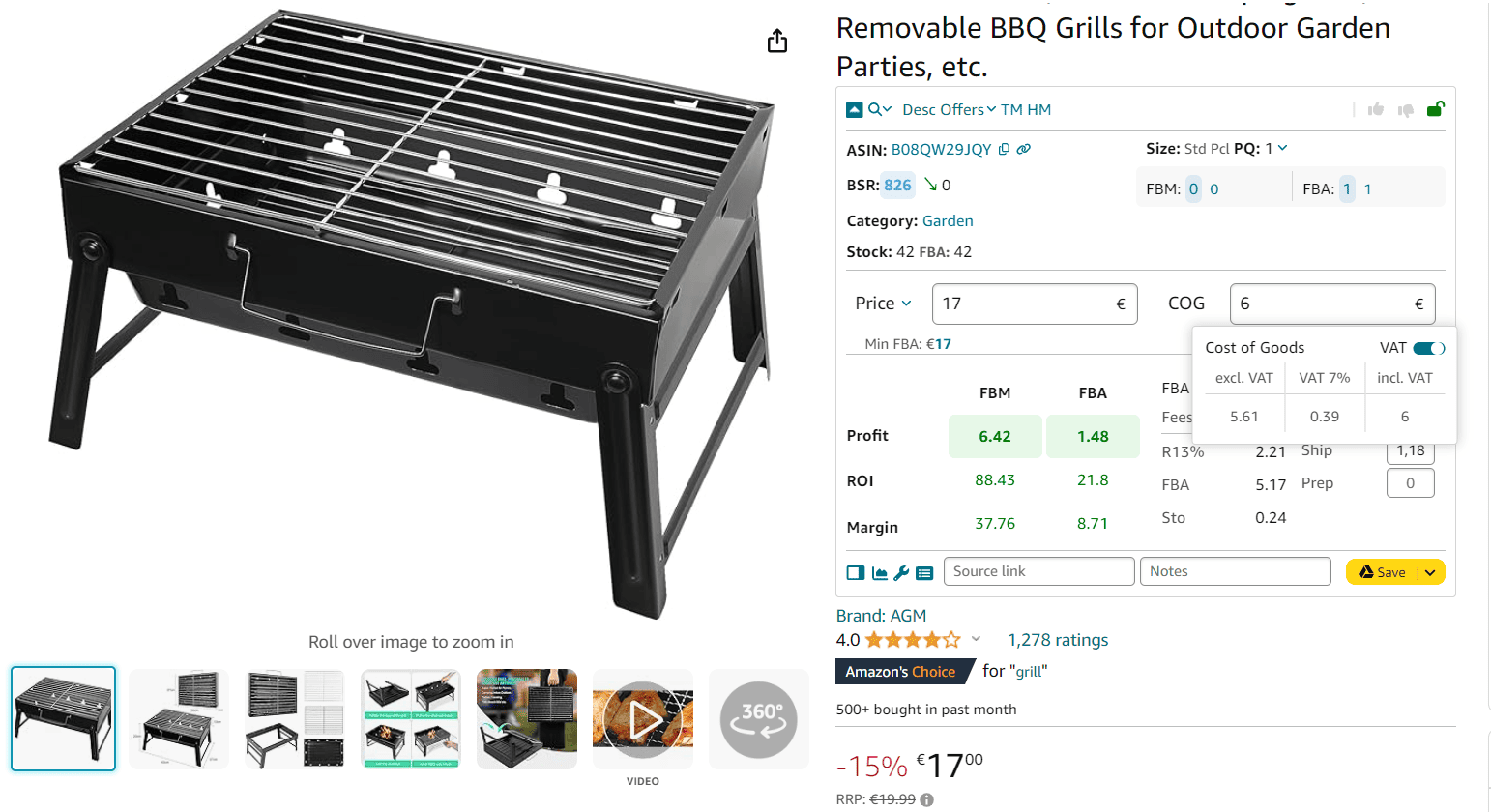
Apply VAT for EU or international sellers
Step 6. Review full profitability breakdown
Once your inputs are added, review the complete cost and profit analysis:
- FBA fees: Total Amazon fulfillment charges
- Referral fee (R15%)
- Plmt: Inbound placement service fee
- Sto: Monthly storage cost per unit
- 3PL: Combined third-party logistics (shipping + prep + fragile packaging)
- Profit per unit
- ROI (%) and margin (%)
- Break-even point
- VAT/Sales tax: If activated for your marketplace
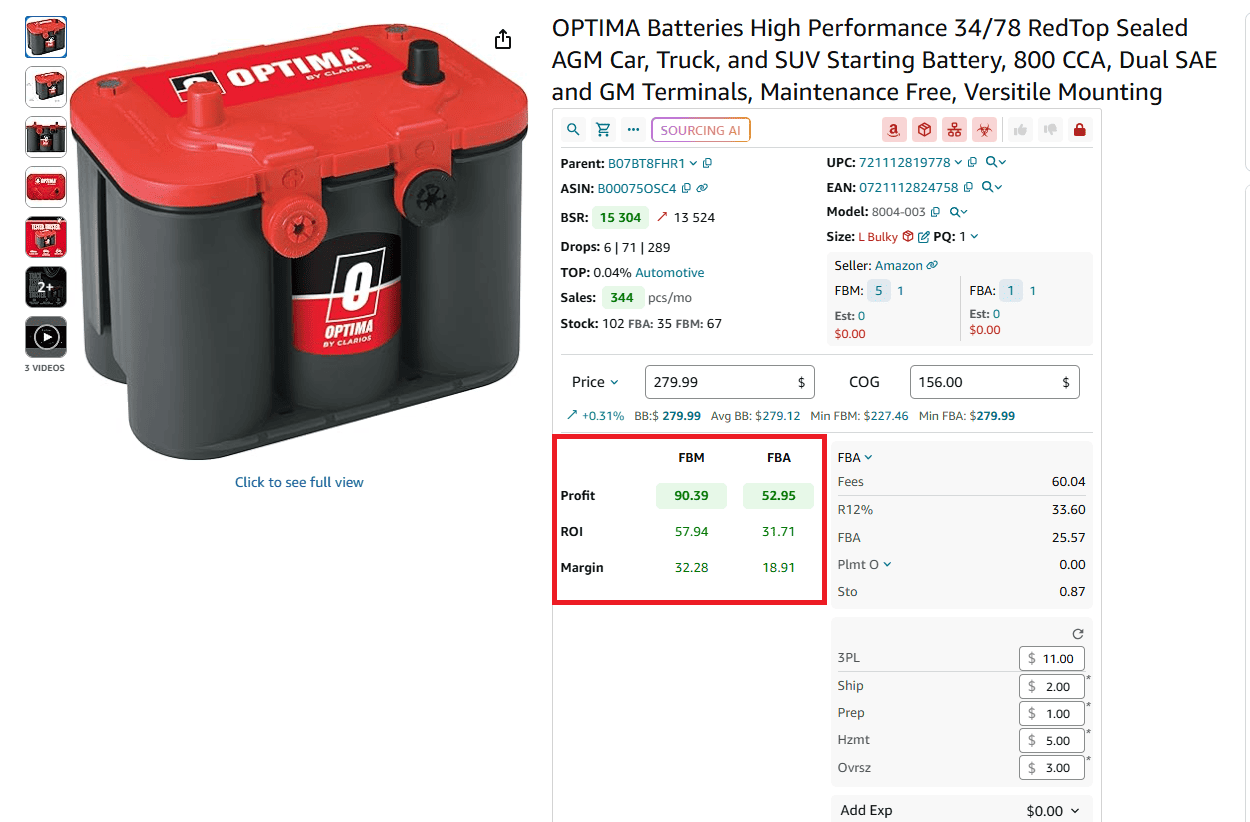
Review full profitability breakdown
Calculate profitability products on supplier websites
While browsing wholesale or retail supplier websites, use Seller Assistant’s Side Panel View to display Amazon listing data and calculate fees without leaving the page. This lets you make sourcing decisions in real time – evaluating both pricing and actual profitability on the spot.
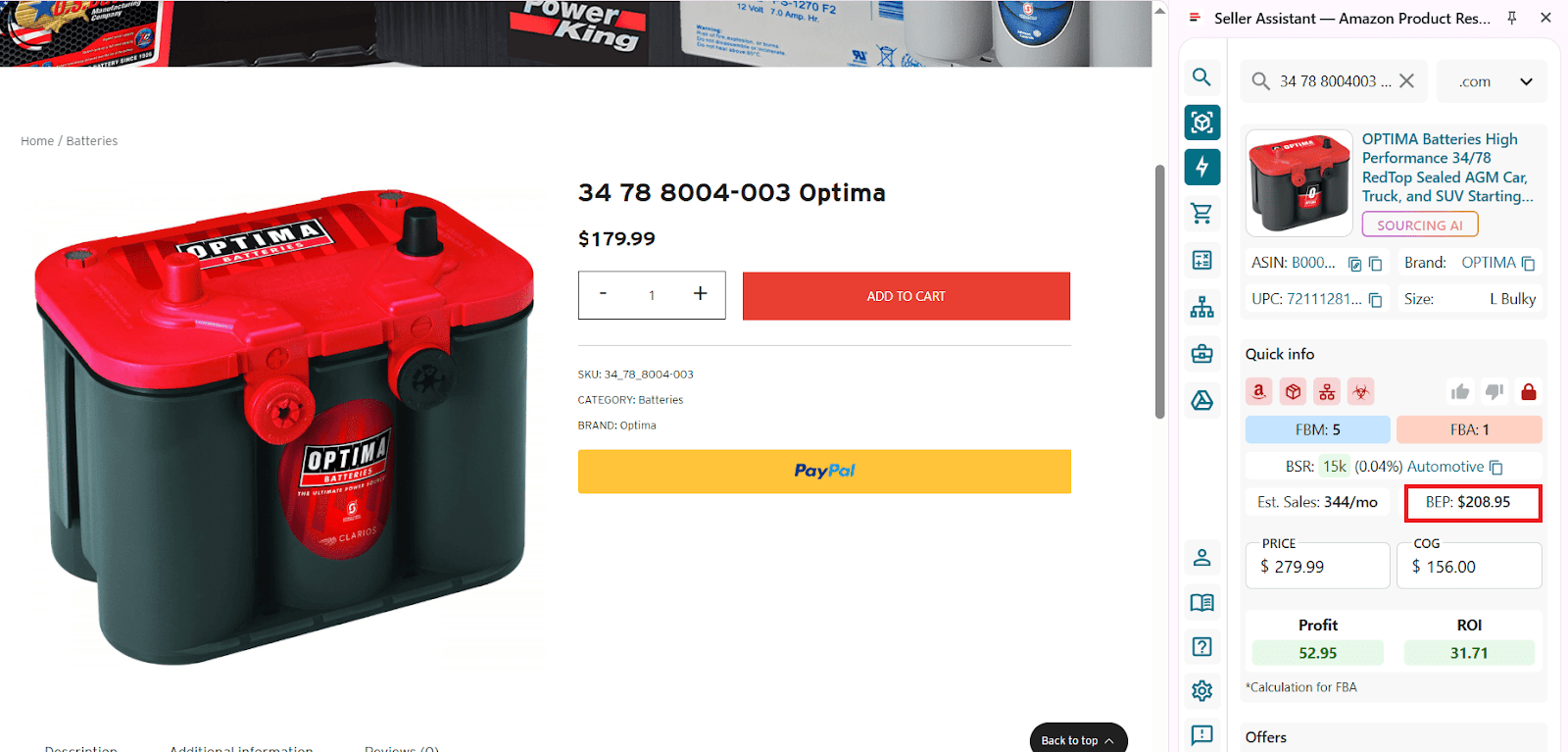
Seller Assistant’s Side Panel View
To access Side Panel View, click the Extensions icon to the right of your address bar in Chrome browser and select Seller Assistant Extension. Side Panel View will appear as a side panel on the right side of your page.
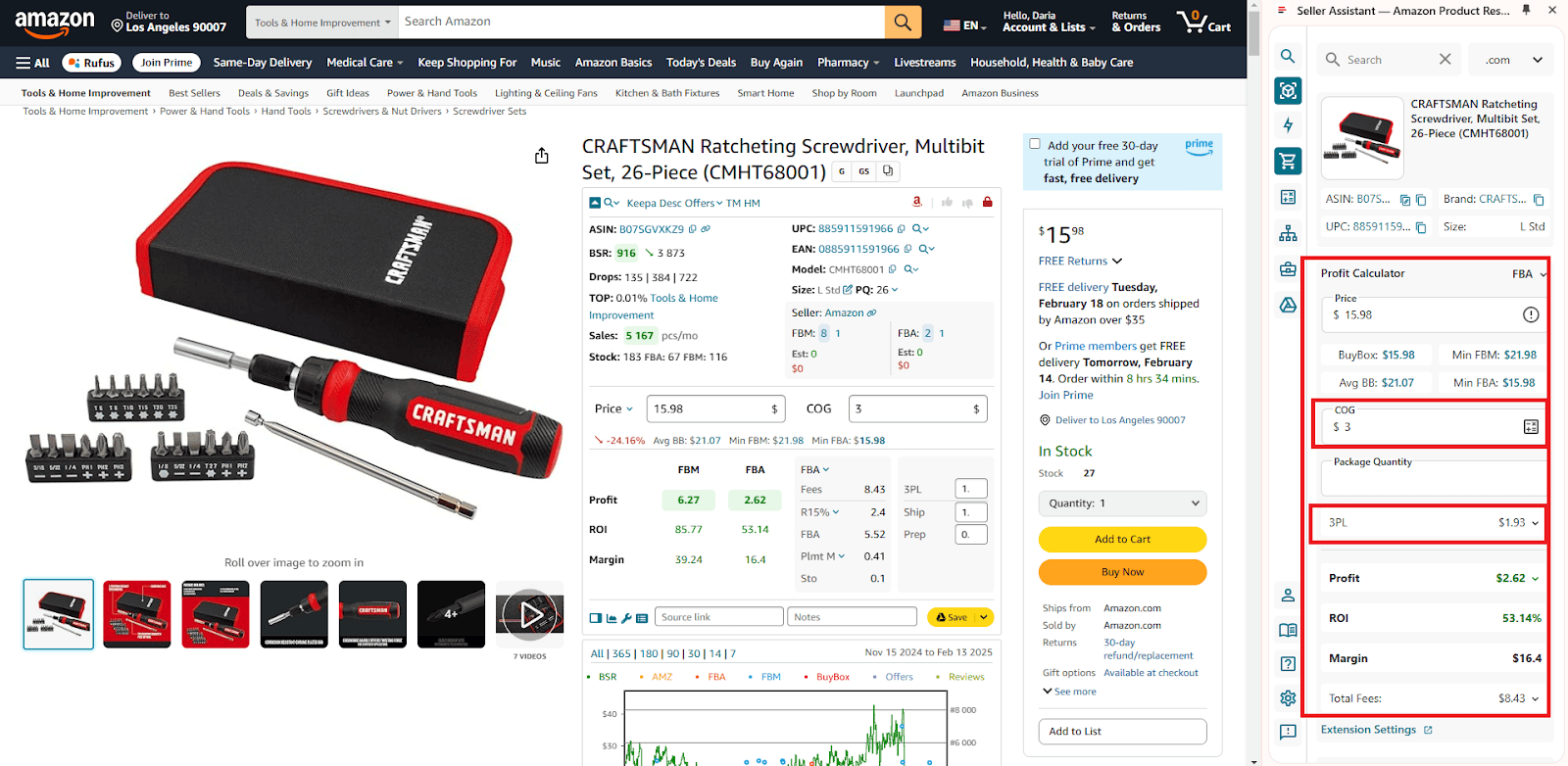
Side Panel View will appear as a side panel on the right side of your page
The calculator will show the same data as on the Amazon product page (as described above).
Amazon FBA calculator: free vs. paid – key benefits and which one you should use
Choosing the right Amazon FBA calculator depends on how deep you need to go with your cost analysis and how many products you’re researching. Here’s a breakdown of what the free and paid tools offer – and which type of seller each one is best for.
Price
Seller Assistant offers flexible pricing plans. The price starts from $13.33. The FBM and FBA Calculator is included in all plans.
Amazon FBA Calculator Comparison: Free vs. Paid
FeatureAmazon Revenue Calculator (Free)Inline Revenue Calculator (Free)Seller Assistant’s Calculator (Paid)Access locationSeller Central (external tool)Seller Central > Manage InventoryChrome Extension (Amazon + supplier sites)Fee types includedCore Amazon fees (referral, FBA, storage)Core Amazon fees for listed SKUsFull Amazon fee structure, 3PL, VAT, logisticsFBM vs. FBA comparisonYesNoYesReal-time data updatesYes (on input)YesYesOn-page sales tax/VAT supportNoLimited (tax on fees only)Full support for US sales tax and EU VAT schemesSourcing support on supplier websitesNoNoYes (Side Panel View)Export to Google SheetsNoNoYes (1-click export)Customization (shipping, prep, logistics)LimitedPartialFull customizationProfit, ROI, and margin calculatorBasicBasicAdvanced (includes break-even & 3PL)Ideal forBeginners, occasional checksManaging existing SKUsHigh-volume, serious sellersPrice
Free calculators: best for basic, one-off estimates
Amazon Revenue Calculator and Inline Revenue Calculator are ideal for beginner sellers or those looking to analyze a few SKUs at a time. They’re easy to access, offer solid core fee estimates, and are 100% free.
What you get
- Basic per-unit fee breakdowns
- Comparison of FBA vs. FBM
- Integration with Seller Central (Inline version)
- No login or additional tools required
Limitations
- No on-page VAT or sales tax support
- Manual data entry
- No export or history tracking
- Doesn’t cover all fee types or prep costs
Best for
- New Amazon sellers
- Sellers with a small catalog
- One-off profitability checks
Paid calculator: best for detailed, scalable analysis
Seller Assistant’s FBM & FBA Calculator is built for sellers who analyze dozens or hundreds of products daily. It shows the full cost structure – including 3PL, VAT, storage, and labeling – and works directly on Amazon and supplier websites.
What you get
- Real-time FBA/FBM fee breakdowns
- ROI, profit, margin, and break-even point
- Full tax & VAT support (including EU schemes)
- Works directly on Amazon and supplier sites
- Side Panel View for product sourcing
- Google Sheets export
- Part of an all-in-one seller toolkit
Best for
- Online arbitrage, wholesale, and dropshipping sellers for easy instant profitability analysis
- High-volume product researchers to check deals in-depth
- European sellers with VAT requirements
- Sellers looking to simplify on-page supplier research
FAQ
How to accurately calculate Amazon FBA fees?
Use an FBA calculator like Seller Assistant’s FBA & FBM Calculator for the most accurate results. It factors in size, weight, category, and fulfillment method to show true costs and profit margins.
What is the benefit of using the FBA calculator?
The FBA calculator helps sellers estimate costs and profitability upfront. It shows fulfillment fees, storage costs, and potential revenue, making it easier to decide if a product is worth selling.
Is the Amazon calculator accurate?
It’s useful, but not always 100% complete. Amazon’s free Revenue Calculator gives good baseline data but may miss costs like prep, logistics, or 3PL. Paid tools like Seller Assistant cover these gaps.
How to save on FBA fees?
Reduce product size/weight and avoid long-term storage fees. Smart packaging, regular inventory checks, and strategic pricing help lower costs and keep your FBA margins healthy.
Final Thoughts
Choosing the right Amazon FBA calculator depends on how deep your analysis needs to go. If you’re just starting out or checking a few SKUs occasionally, Amazon’s free tools – Revenue Calculator and Inline Revenue Calculator – offer a fast, no-cost way to get basic profit estimates.
But for serious sellers working at scale, precision matters. Seller Assistant’s FBA&FBM Profit Calculator gives you the full financial picture – including prep, logistics, taxes, and VAT – directly on Amazon and supplier pages. With real-time updates, export features, and side-by-side profit visibility, it’s built to support smarter, faster sourcing decisions.
Seller Assistant automates and connects every stage of your Amazon wholesale and arbitrage workflow. It brings together in one platform: workflow management tools — Purchase Orders Module, Supplier Database, Warehouse Database, bulk research & sourcing tools — Price List Analyzer, Bulk Restriction Checker, Sourcing AI, Brand Analyzer, Seller Spy, Chrome extensions — Seller Assistant Browser Extension, IP-Alert Extension, and built-in VPN by Seller Assistant, and integrations & team access features — seamless API connectivity, integrations with Zapier, Airtable, and Make, and Virtual Assistant Accounts.