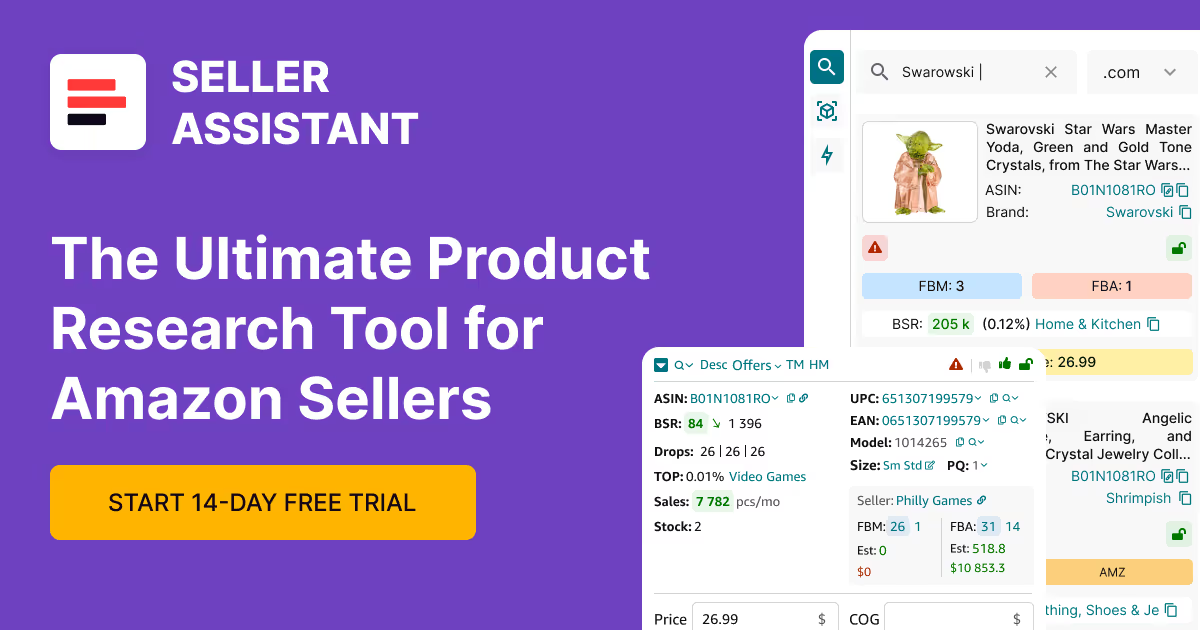



Most Amazon sellers start with online arbitrage because it’s fast and accessible. But as volume grows, one-by-one sourcing, manual checks, and scattered spreadsheets stop working. Scaling into wholesale requires a different level of structure, control, and confidence.
That transition is exactly where Seller Assistant tools come in. Built for Amazon resellers, these tools help you move from manual OA workflows to scalable wholesale operations by enabling bulk product analysis, restriction checks, supplier management, and clean purchase order creation.
Instead of guessing which ASINs to buy next, you build a repeatable, data-driven system that supports wholesale, online arbitrage, and dropshipping growth.
Note. Seller Assistant is an end-to-end Amazon workflow management platform that integrates 10+ wholesale-focused solutions into one connected system. It combines sourcing workflow automation, bulk research and intelligence tools, and integrated Chrome extensions – giving you everything you need to streamline finding deals, managing suppliers, and creating purchase orders.

The platform aggregates: workflow management tools – Purchase Orders Module, Suppliers Database, Warehouses Database to organize, automate, and scale every step of your wholesale and arbitrage operations; bulk research & sourcing tools – Price List Analyzer, Bulk Restriction Checker, Sourcing AI, Brand Analyzer, Seller Spy to evaluate supplier price lists, verify selling eligibility and restrictions, open new brands, and discover winning product ideas from competitors to expand your product catalog; Chrome extensions – Seller Assistant Browser Extension, IP-Alert Extension, and built-in VPN by Seller Assistant to deep-research products, check IP claims and compliance, and access geoblocked supplier sites directly within your browser; and integrations & team access features – seamless API connectivity and integrations with Zapier, Airtable, and Make, plus Virtual Assistant Accounts for secure, scalable team collaboration.
With Seller Assistant, every step of your Amazon wholesale and arbitrage workflow is automated and connected.
From OA Workflows to Scalable Wholesale Systems
Seller Assistant wholesale tools are designed to help Amazon sellers transition from manual online arbitrage processes to structured wholesale operations that scale. Instead of relying on spreadsheets and product-by-product checks, resellers can handle bulk sourcing, analysis, and purchasing across wholesale, online arbitrage, and dropshipping in one workflow.
The toolset covers the key tasks sellers face as volume grows: analyzing supplier price lists, researching brands, checking selling eligibility, organizing suppliers, routing inventory, and creating purchase orders.
Core tools include Price List Analyzer, Brand Analyzer, Bulk Restriction Checker, Purchase Orders Module, Suppliers Database, and Warehouses Database, each removing a common bottleneck in bulk sourcing. Each tool focuses on a specific step.
- Price List Analyzer processes supplier files and surfaces profitable, low-risk ASINs at scale. Brand Analyzer helps assess whether a brand is worth pursuing based on demand and competition.
- Bulk Restriction Checker confirms selling eligibility before money is spent.
- Suppliers Database keeps supplier data and outreach status organized
- Warehouses Database handles default routing to prep centers or warehouses.
- Purchase Orders Module converts approved products into accurate, ready-to-send purchase orders.
What makes this setup effective for moving from OA to wholesale is how everything connects. Information flows from analysis to ordering without duplication, reducing errors and speeding up decisions. Once sellers manage multiple suppliers, price lists, or team members, manual workflows stop working. These tools provide the structure, consistency, and visibility needed to scale inventory and operations without losing control over margins, compliance, or execution.
Seller Assistant Tools to Scale Your Business
Seller Assistant Tool | What It Does for Amazon Sellers |
Price List Analyzer | Scans large supplier price lists, matches SKUs to ASINs, and highlights profitable, low-risk wholesale deals at scale using sales, fees, ROI, and risk data. |
Brand Analyzer | Evaluates whether a brand is resale-ready by analyzing demand, competition, Amazon presence, pricing, and catalog depth before supplier outreach. |
Bulk Restriction Checker | Verifies selling eligibility for up to 20,000 ASINs at once, helping sellers avoid gated or restricted products before buying inventory. |
Suppliers Database | Centralizes supplier details, outreach status, terms, and routing rules, replacing spreadsheets and preventing duplicate or disorganized supplier management. |
Warehouses Database | Stores prep center and warehouse details and assigns default ship-to locations for suppliers to ensure accurate, automated inventory routing |
Purchase Orders Module | Creates clean, professional purchase orders from verified product data with auto-filled supplier and warehouse details, tracking orders from draft to completion. |
Price List Analyzer: From Single ASIN Checks to Bulk Sourcing
Price List Analyzer is a bulk Amazon price list analysis tool built for sellers ready to move beyond one-by-one online arbitrage sourcing into wholesale-scale buying. Instead of manually checking individual products, sellers upload supplier spreadsheets or parse supplier websites and receive a clean, Amazon-ready dataset built for bulk decision-making. This shift – from single ASIN checks to full price list analysis – is a key step in growing from OA to wholesale.
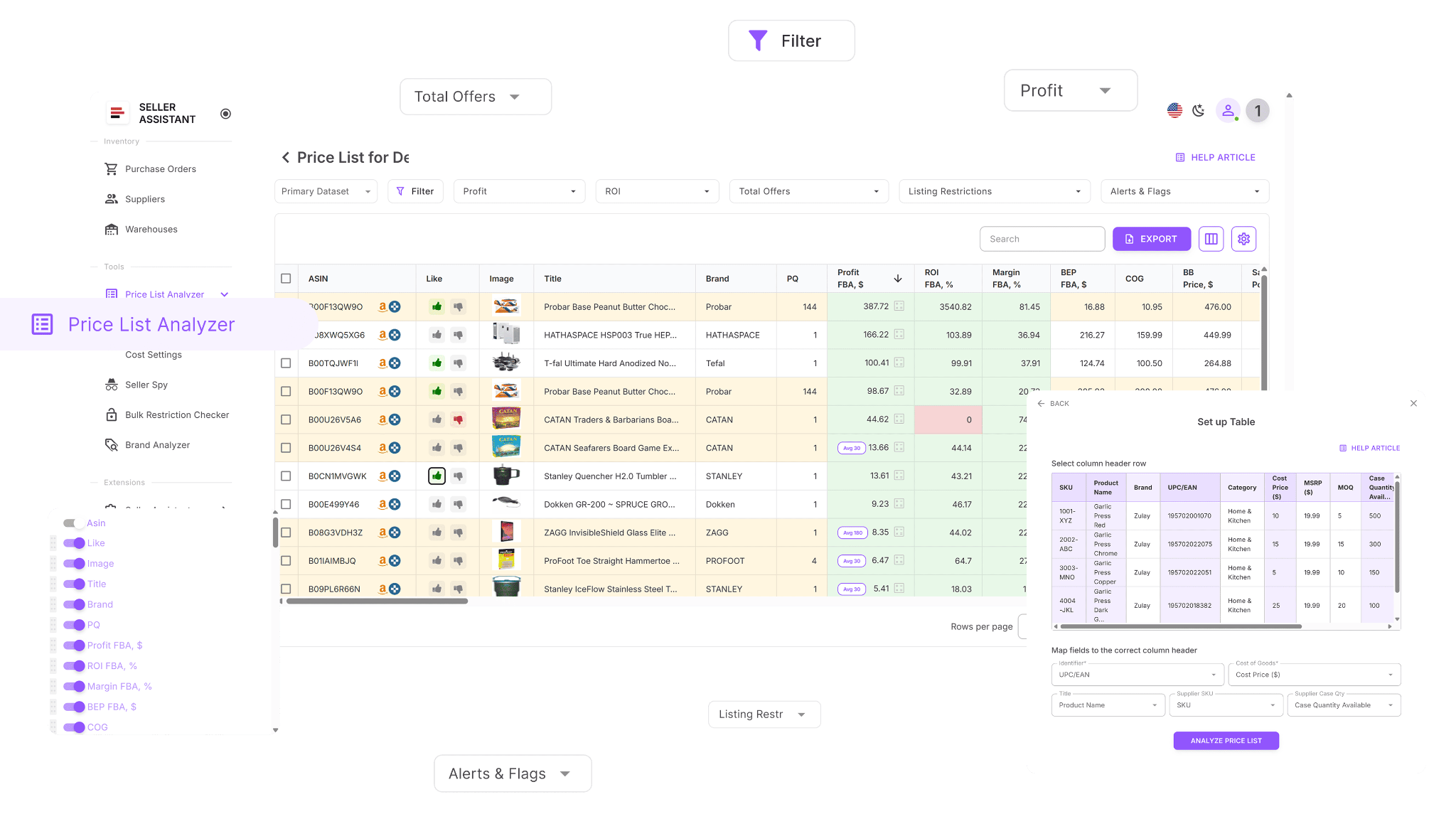
Every product is automatically matched to an Amazon ASIN and enriched with 100+ data points. This allows sellers to evaluate profitability, demand, competition, fees, and risk across hundreds or thousands of products in a single workflow, using the same metrics they rely on in Seller Central and FBA planning.
What Price List Analyzer does
This Software Makes Amazon FBA Wholesale Selling 10x Easier
- Scan large supplier price lists to surface high-potential Amazon product opportunities
- Match supplier SKUs to Amazon ASINs automatically, without manual lookup
- Flag gated, restricted, or ineligible products for your seller account
- Measure demand using BSR, sales trends, and estimated monthly sales volume
- Calculate ROI, profit margin, net profit, and breakeven points per ASIN
- Review Buy Box price history across 30-, 90-, and 180-day periods
- See full Amazon fee breakdowns, including referral, FBA or FBM, storage, prep, and shipping
- Identify high-risk ASINs such as meltable, hazmat, oversized, fragile, or bundled items
- Trigger alerts for approval required, missing Buy Box prices, or low FBA ROI
- Filter products by profitability, ROI, demand, competition, and risk signals
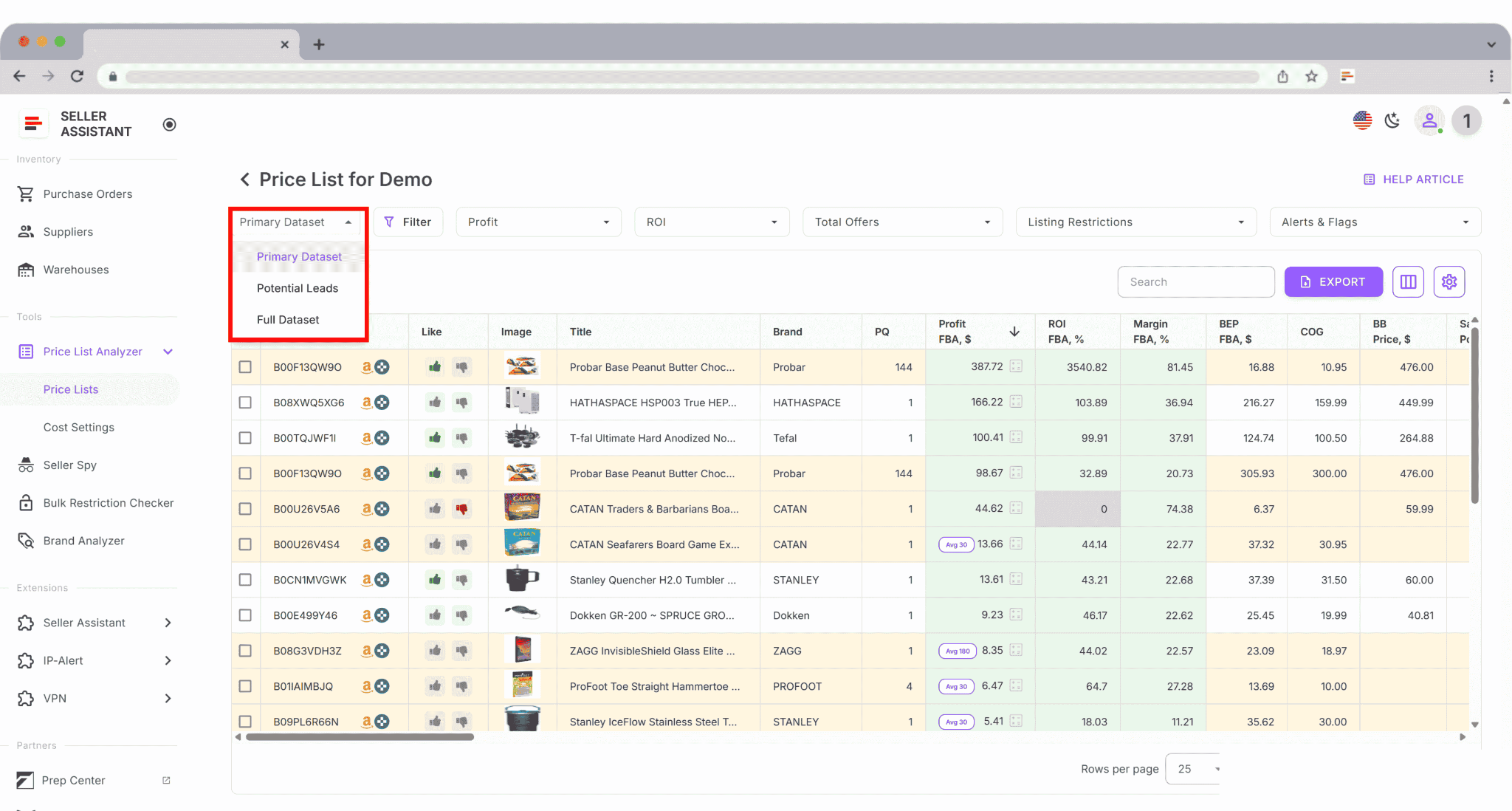
- Save table layouts and filter presets for reuse across future uploads
- Adjust COG, shipping, prep costs, or pack sizes with instant profit recalculation
- Add shared team notes that stay attached to products across uploads
- Tag products by sourcing status and filter by workflow stage
How Price List Analyzer helps scale from online arbitrage to wholesale
Online arbitrage breaks when sellers rely on manual checks and isolated product decisions. Price List Analyzer replaces that approach with a wholesale-ready system. It allows sellers to evaluate entire supplier catalogs at once, apply consistent buying rules, and eliminate unprofitable or restricted products before capital is committed. This makes sourcing faster, more accurate, and repeatable – exactly what’s required when moving from OA experimentation to wholesale volume.
How to use Price List Analyzer
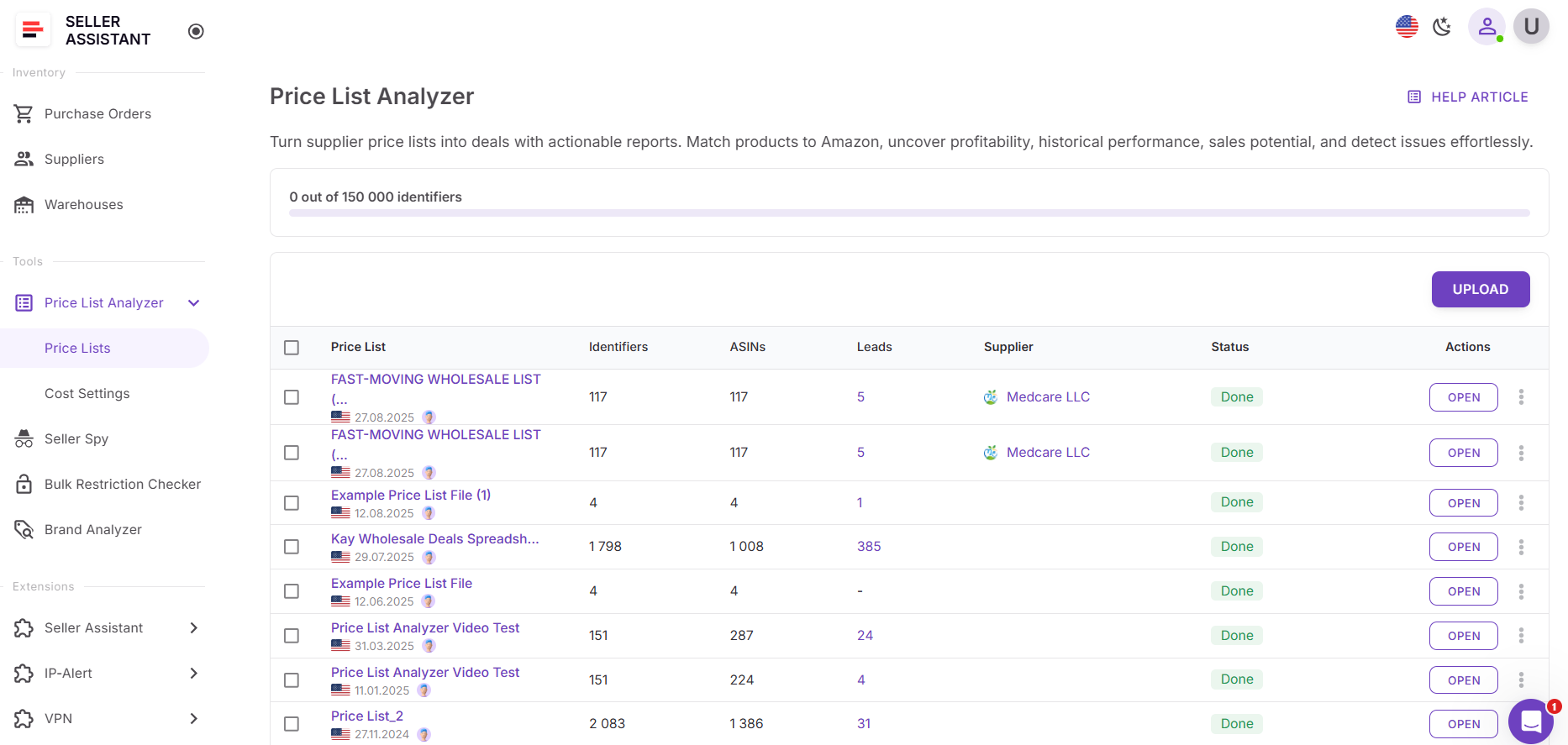
Step 1. Open Price List Analyzer
Log in to your Seller Assistant account, navigate to the Tools section, and open Price List Analyzer. Click Upload to begin.
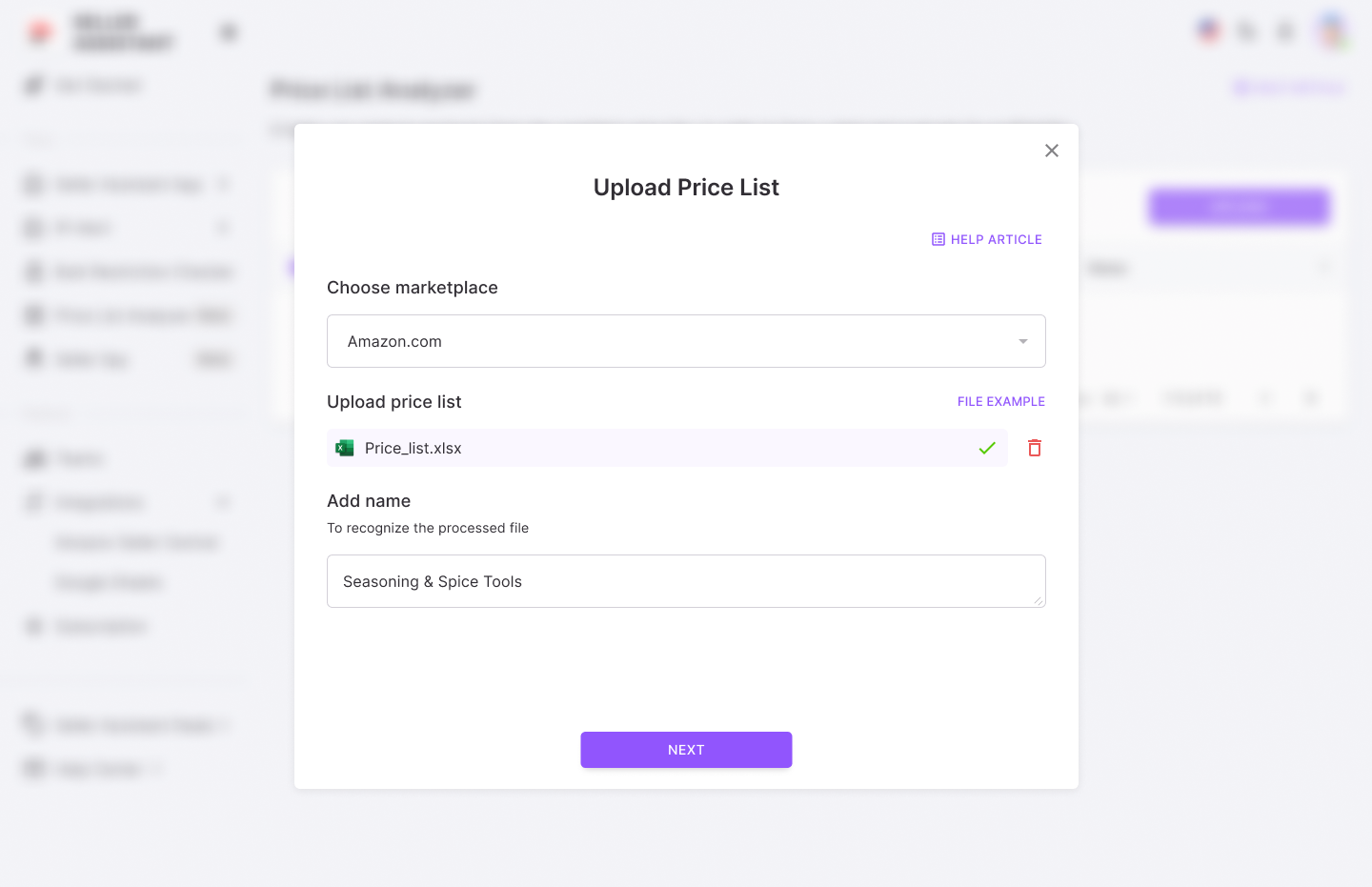
Step 2. Upload your price list
Select your Amazon marketplace and upload your supplier file in .xlsx or .xls format.
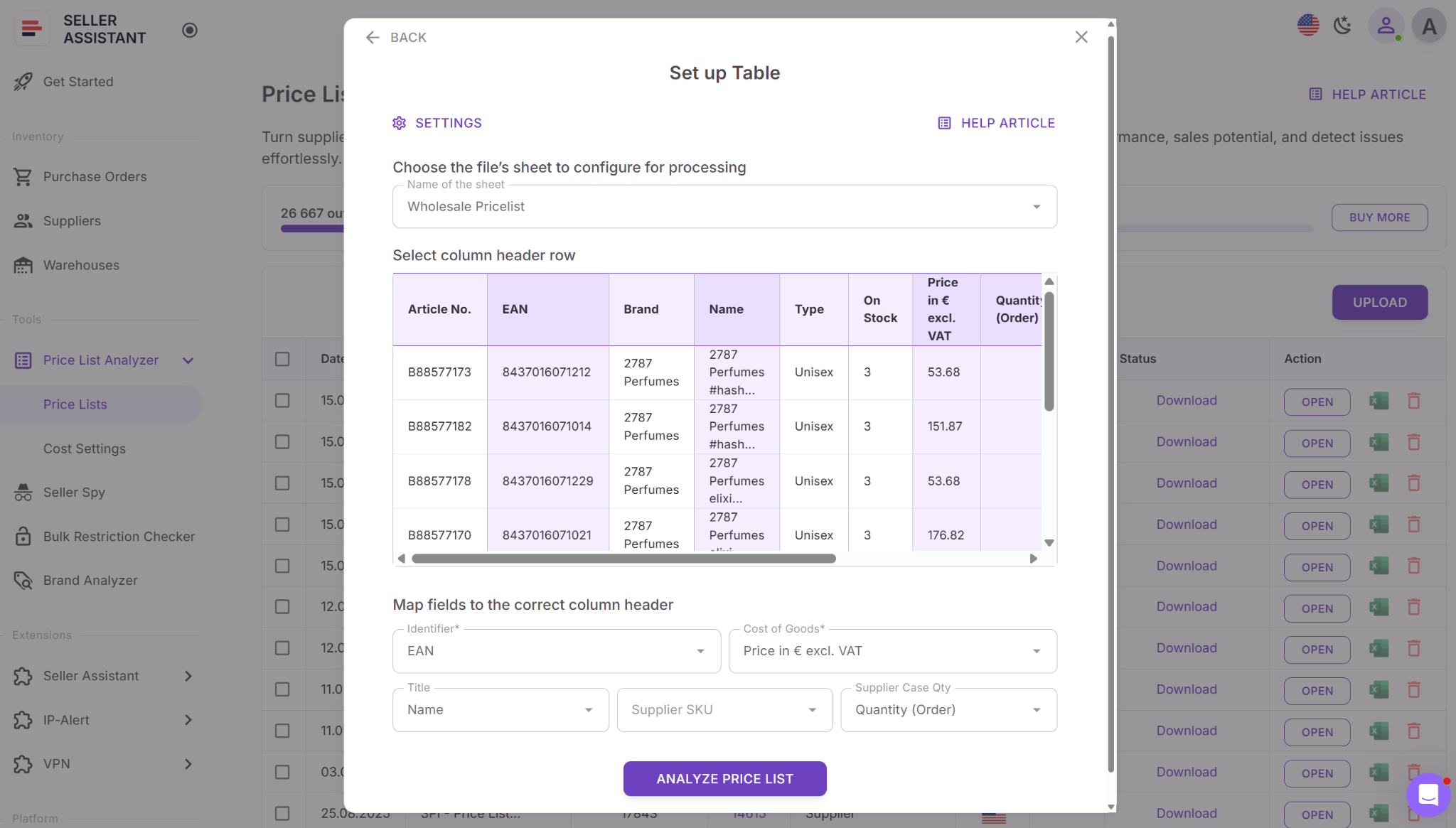
Step 3. Map your fields
Choose the correct sheet, define the header row, and map identifiers: UPC, EAN, or GTIN. Assign COG and product titles if available.
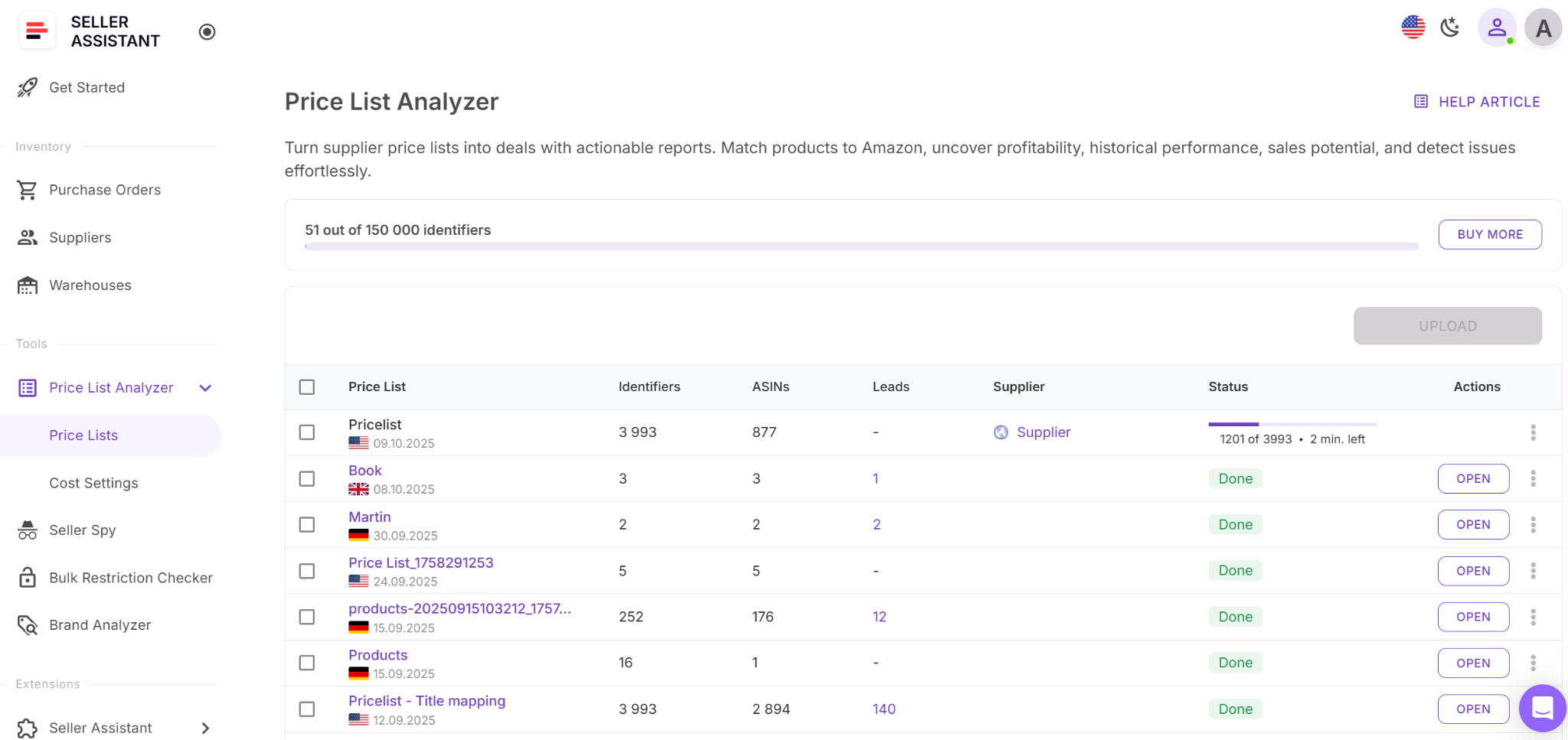
Step 4. Run the scan
Click Analyze price list to initiate automatic ASIN matching and bulk deal metrics enrichment.
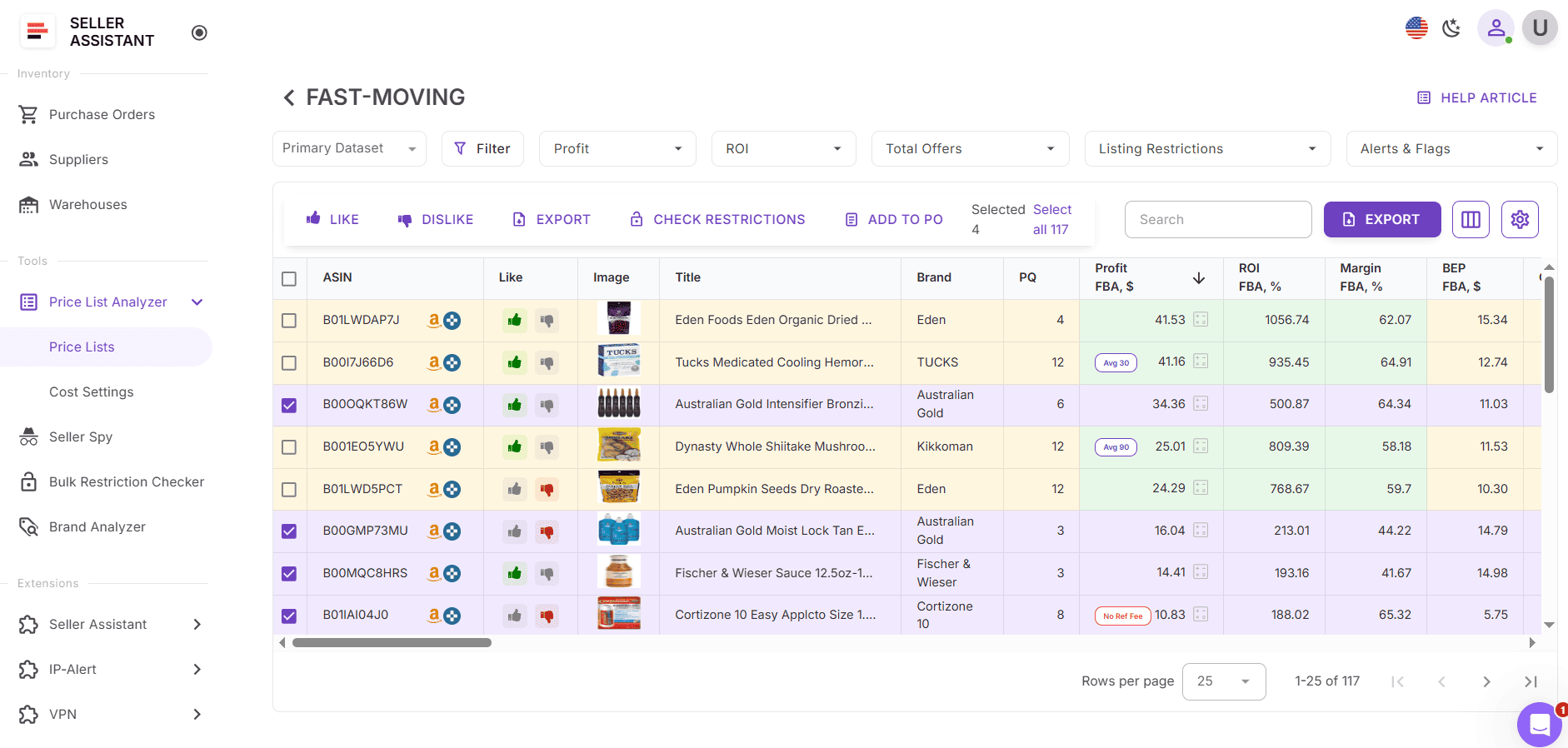
Step 5. Review enriched results
View matched items and their metrics in the UI table or export the full dataset to XLSX.
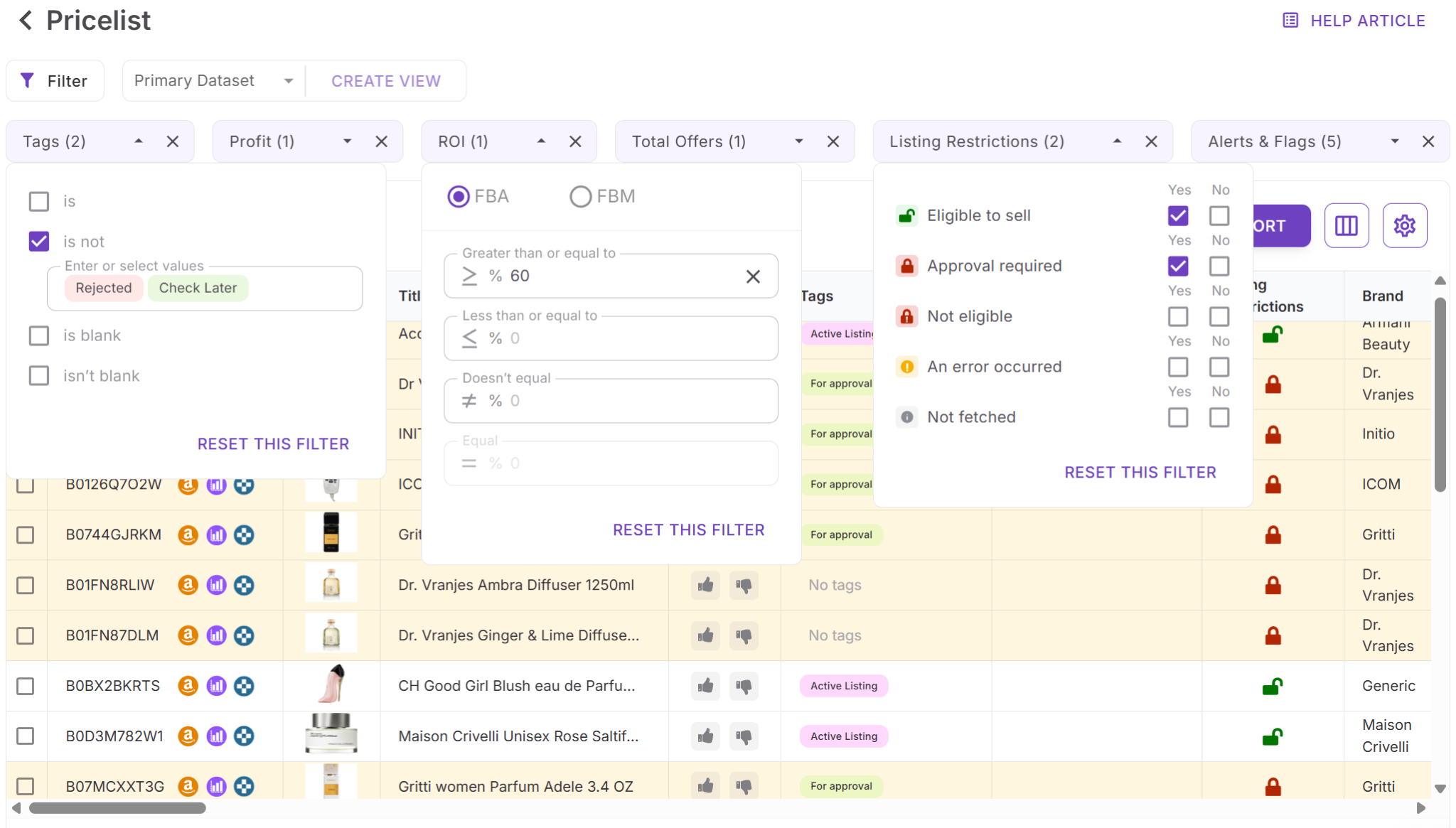
Step 6. Filter your results
- Use quick filters for profit, ROI, offer count, restrictions, alerts, flags, and tags.
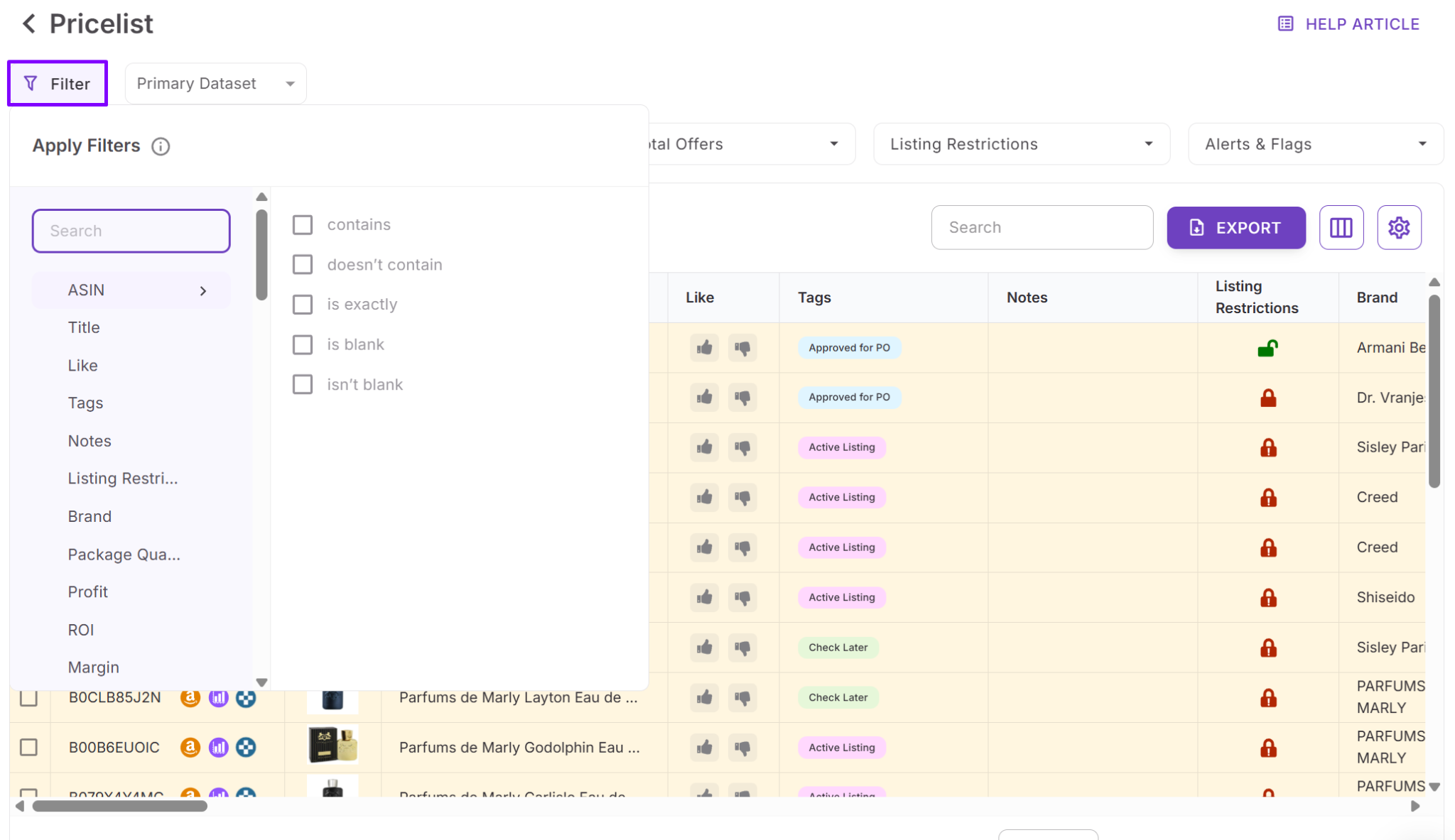
- Apply advanced filters for eligibility, risk, demand, competition, brand, or category.
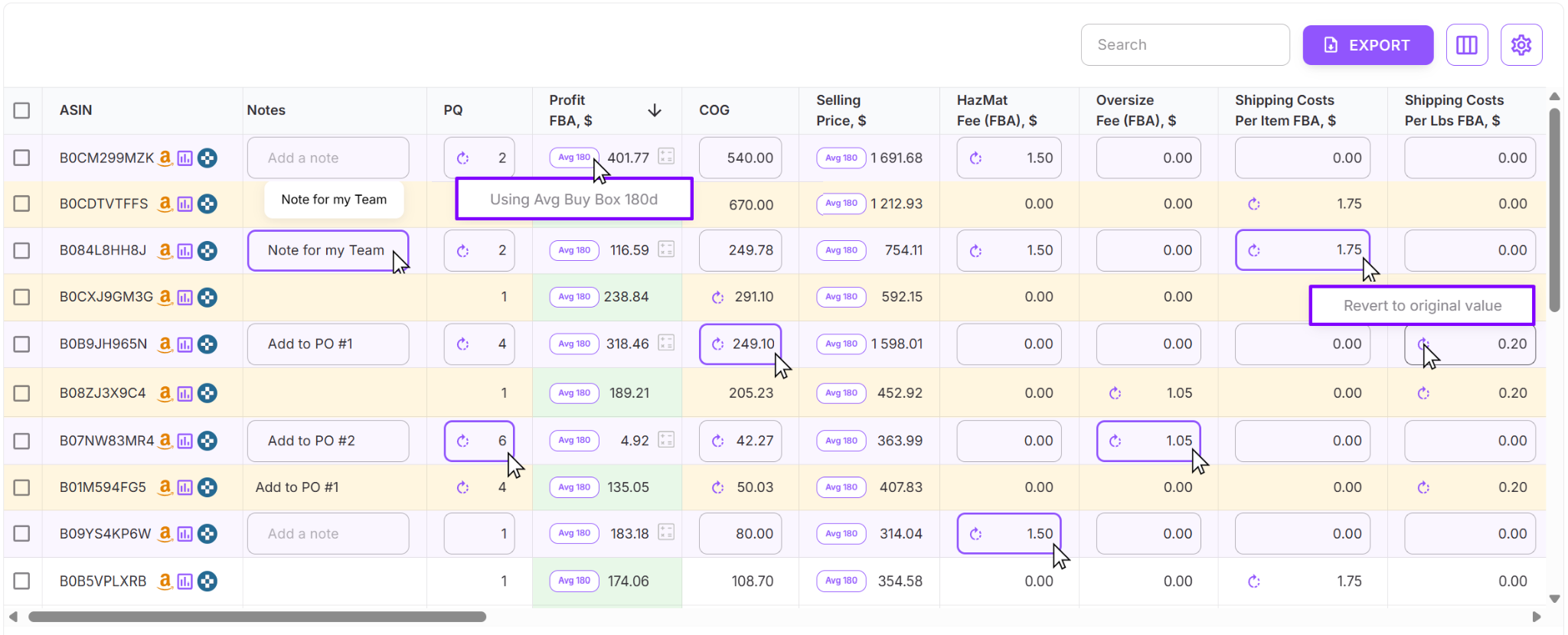
Step 7. Adjust costs and recalculate
Edit COG, shipping, prep costs, or pack quantities directly in the table. Profit, margin, and ROI update instantly.
Step 8. Save layouts and shortlist deals
Save reusable column views and filters like “Best leads.” Use Likes and Dislikes to pinpoint promising SKUs and create a shortlist.
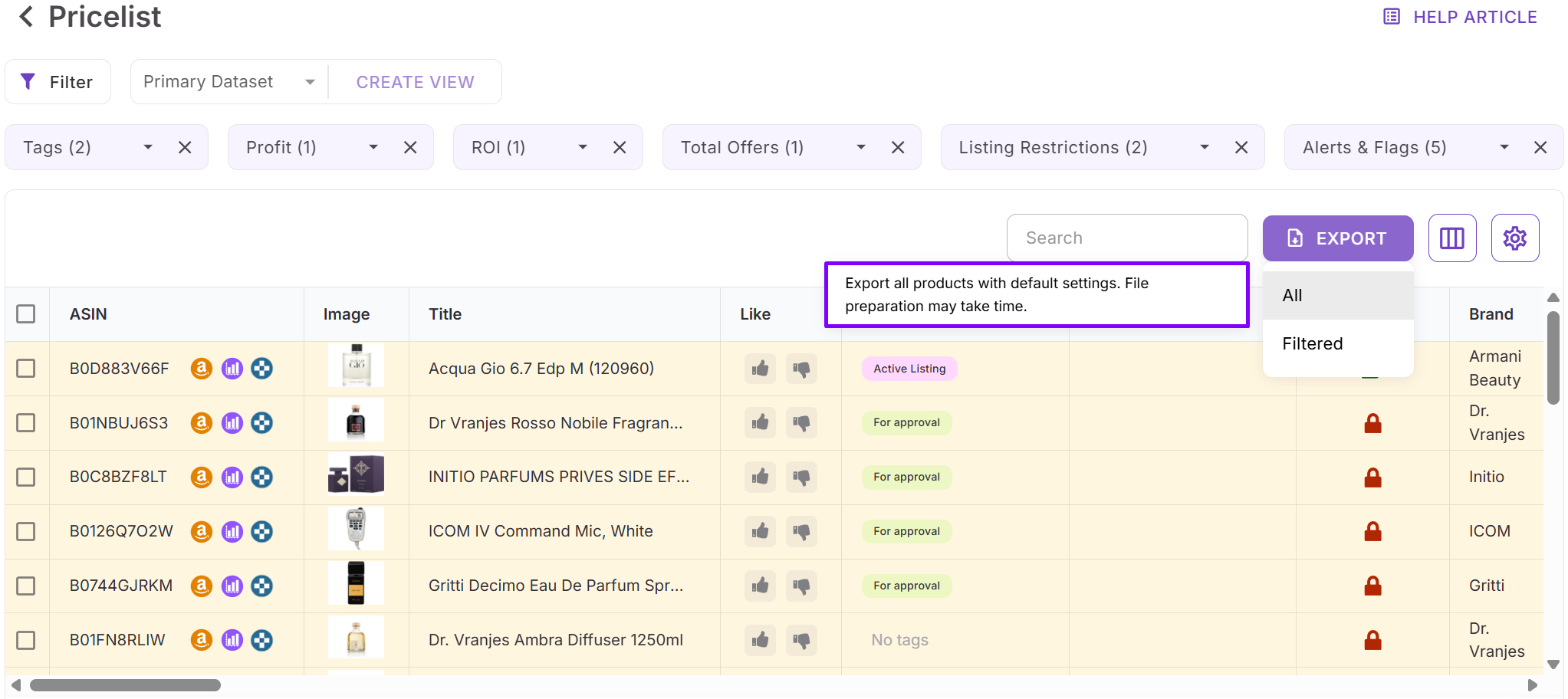
Step 9. Export filtered results
Export only shortlisted products, filtered results, or the full file based on your sourcing workflow.
Brand Analyzer: Choose Resellable Brands to Go Wholesale
Brand Analyzer is an Amazon brand research tool designed to help sellers move from opportunistic online arbitrage into structured wholesale sourcing. When scaling beyond single-product OA deals, guessing whether a brand will perform – or whether Amazon dominates the Buy Box – becomes too risky. Brand Analyzer replaces manual catalog browsing with a clear, data-driven way to evaluate brands before investing time, outreach, or capital.
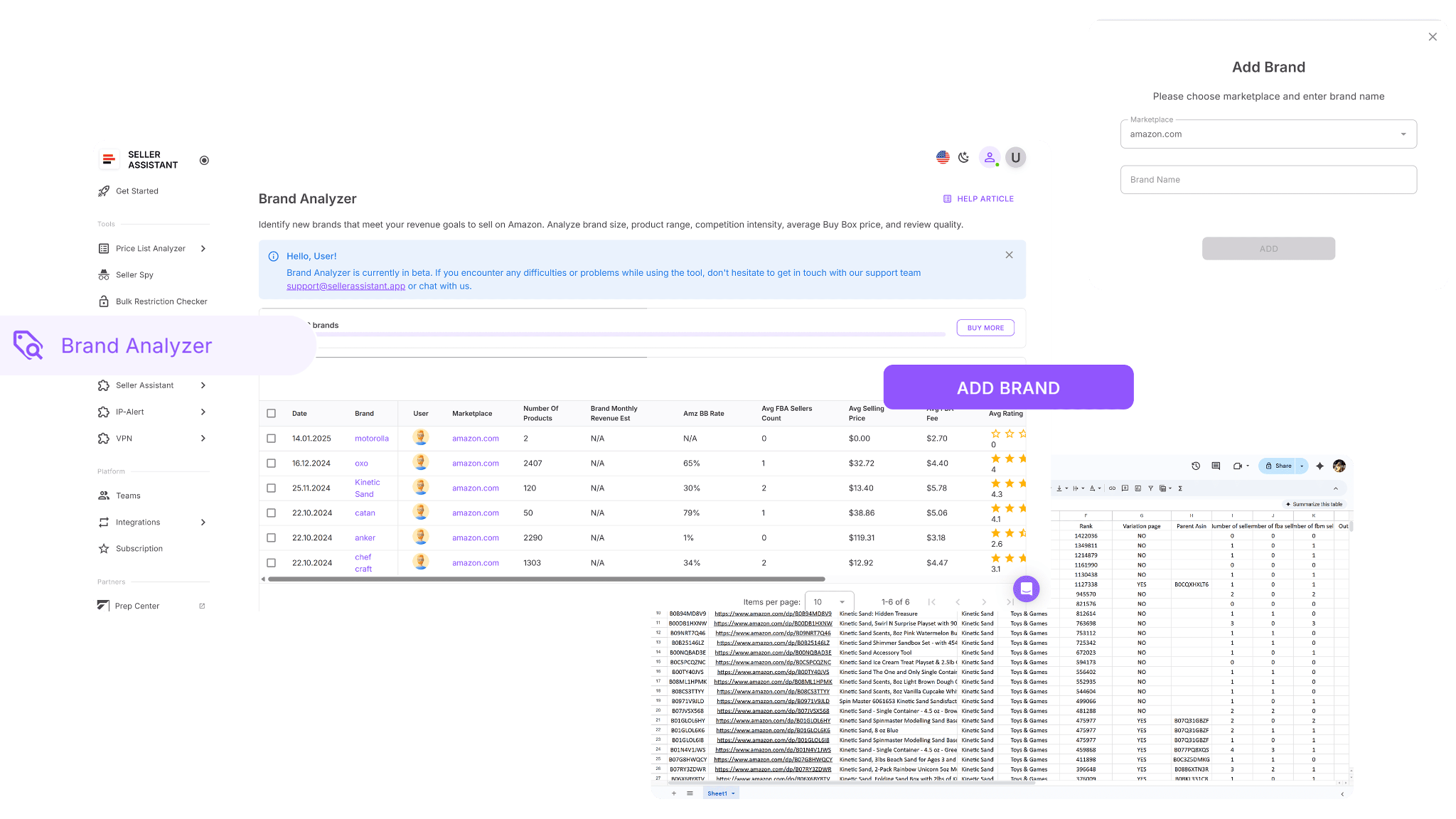
Instead of checking ASINs one by one, sellers enter a brand name and get a complete snapshot of its Amazon performance. The tool reveals brand size, revenue potential, competition, pricing dynamics, and customer trust signals. This makes it easier to eliminate brands with low upside or heavy Amazon competition and focus only on those that fit your wholesale margin and volume goals.
What Brand Analyzer does
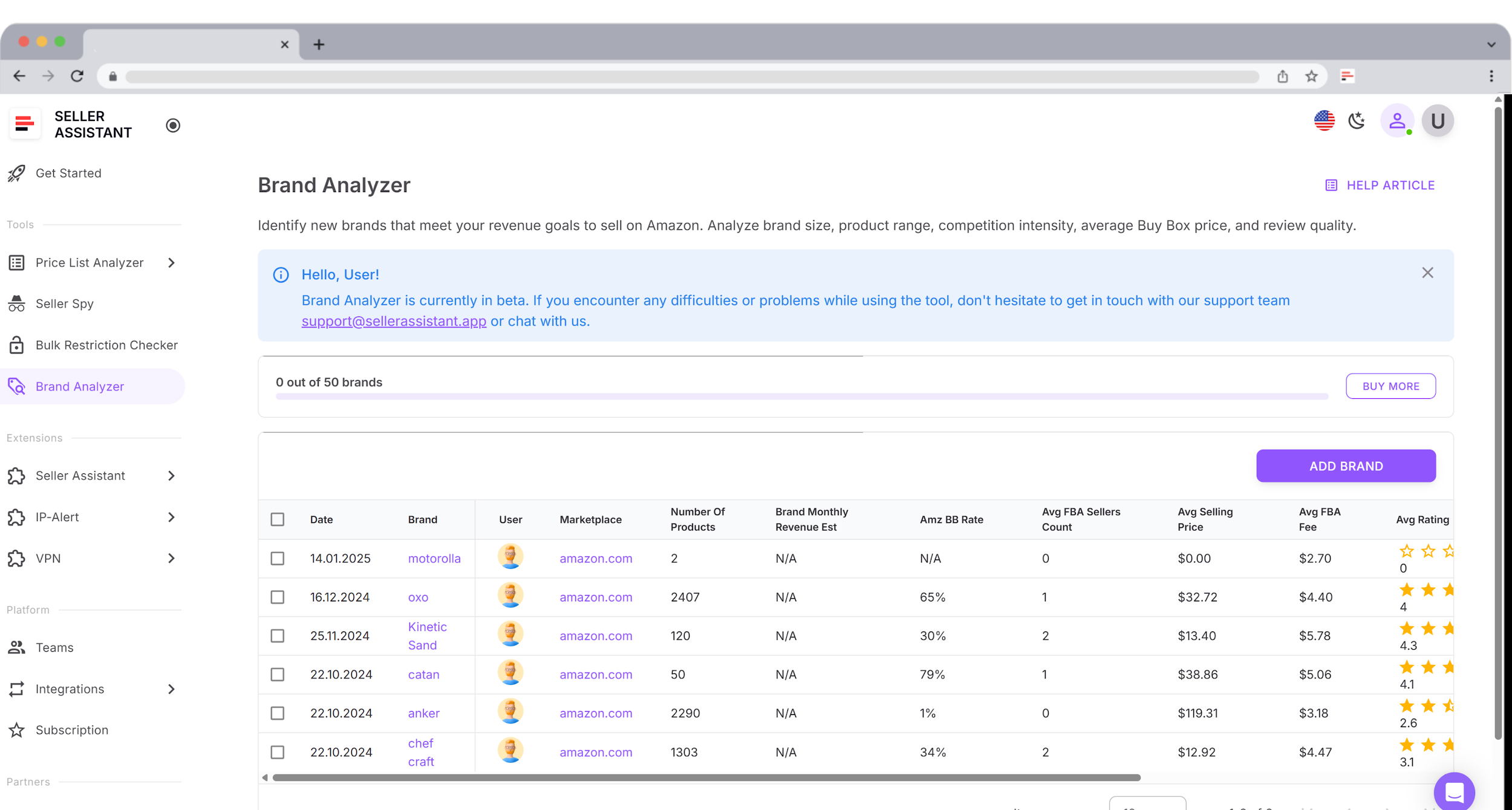
- Quickly determine if a brand is resale-friendly before contacting suppliers
- Replace manual brand research with automated, Amazon-wide analysis
- Measure brand size using total ASIN count across the catalog
- Estimate monthly revenue potential for the brand’s full product lineup
- Analyze competition through average FBA seller counts per ASIN
- Check Amazon’s Buy Box share to gauge direct Amazon competition
- Review average Buy Box prices for margin and pricing planning
- Analyze average FBA fees to understand cost structure and profitability
- Assess customer trust using average ratings and total review volume
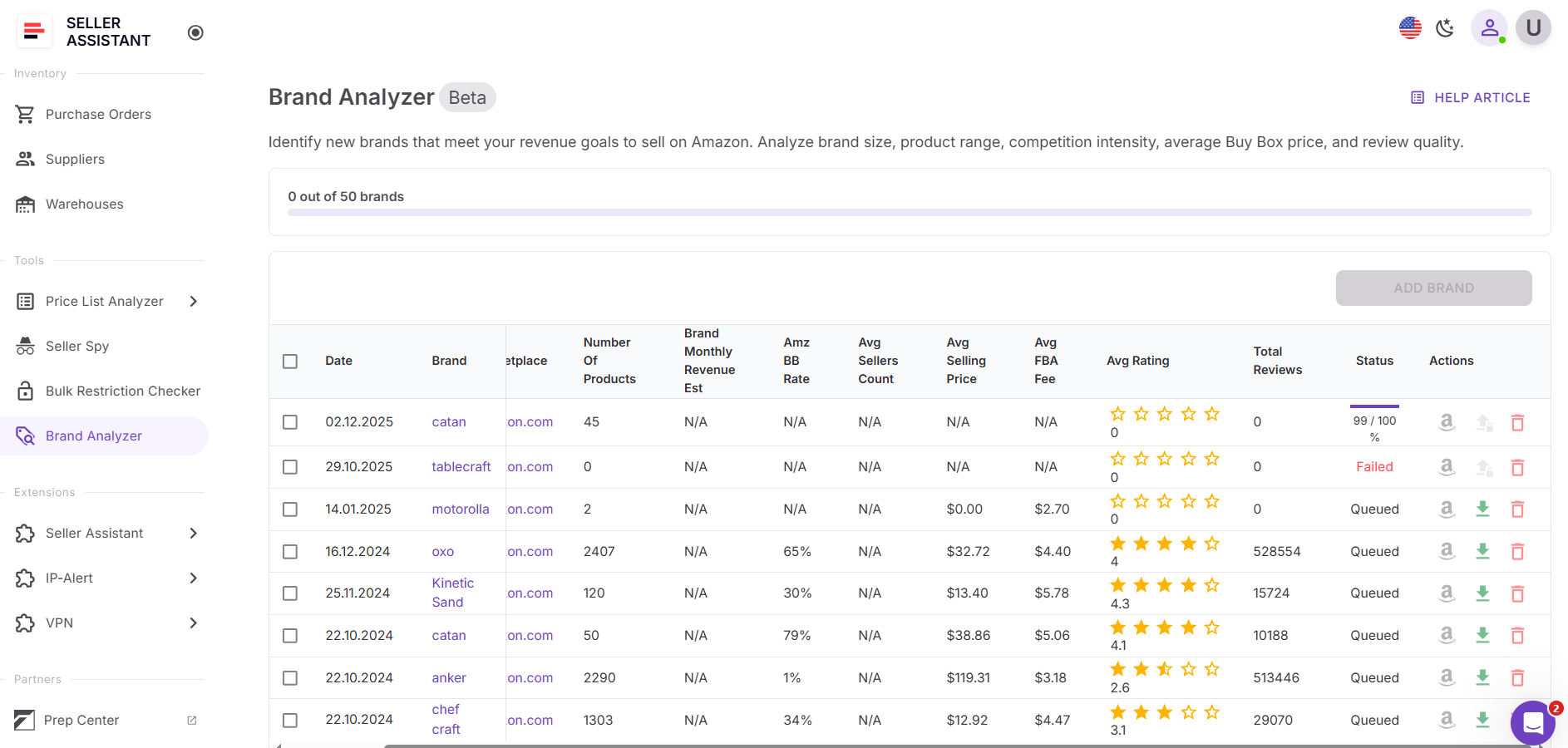
- View a consolidated dashboard covering revenue, pricing, competition, Amazon presence, in-stock rate, and brand reputation
- Identify high-potential brands fast and filter out brands with low upside or excessive competition
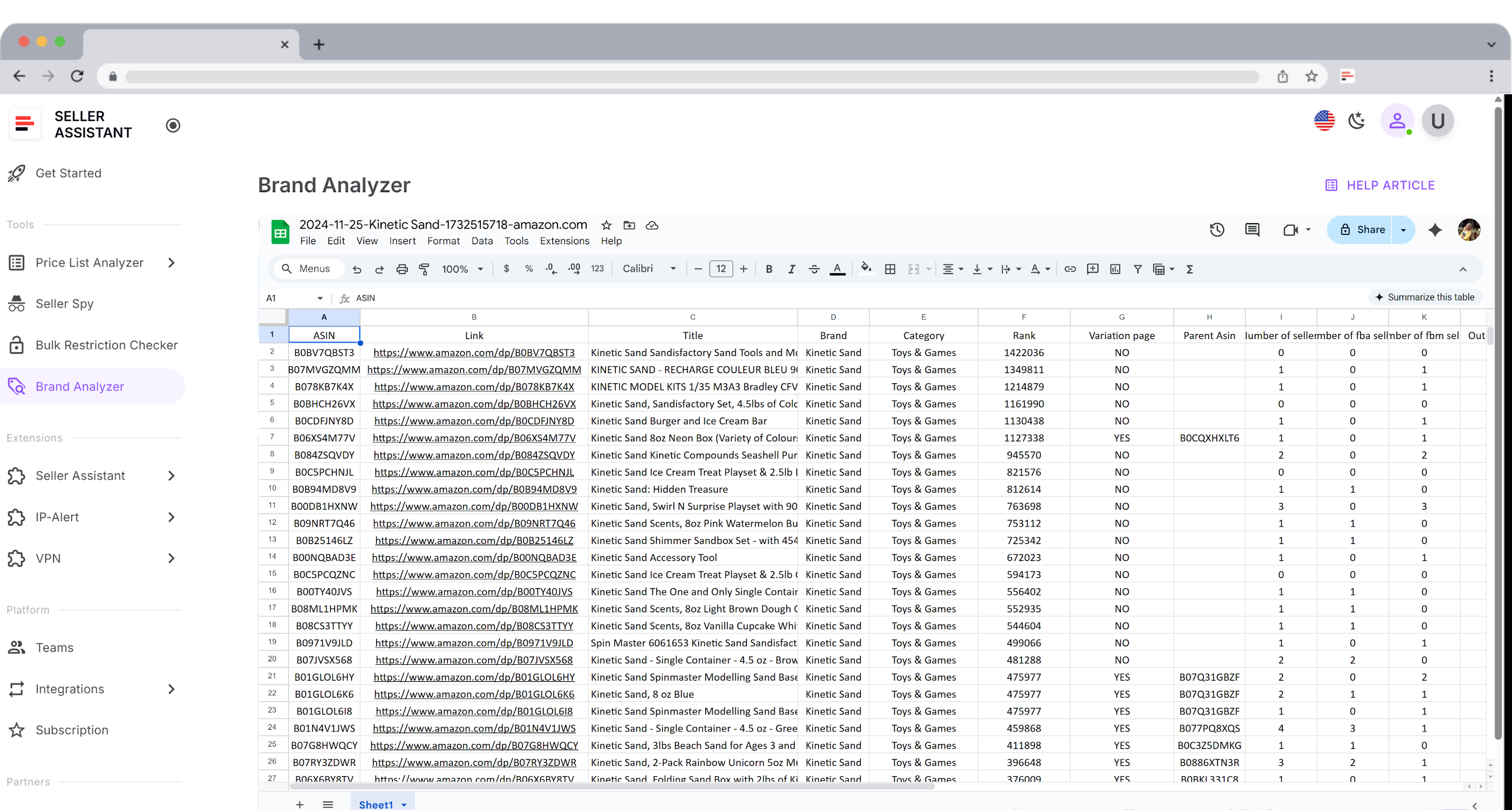
- Download a complete .xls file with all brand ASINs and detailed product metrics for deeper filtering
How Brand Analyzer helps scale from online arbitrage to wholesale
Online arbitrage often focuses on isolated ASIN wins. Wholesale requires confidence at the brand level. Brand Analyzer helps sellers make that shift by validating brands before supplier outreach begins. Instead of discovering issues after receiving a price list, sellers can prioritize brands with healthy demand, manageable competition, and realistic margins. This turns brand selection into a repeatable process and lays the foundation for scalable wholesale relationships.
How to use Brand Analyzer
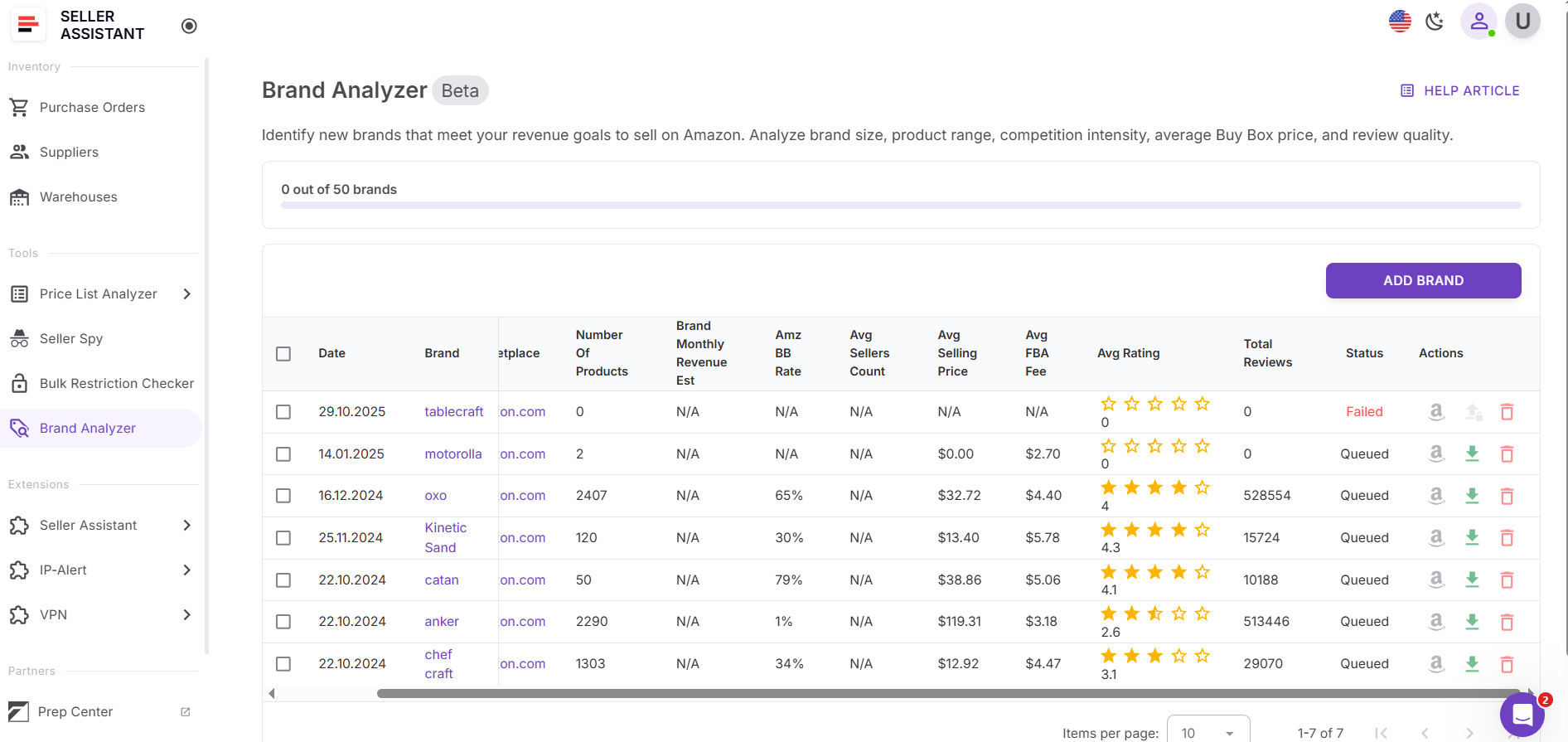
Step 1. Open Brand Analyzer in Seller Assistant
Log in to your Seller Assistant account, go to the Tools section, and select Brand Analyzer. Click Add brand to begin.
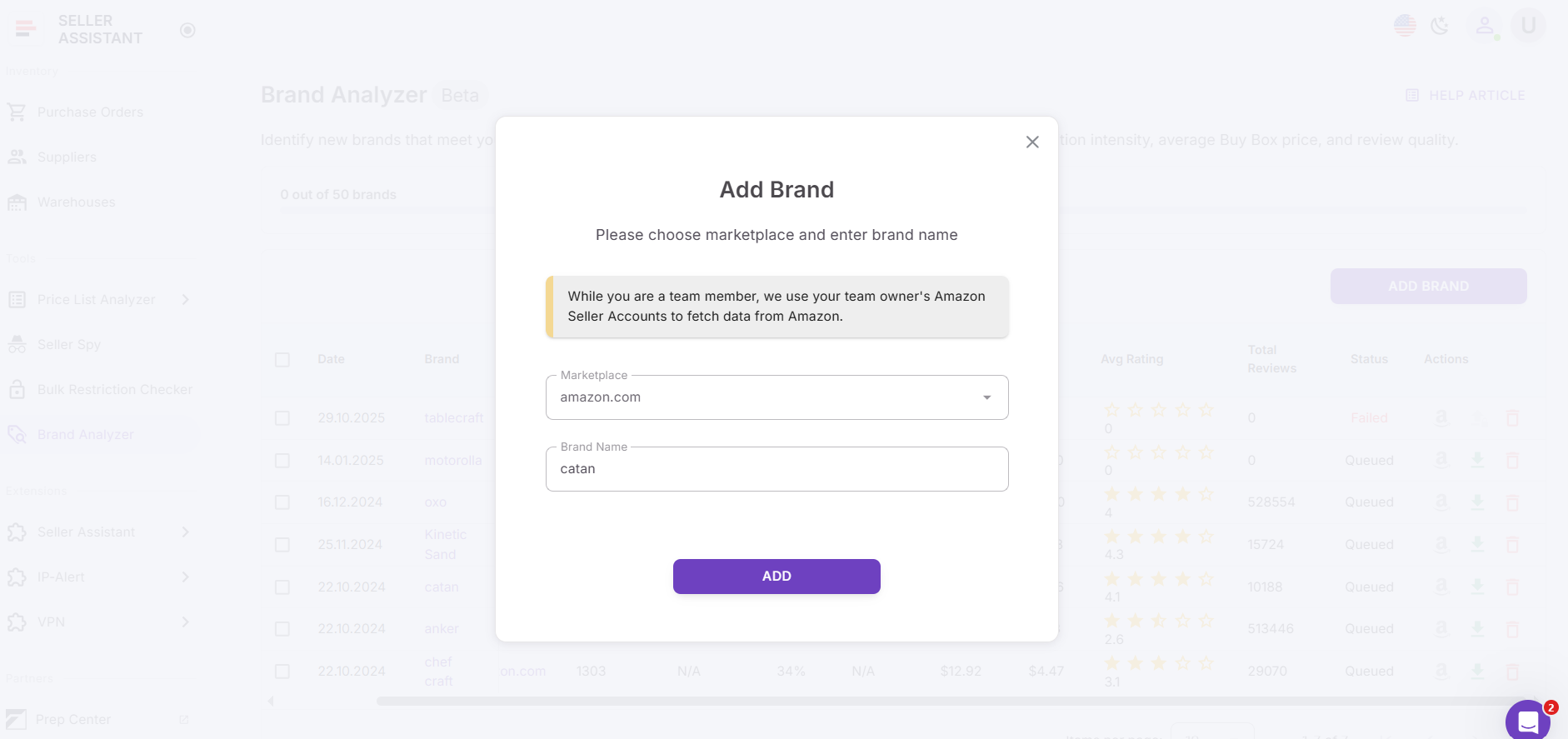
Step 2. Add brand details
Choose your Amazon marketplace, enter the brand name, and click Add to start the brand research.
Step 3. Review the brand analysis results
Once processing is complete, review the dashboard to assess revenue potential, competition, pricing, Amazon presence, and overall brand reputation.
Step 4. Download the brand report
Download the .xls report with the brand’s full ASIN list and detailed metrics. Use this file to filter products and move forward with supplier outreach or price list analysis.
Bulk Restriction Checker: Avoid Gated ASINs
Bulk Restriction Checker is built for Amazon sellers who are moving from small-scale online arbitrage into wholesale sourcing, where buying mistakes become expensive. In OA, sellers often check eligibility one ASIN at a time. In wholesale, that approach doesn’t work. Bulk Restriction Checker lets sellers validate entire ASIN lists upfront, so restricted or gated products are removed before money is committed.
The tool checks large ASIN files against your actual Seller Central marketplace permissions. Each product is clearly labeled as eligible, approval required, or not eligible, giving you certainty before you analyze price lists, place orders, or start supplier negotiations.
What Bulk Restriction Checker does
- Check selling eligibility for up to 20,000 ASINs in a single scan
- Compare uploaded ASINs directly against your Seller Central permissions
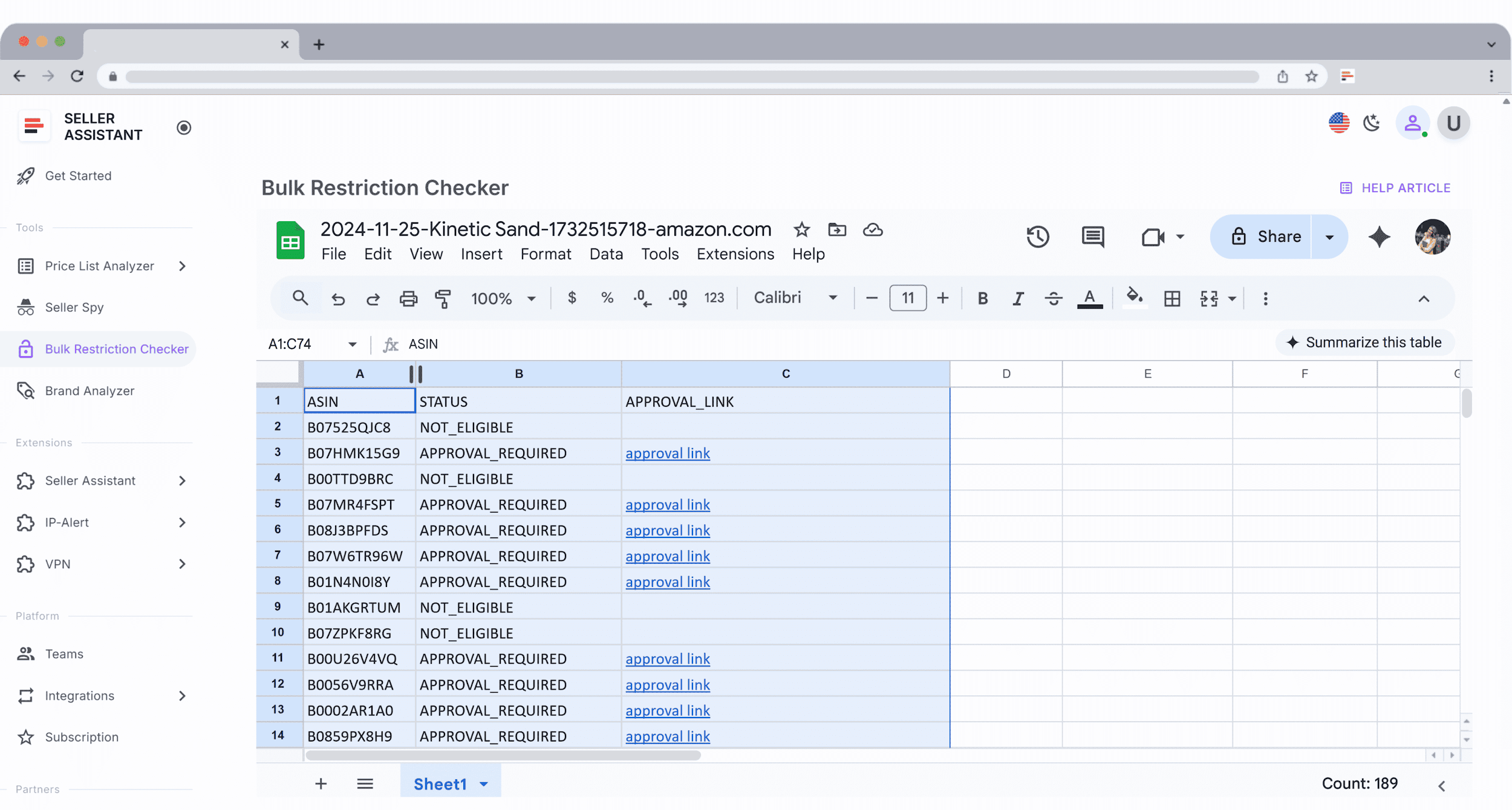
- Label products as eligible, approval required, or not eligible
- Identify gated ASINs early and decide whether ungating is worth the effort
- Prevent purchasing inventory your account cannot list or sell
- Clean supplier spreadsheets and sourcing lists before deeper analysis
- Generate clear, downloadable reports for filtering and team use
- Support bulk eligibility checks for wholesale, online arbitrage, and dropshipping workflows
How BulkRestriction Checker helps scale from online arbitrage to wholesale
As sellers move into wholesale, supplier price lists often contain hundreds or thousands of ASINs. Manually checking eligibility isn’t realistic, and missing one gated product can lock up capital. Bulk Restriction Checker removes that risk by validating eligibility at scale. It allows sellers to apply eligibility rules consistently across entire catalogs, making sourcing decisions faster, safer, and repeatable – key requirements when transitioning from OA testing to wholesale volume buying.
How to use Bulk Restriction Checker
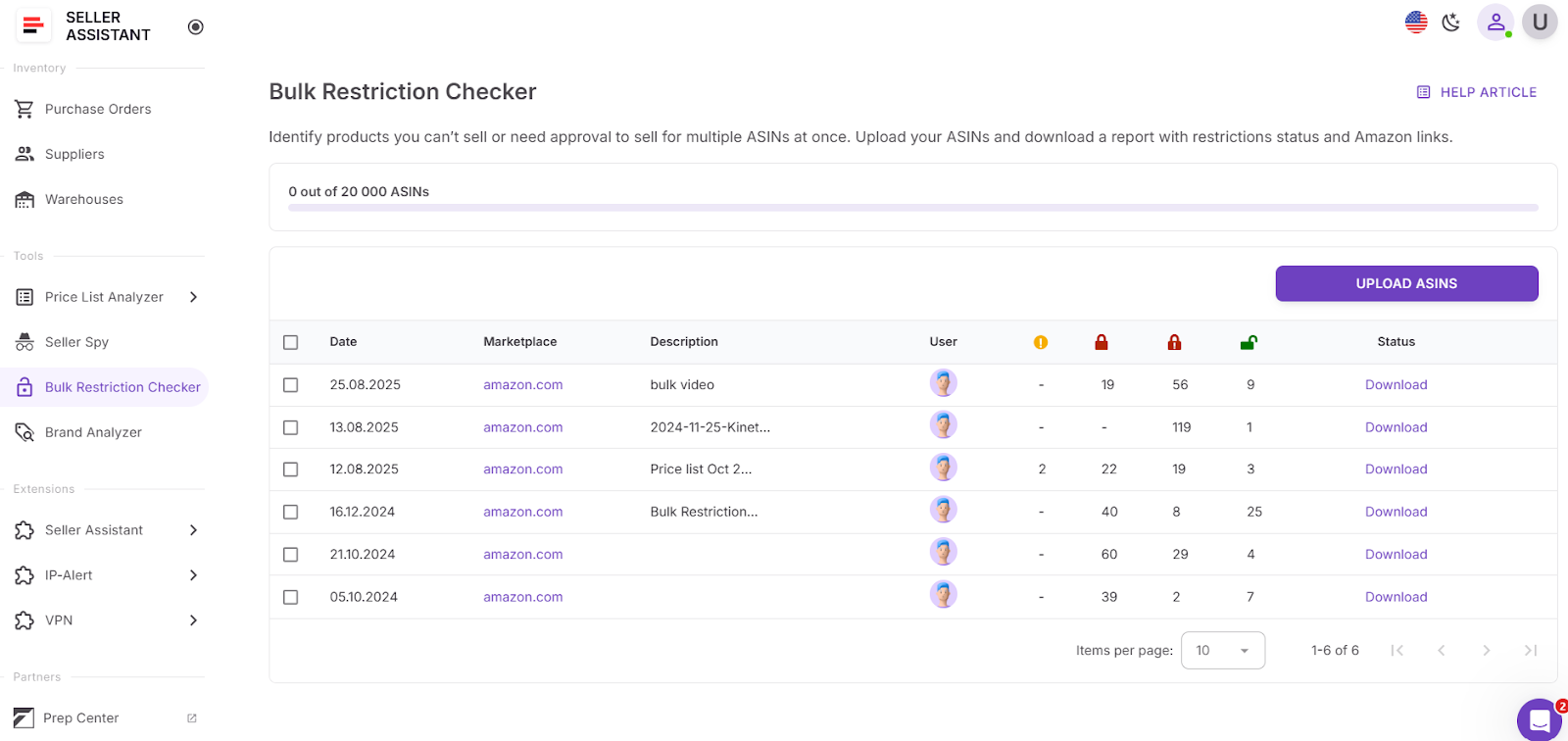
Step 1. Open Bulk Restriction Checker
Log in to your Seller Assistant account, go to the Tools section, and select Bulk Restriction Checker.
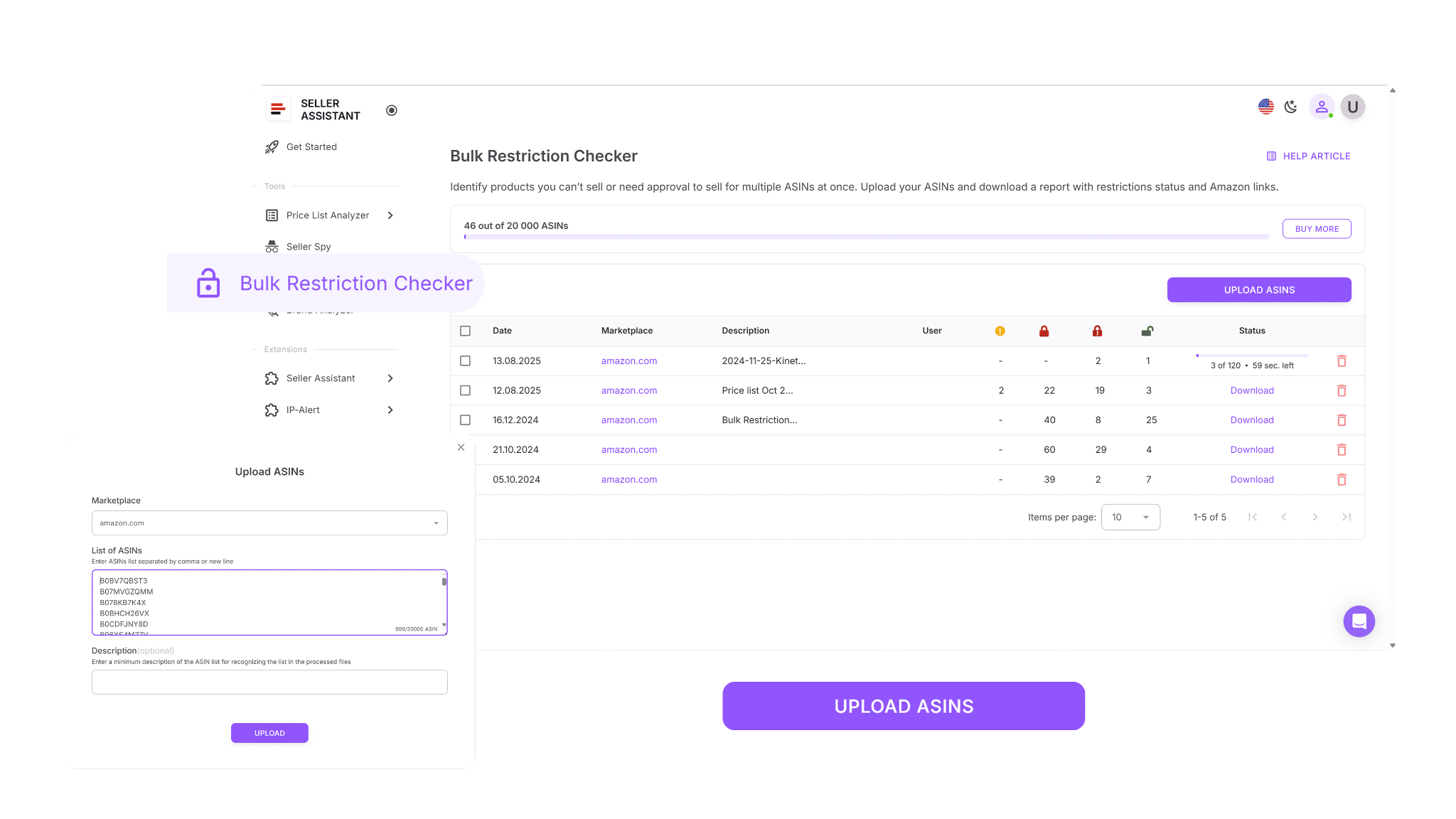
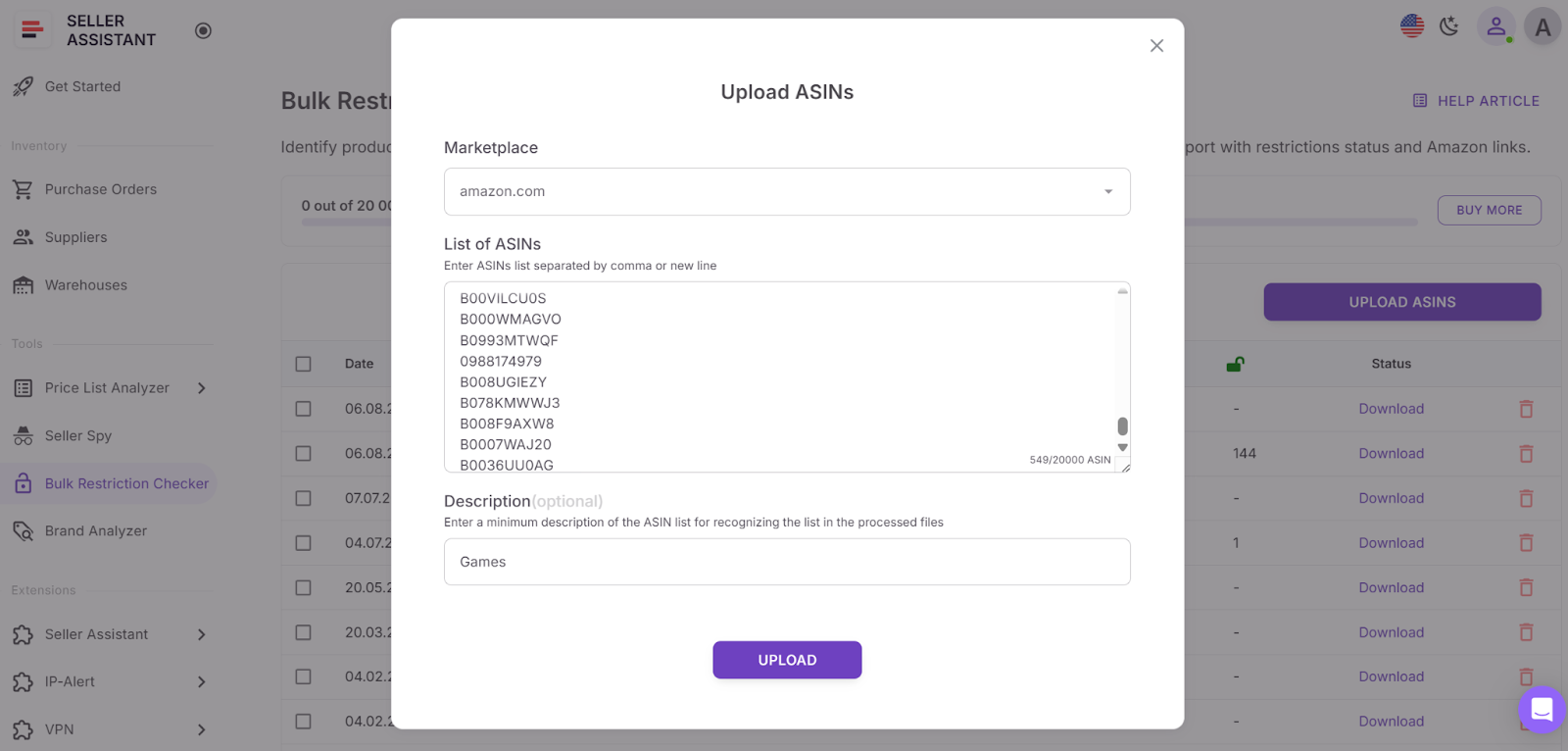
Step 2. Upload your ASIN list
Upload a file containing up to 20,000 ASINs. The tool immediately begins checking each item for restrictions.
Step 3. Wait for processing to complete
As soon as the scan is finished, you’ll receive an email notification when the results are ready.
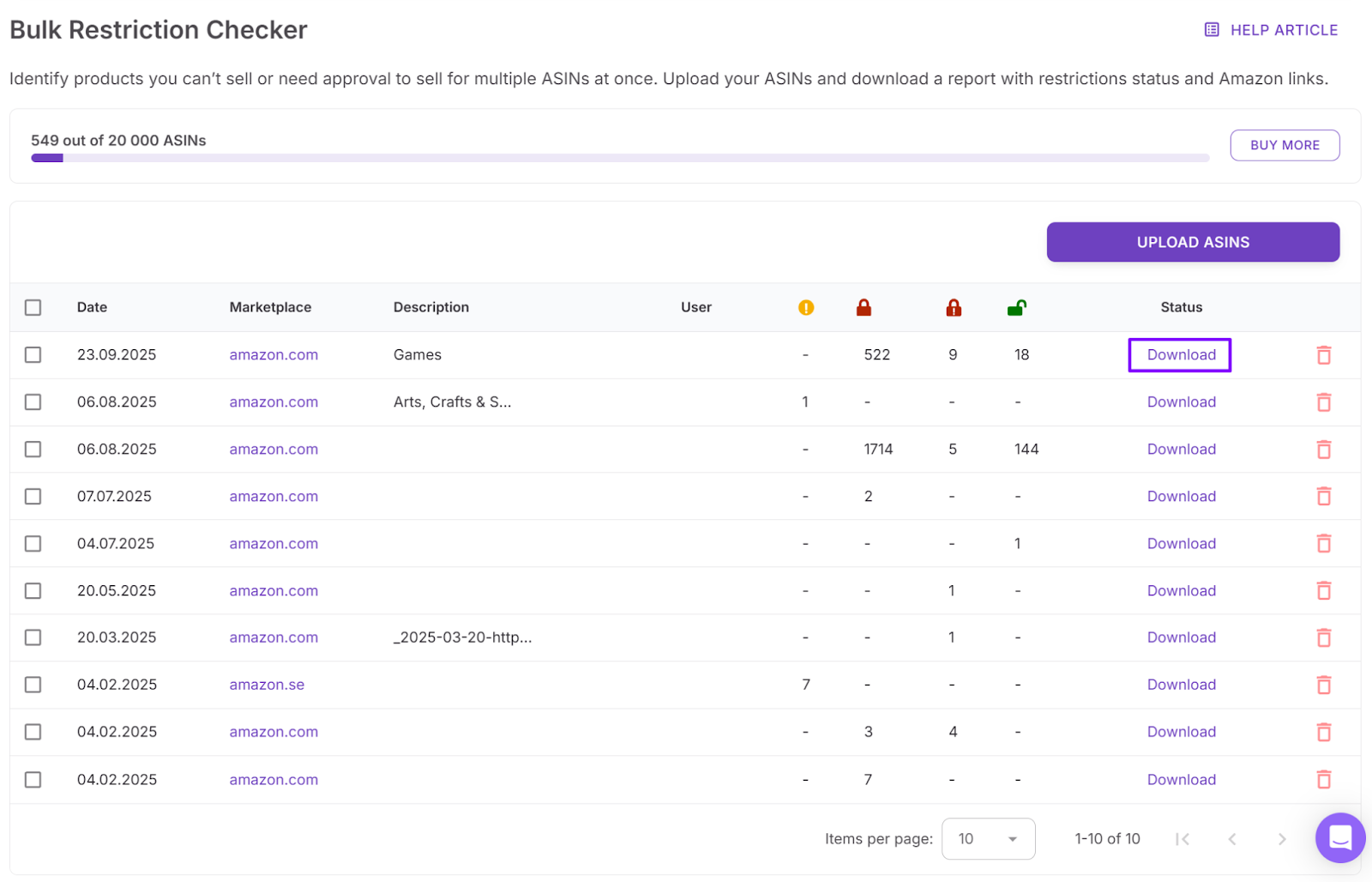
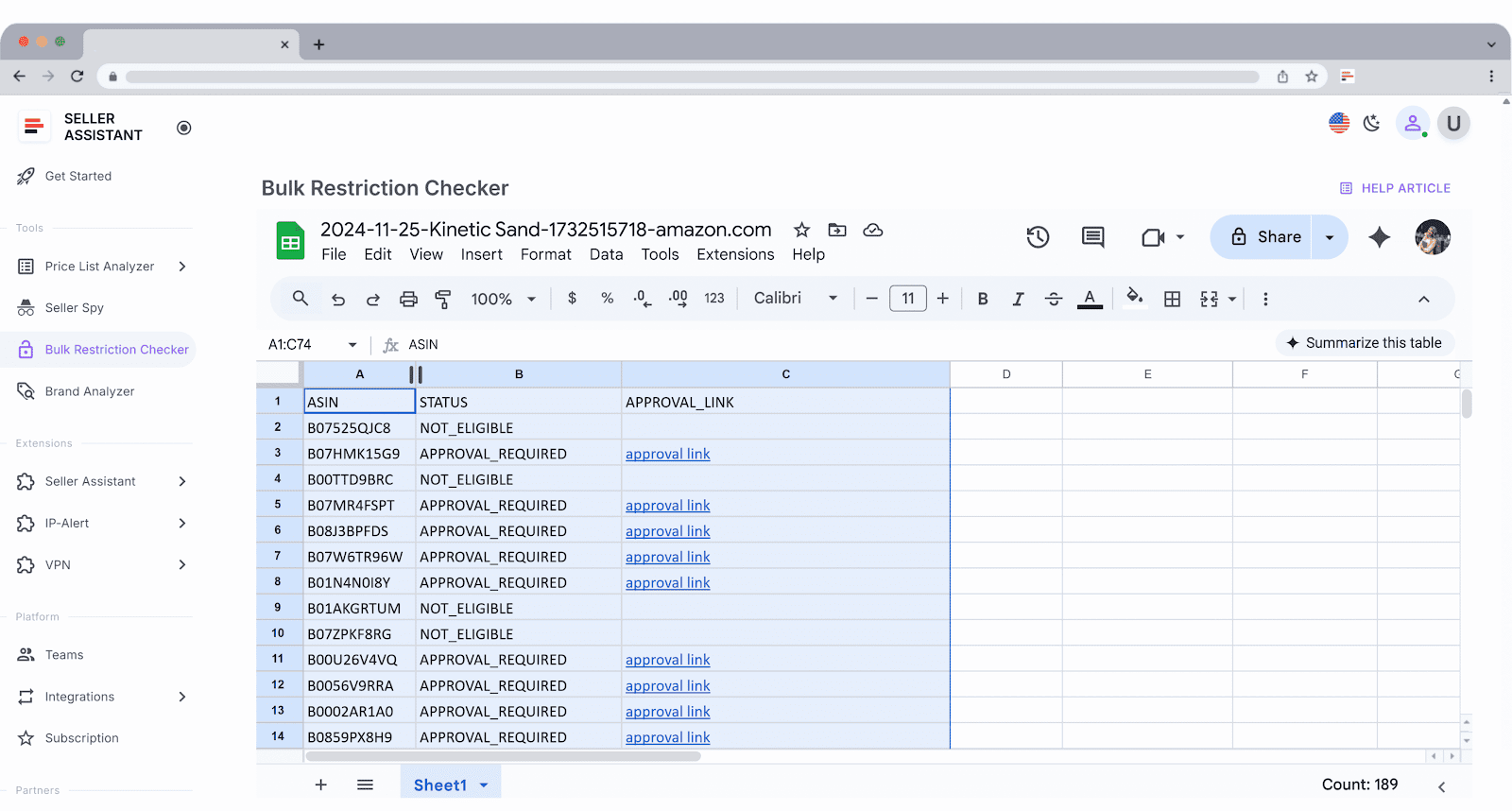
Step 4. Download and review your report
Download the report and go through each product’s status. ASIN are marked as ELIGIBLE, APPROVAL REQUIRED, or NOT ELIGIBLE, making it easy to sort, filter, and share results with your team to guide sourcing decisions.
Suppliers Database: Turn OA Buys into Wholesale Suppliers
Suppliers Database is a centralized system for managing all supplier information as sellers move from ad-hoc online arbitrage sourcing to structured wholesale operations. In OA, supplier details often live in notes, emails, or spreadsheets. That breaks down fast when outreach, approvals, and reorders increase. Suppliers Database replaces scattered records with a single, connected source of truth built into your sourcing and purchasing workflow.
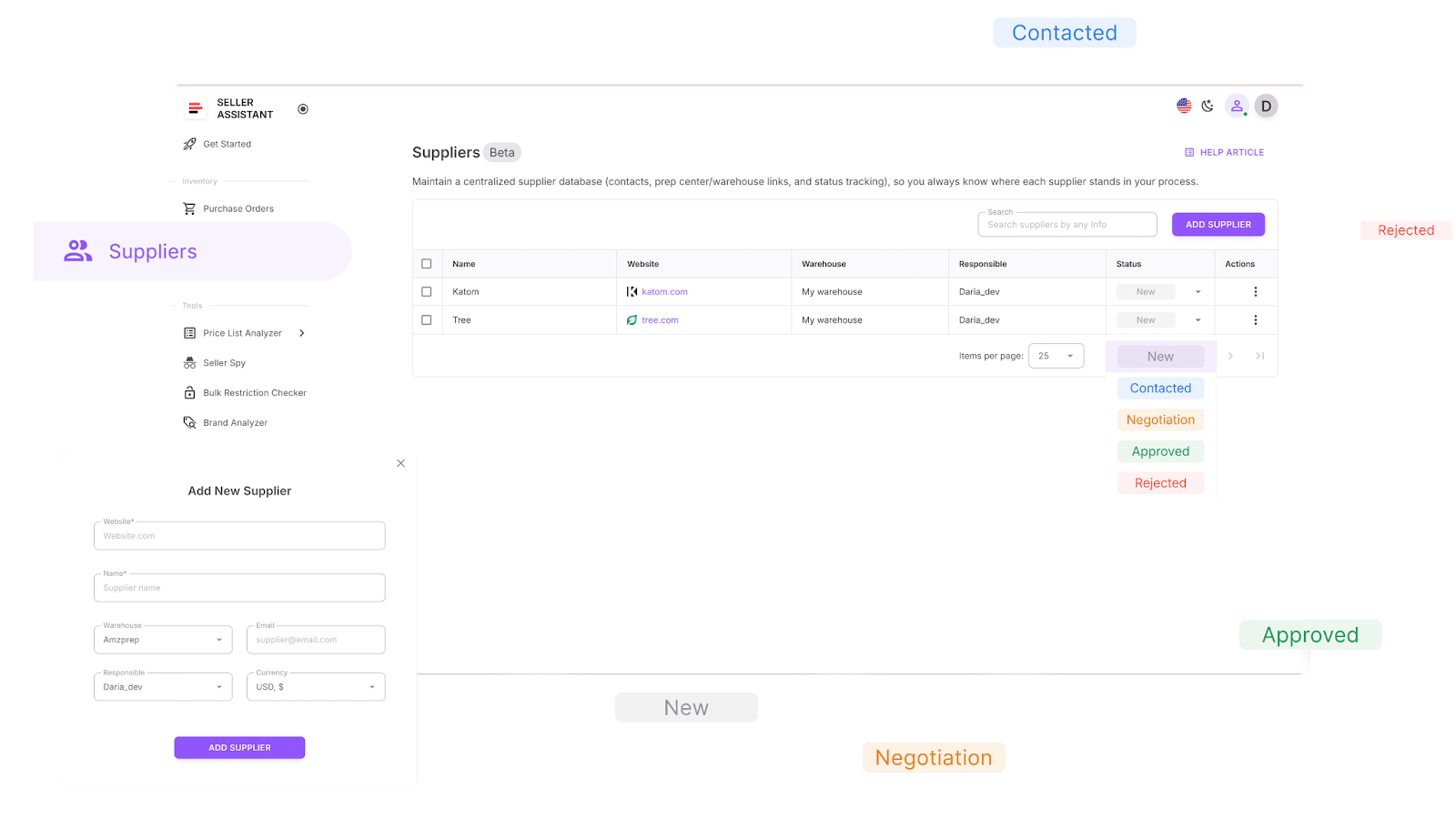
The database stores supplier names, websites, contact details, terms, routing rules, and relationship status. Unlike a standalone spreadsheet, it connects directly with Price List Analyzer, Purchase Orders Module, and Warehouses Database. This allows sellers to move from supplier outreach to price list analysis and purchase order creation without re-entering data. Supplier profiles stay synchronized across tools, reducing errors, preventing duplicate outreach, and keeping decisions consistent as operations scale.
What Suppliers Database does
- Create complete supplier profiles with names, websites, contact details, currencies, and assigned team members
- Store key operational data such as minimum order value, lead time, and internal notes
- Search and filter suppliers by name, website, address, status, or linked warehouse
- Track supplier relationships using clear stages like New, Contacted, Negotiation, Approved, Active, or Rejected
- Link suppliers to default prep centers or warehouses for automatic routing
- Auto-fill supplier and warehouse details during price list analysis and purchase order creation
- Edit supplier information without breaking connections across tools
- Access supplier profiles directly from Price List Analyzer and Purchase Orders Module
- Discover new suppliers through Seller Assistant’s AI Supplier Finder and add them instantly
How Suppliers Database helps scale from online arbitrage to wholesale
Online arbitrage often treats suppliers as one-off sources. Wholesale depends on repeatable relationships. Suppliers Database supports that shift by giving sellers visibility and control over every supplier interaction. It keeps outreach organized, eliminates duplicated work, and ensures approved suppliers flow smoothly into analysis and ordering. This structure makes it possible to manage more suppliers, delegate tasks safely, and grow into wholesale without losing track of relationships or terms.
How to use Suppliers Database
Step 1. Access Suppliers Database
Log in to your Seller Assistant account and go to Inventory → Suppliers. This tool acts as the central workspace for organizing and managing supplier profiles.
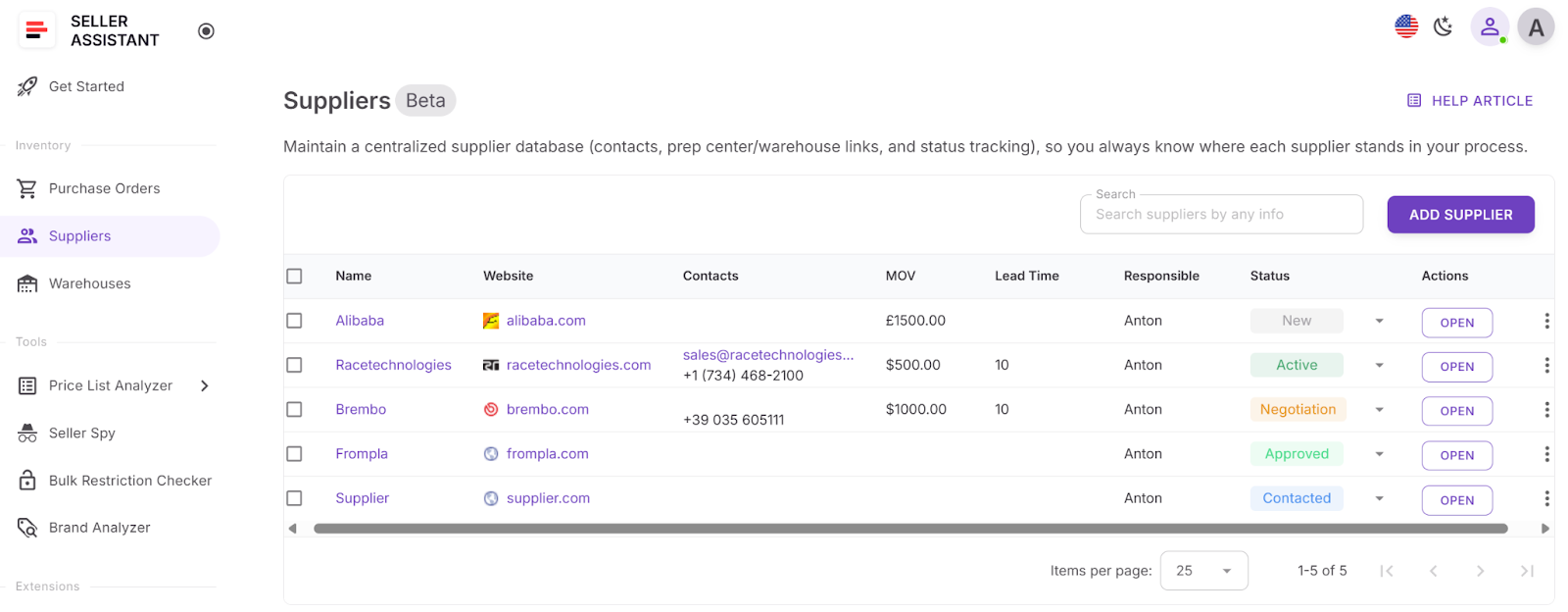
Step 2. Add a new supplier
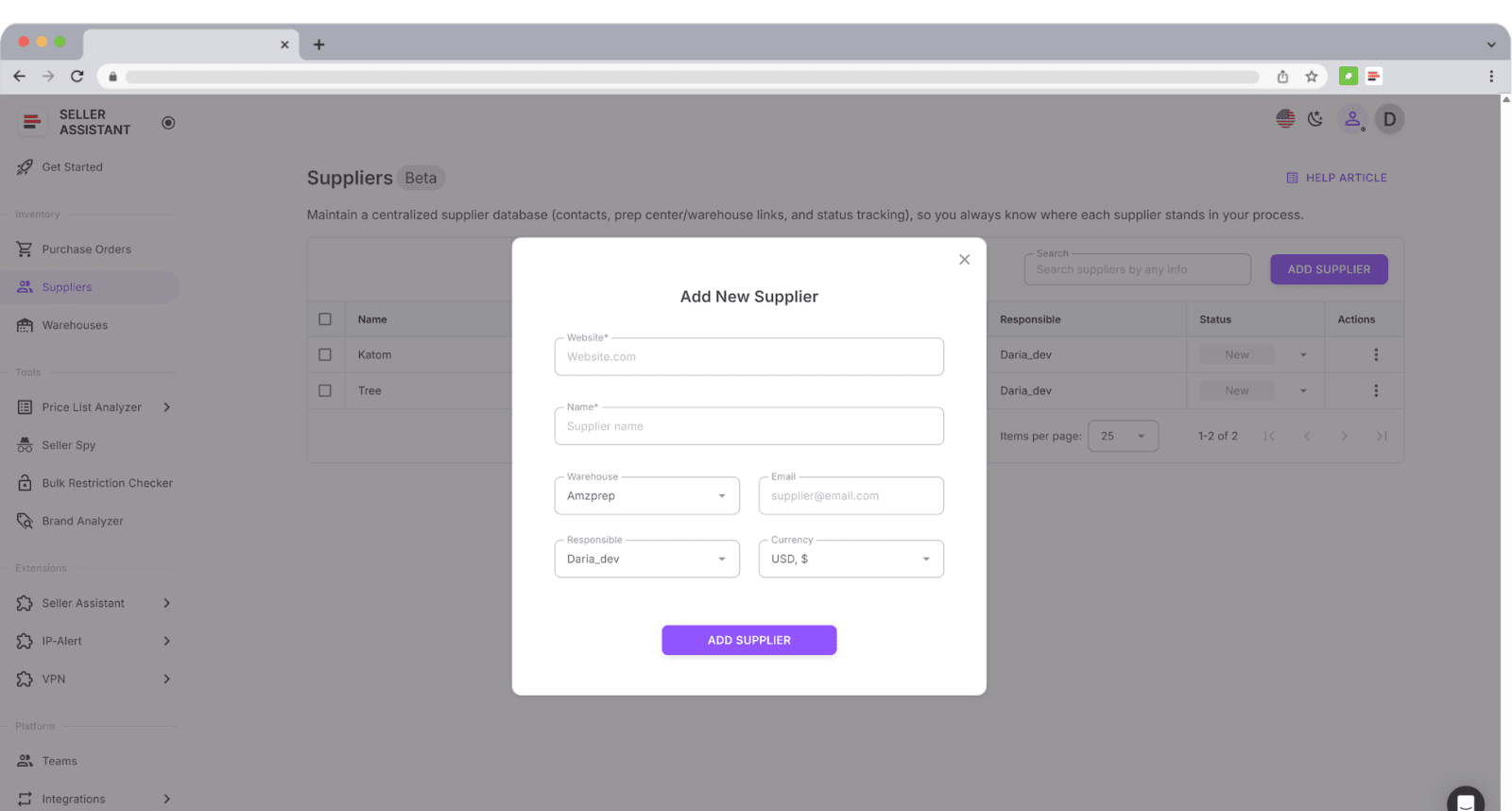
Click Add supplier and enter the supplier’s name and website. You can also include optional details such as email address, currency, assigned warehouse, responsible team member, minimum order value, and lead time.
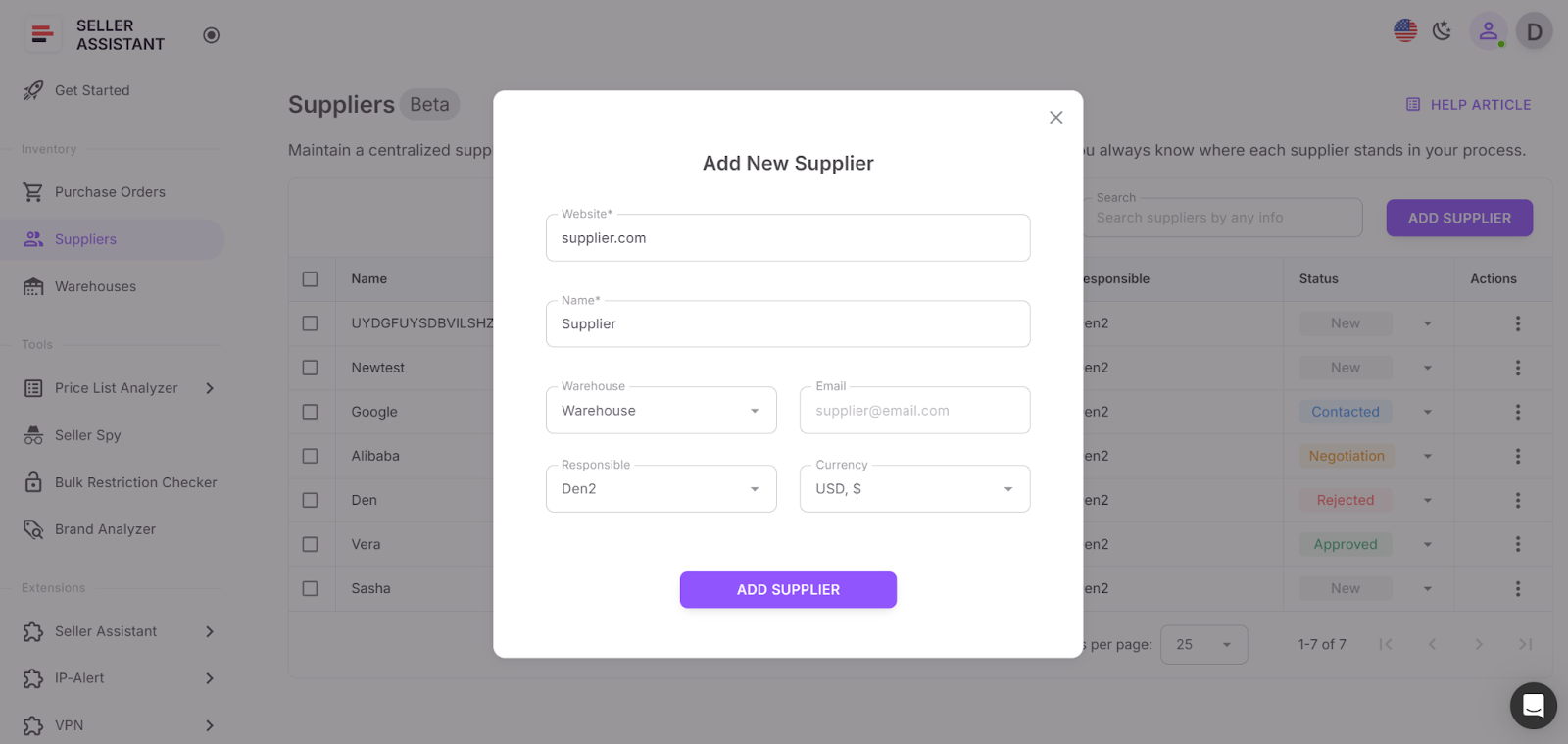
Step 3. Set the supplier’s status
Choose the current stage of the relationship – New, Contacted, Negotiation, Approved, Active, or Rejected – to keep supplier outreach organized and easy to track.
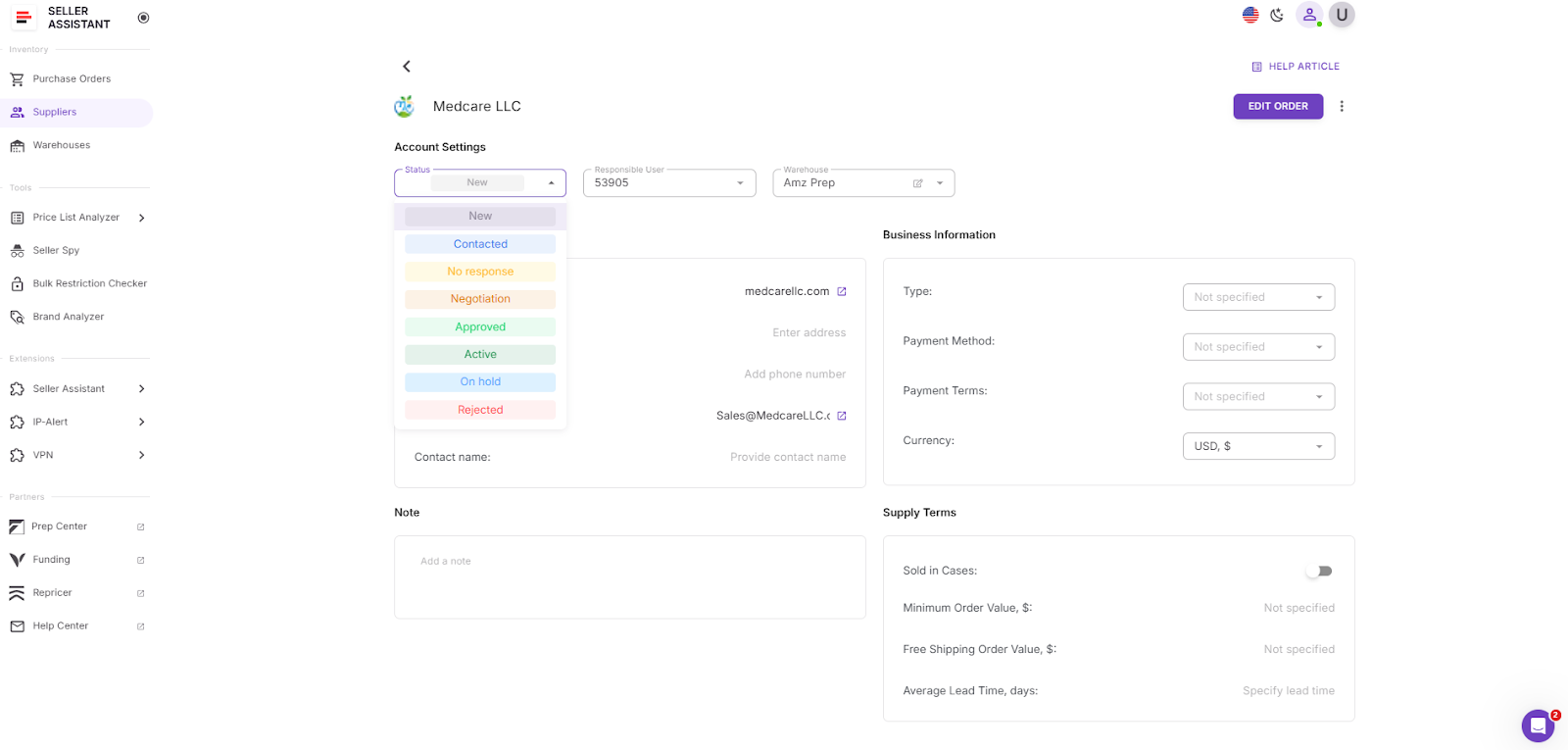
Step 4. Assign a default warehouse or prep center
Select a warehouse or prep center so shipping and routing details are applied automatically during sourcing and purchase order creation.
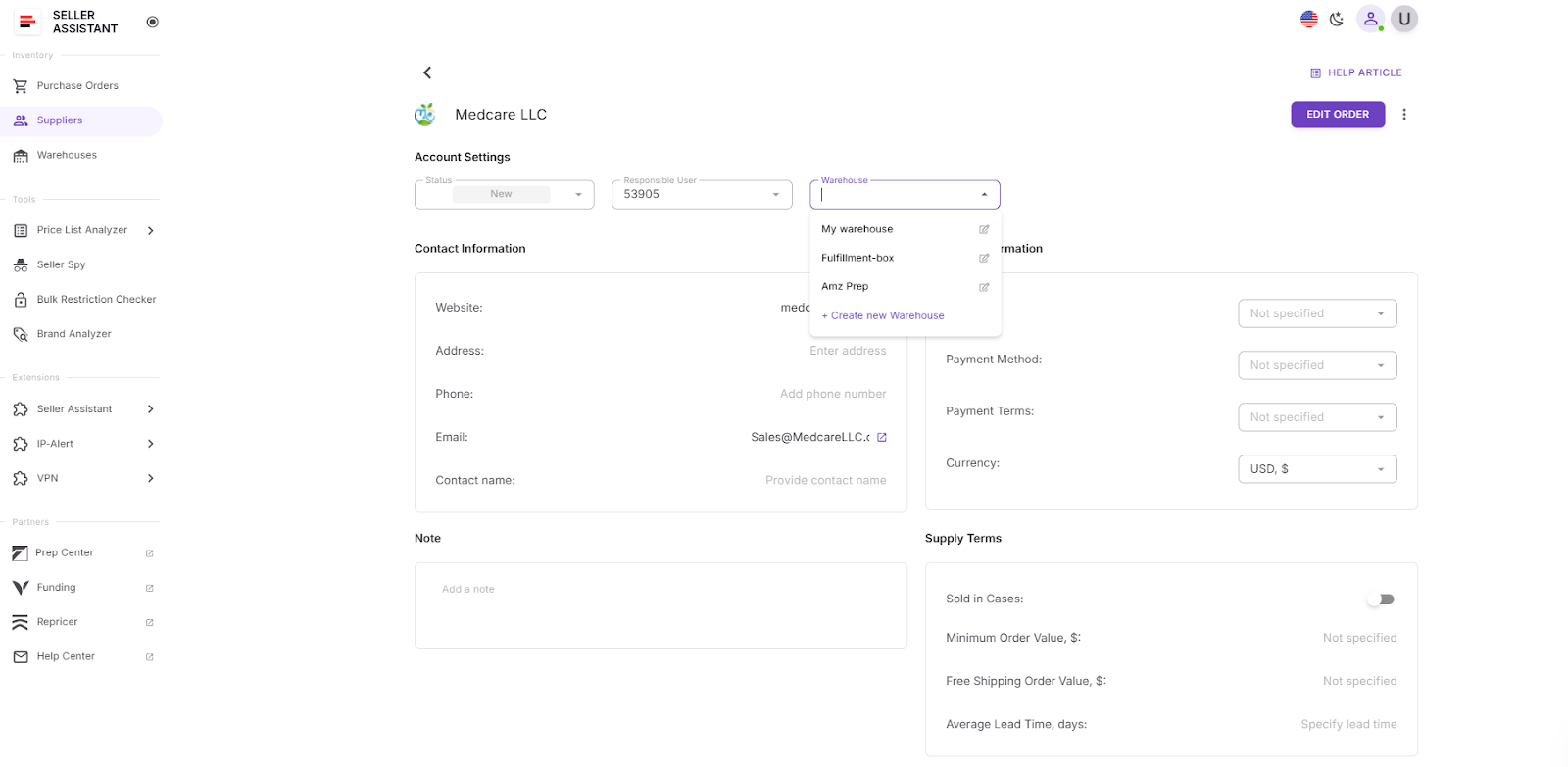
Step 5. Use the supplier throughout your workflow
After saving, the supplier becomes available across Seller Assistant. You can select them when uploading price lists, creating purchase orders, or sourcing with AI Supplier Finder – without re-entering information.
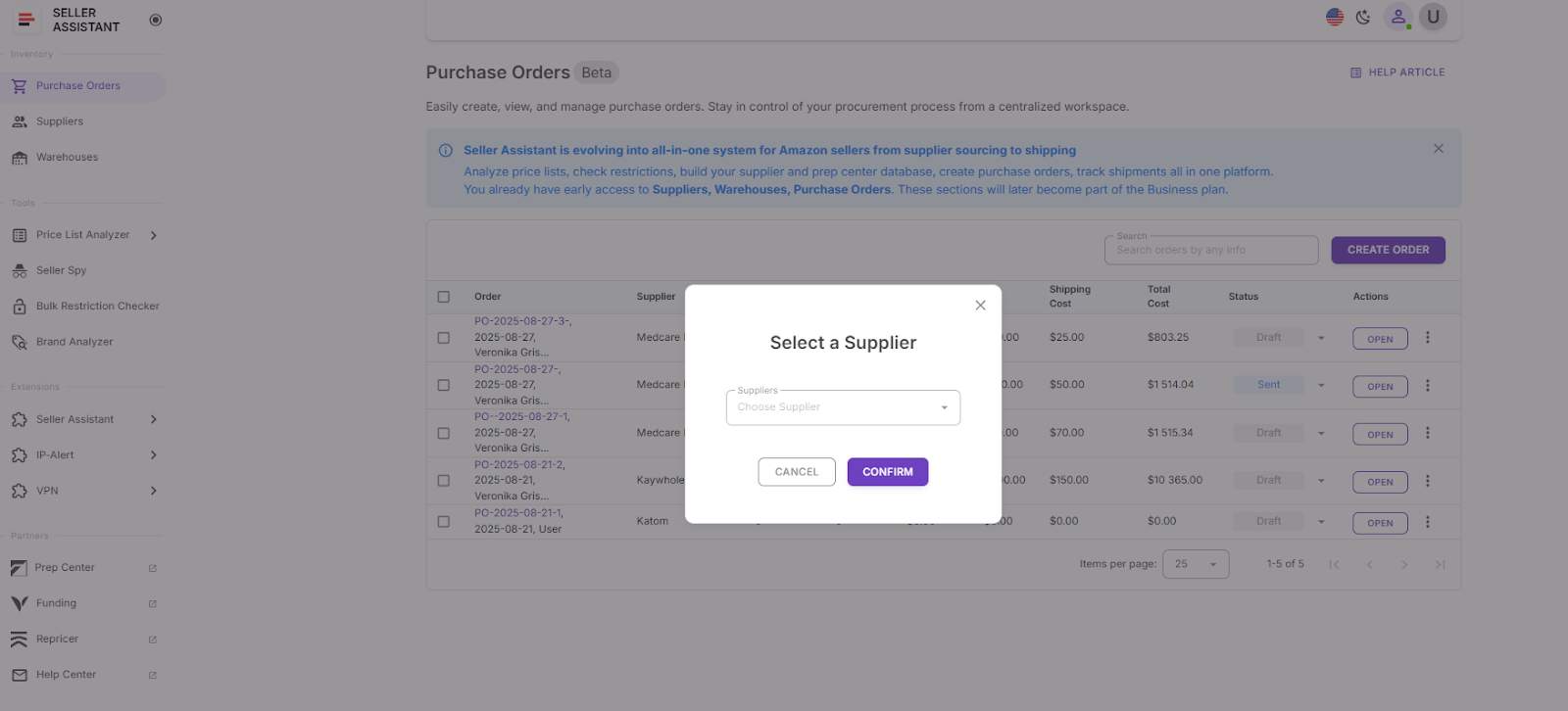
Step 6. Keep supplier information up to date
Update statuses, notes, lead times, and order terms as communication evolves. Keeping supplier data current helps ensure smoother sourcing decisions and more reliable purchasing workflows.
Warehouses Database: From Manual Routing to Scalable Fulfillment
Warehouses Database is a centralized system for managing prep centers and warehouses as Amazon sellers grow from simple online arbitrage setups into multi-supplier wholesale operations. In early OA stages, ship-to details often live in spreadsheets or emails. Once order volume increases, that approach becomes risky. A single wrong address or outdated contact can delay fulfillment or throw off landed cost calculations.
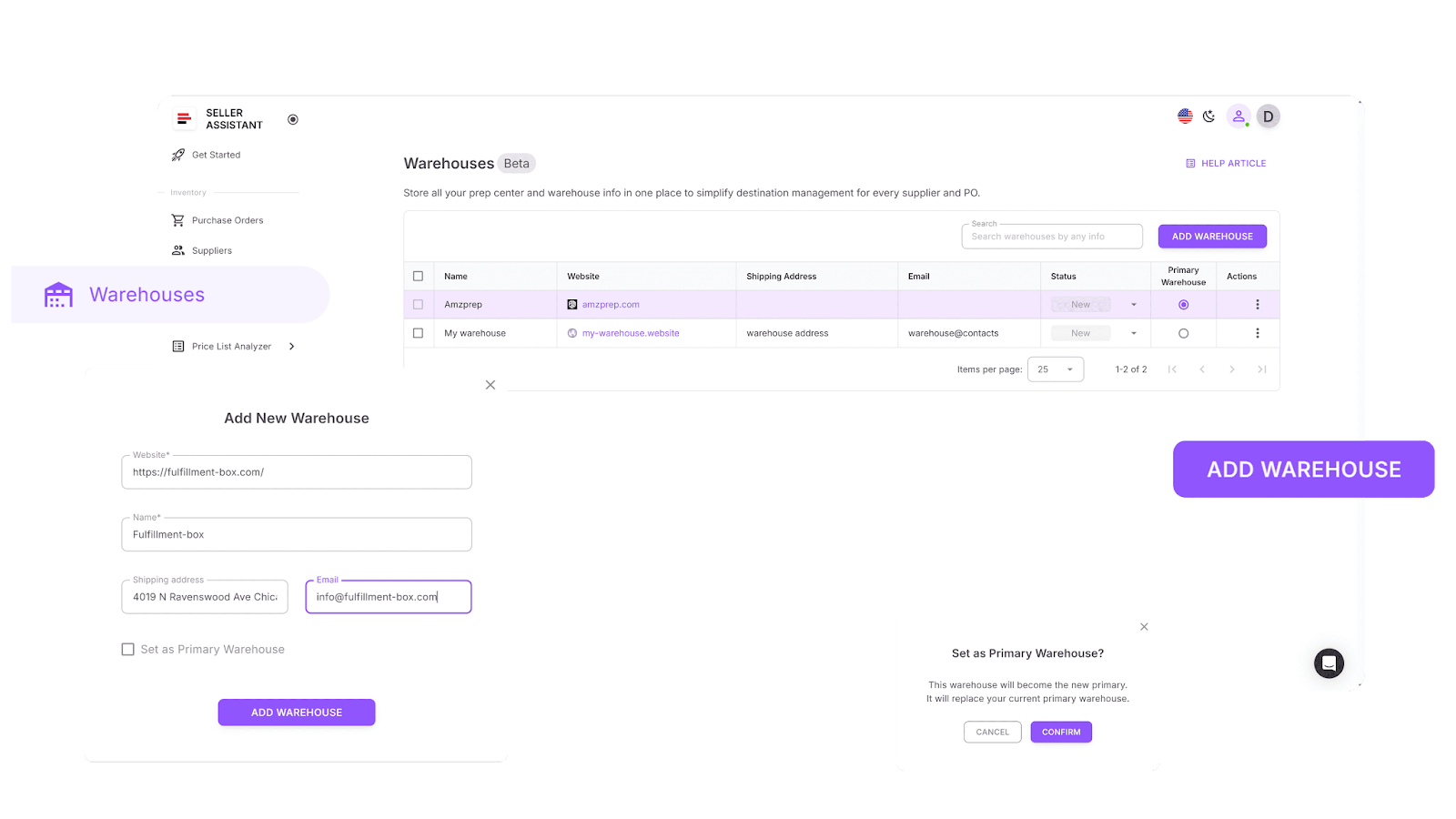
Warehouses Database keeps all warehouse and prep center information in one place and links it directly to suppliers and purchase orders. Each location’s shipping address, contact details, and operational status are stored once and reused across your workflow. By assigning default warehouses to suppliers, routing details are applied automatically during price list analysis and purchase order creation. This removes repetitive data entry, prevents routing mistakes, and keeps fulfillment consistent as your supplier network and order volume grow.
What Warehouses Database does
- Store complete prep center and warehouse profiles in one unified system
- Save warehouse names, websites, shipping addresses, contact details, and operational status
- Assign warehouse statuses such as New, Active, or Inactive
- Link suppliers to default warehouses for automatic routing
- Auto-fill ship-to addresses during purchase order creation
- Reuse warehouse data across Suppliers and Purchase Orders Modules
- Assign one primary warehouse as the default ship-to location
- Search warehouses by name, website, address, or contact details
- Sort warehouses by any column for faster navigation
- Edit warehouse information without breaking links to suppliers or purchase orders
How Warehouses Database helps scale from online arbitrage to wholesale
Online arbitrage often relies on simple, one-off shipping setups. Wholesale requires repeatable and accurate routing across multiple suppliers and locations. Warehouses Database supports this transition by standardizing fulfillment data and automating routing decisions. It ensures every order ships to the correct location without manual checks, allowing sellers to manage more suppliers, delegate purchasing tasks, and scale operations without fulfillment errors slowing them down.
How to use Warehouses Database
Step 1. Open Warehouses Database
Sign in to your Seller Assistant account and navigate to Inventory → Warehouses. This area serves as the main workspace for managing all prep centers and warehouse locations.
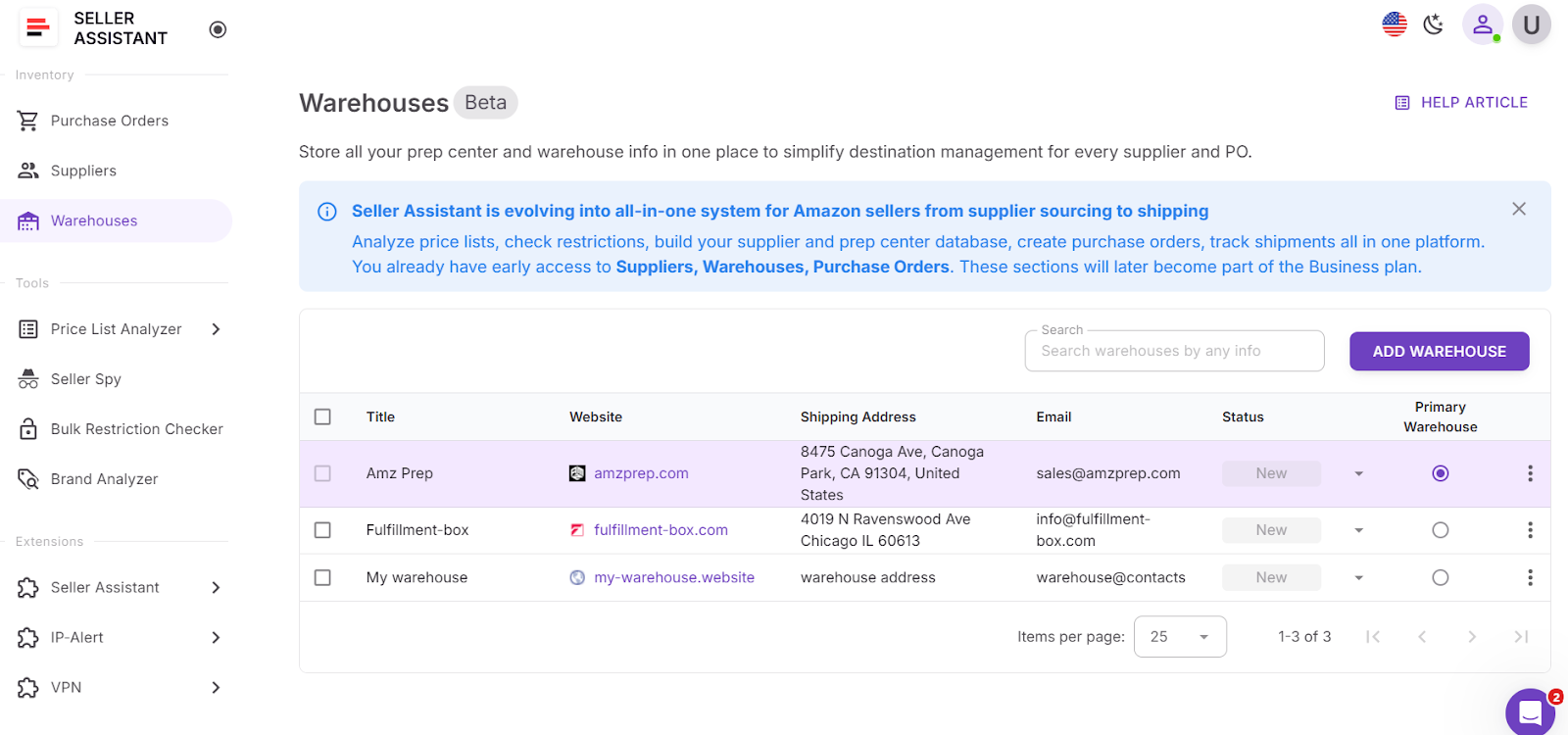
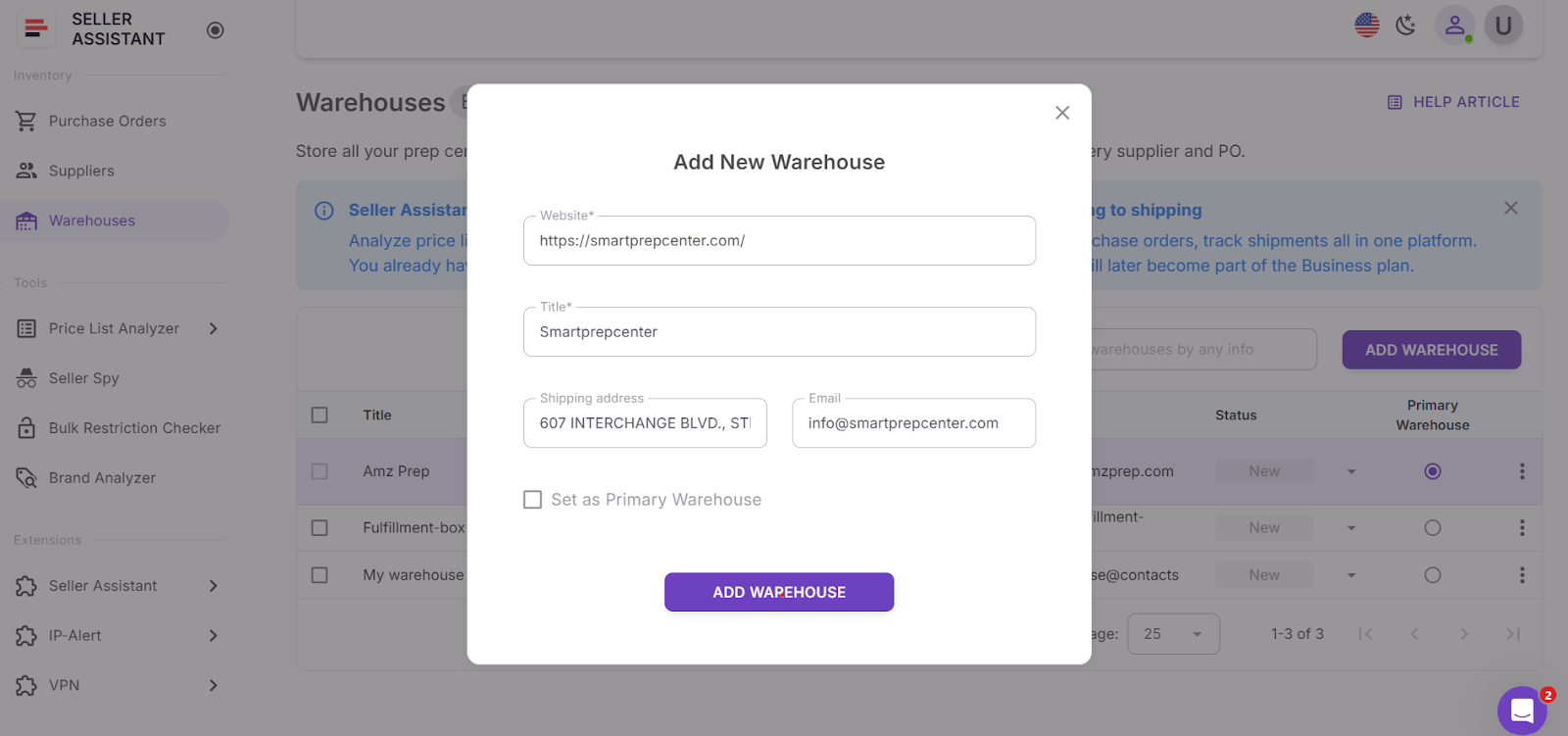
Step 2. Add a new warehouse or prep center
Click Add warehouse and enter the required information, including the website and location name. The name is pulled automatically from the website and can be adjusted. You may also add optional details such as the full shipping address, email, phone number, and internal notes.
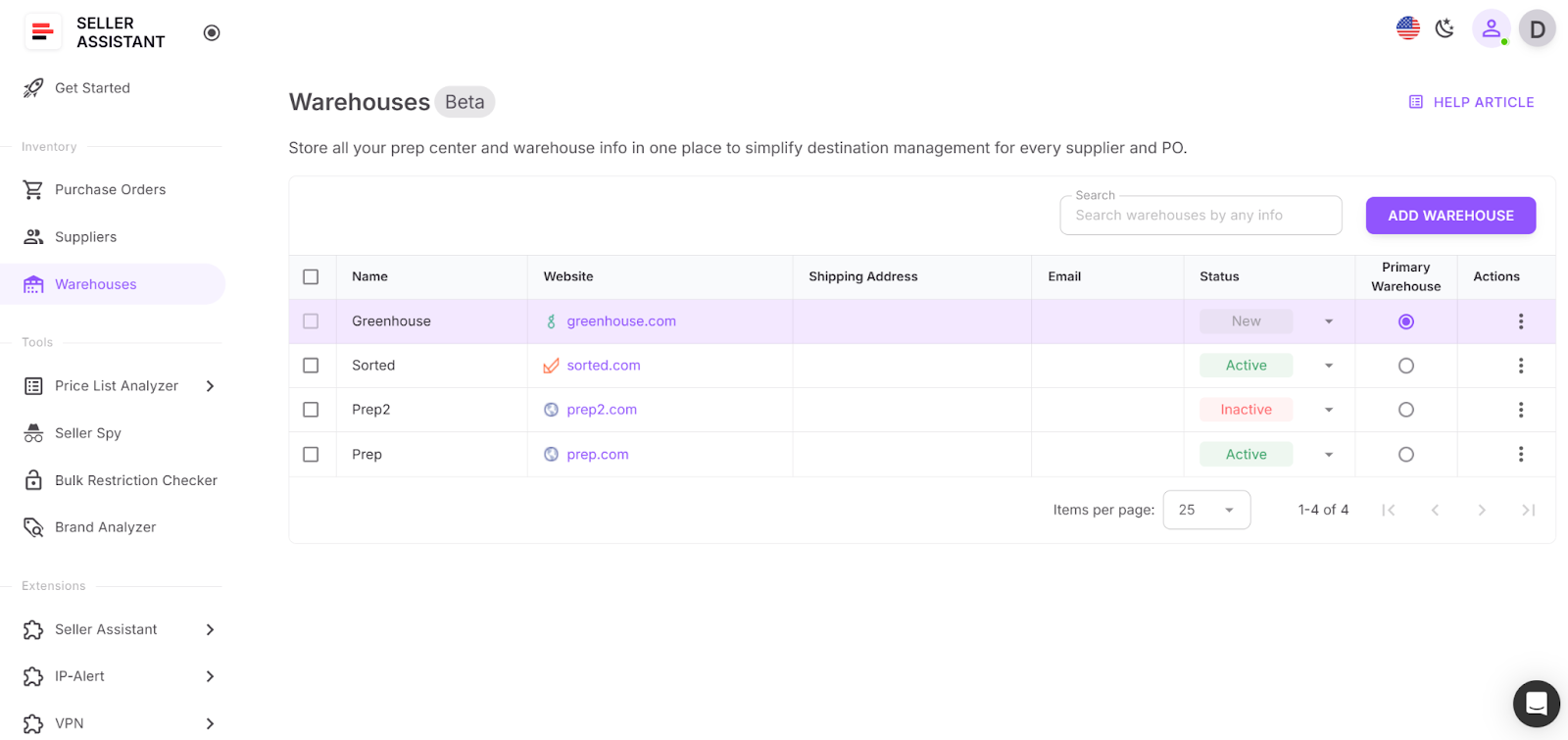
Step 3. Define the warehouse status
Assign a status like New, Active, or Inactive to indicate whether the location is currently used for fulfillment.
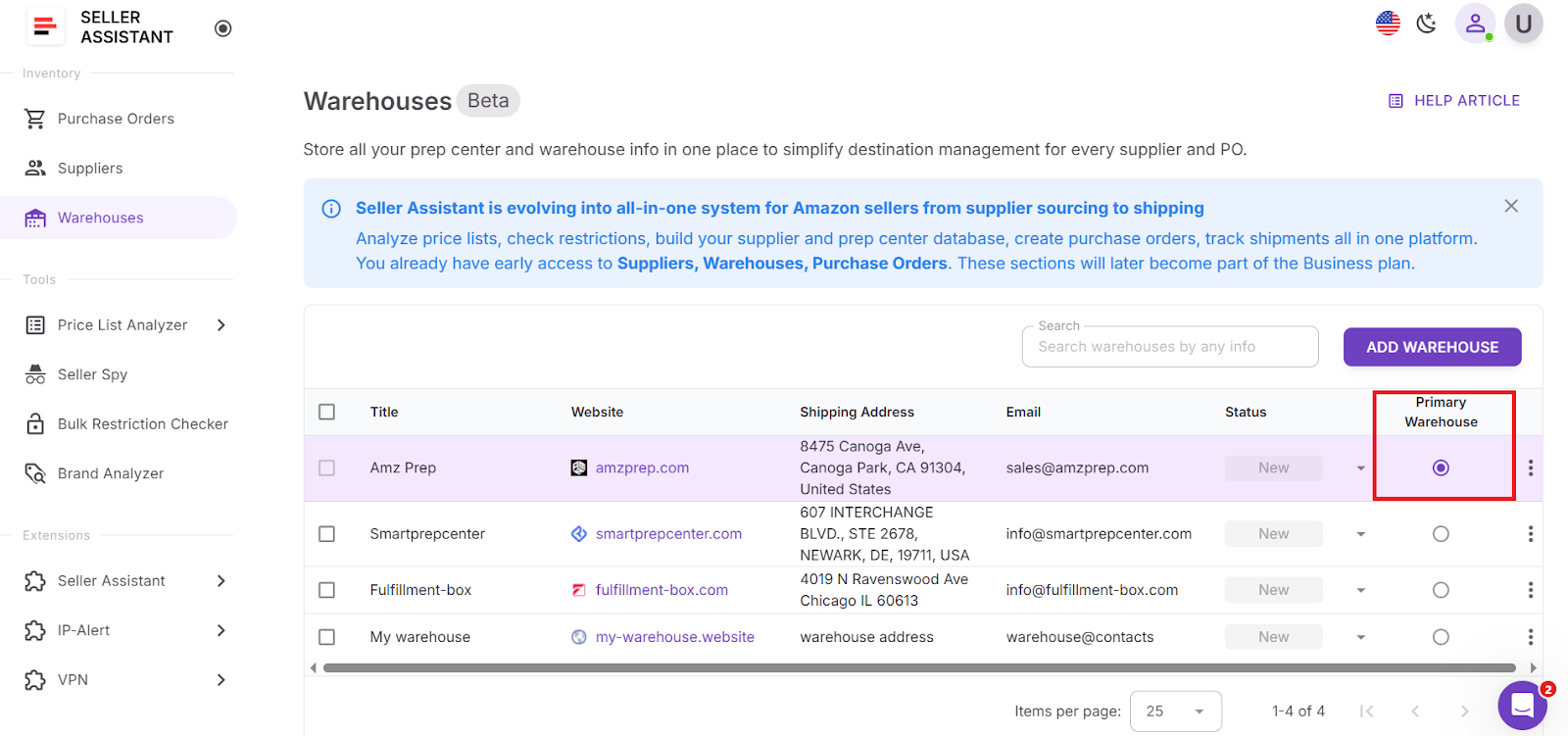
Step 4. Set a primary warehouse
Select one warehouse as the main ship-to location. Only one primary warehouse can be active at a time, and another must be selected before the current one can be removed.
Step 5. Keep warehouse details up to date
Edit addresses, contact information, or statuses as operations change. Accurate warehouse data helps ensure correct routing, clean purchase orders, and reliable fulfillment as your business grows.
Purchase Orders Module: Turn Sourcing Decisions into Bulk Buys
Purchase Orders Module is a centralized workspace for creating, managing, and tracking Amazon wholesale purchase orders as sellers move from ad-hoc OA buying to structured wholesale procurement. In online arbitrage, orders are often created manually in spreadsheets or documents. That approach quickly breaks when order volume increases. Purchase Orders Module replaces manual PO creation with a clean, system-driven process built on verified product, supplier, and warehouse data.
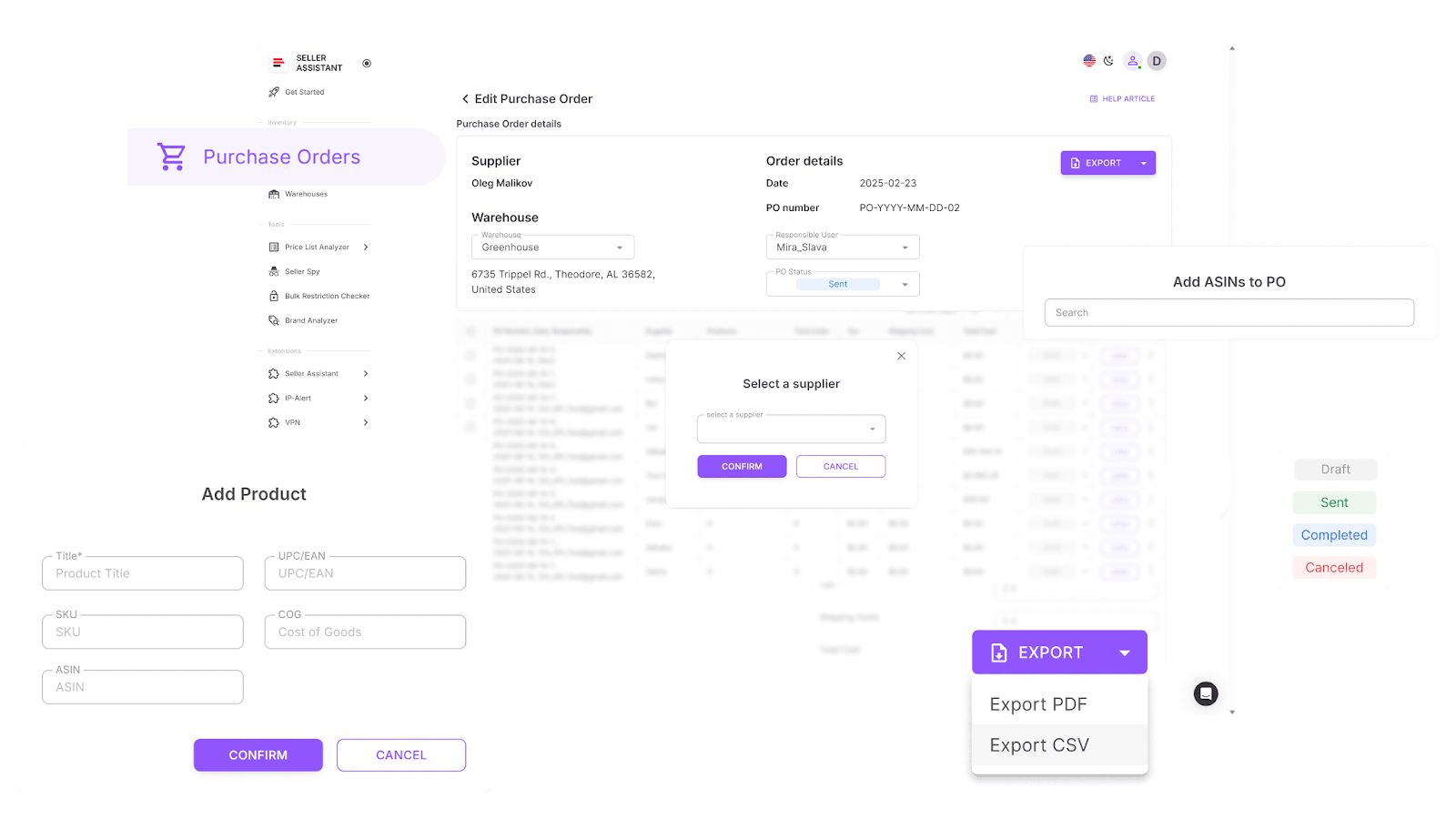
The module connects sourcing, suppliers, and fulfillment into a single workflow. Supplier and warehouse details are pulled automatically from your connected databases, costs are calculated in real time, and each order is tracked from draft to completion. Sellers can create purchase orders directly from Price List Analyzer shortlists, supplier price lists, or product searches using ASIN, UPC, EAN, brand, or Keepa data. This keeps purchasing consistent, auditable, and easy to manage across teams and reorder cycles.
What Purchase Orders Module does
- Create purchase orders from Price List Analyzer shortlists, supplier price lists, Keepa data, or manual entry
- Auto-fill supplier and warehouse details from Suppliers Database and Warehouses Database
- Generate and edit PO numbers, order dates, and assigned team members
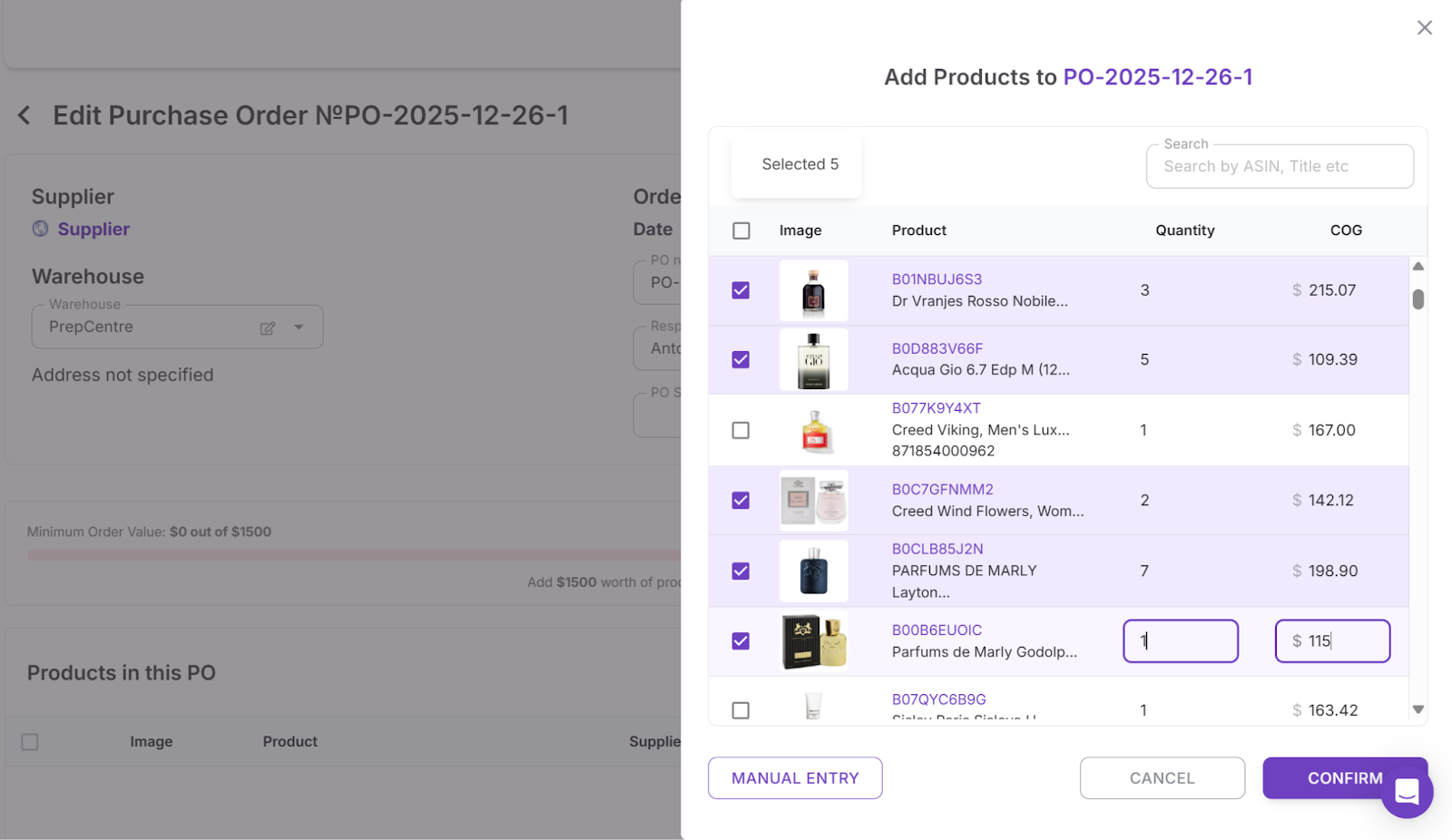
- Add products using ASIN, UPC, EAN, title, or brand search
- Prevent duplicate items by updating existing products instead of adding them twice
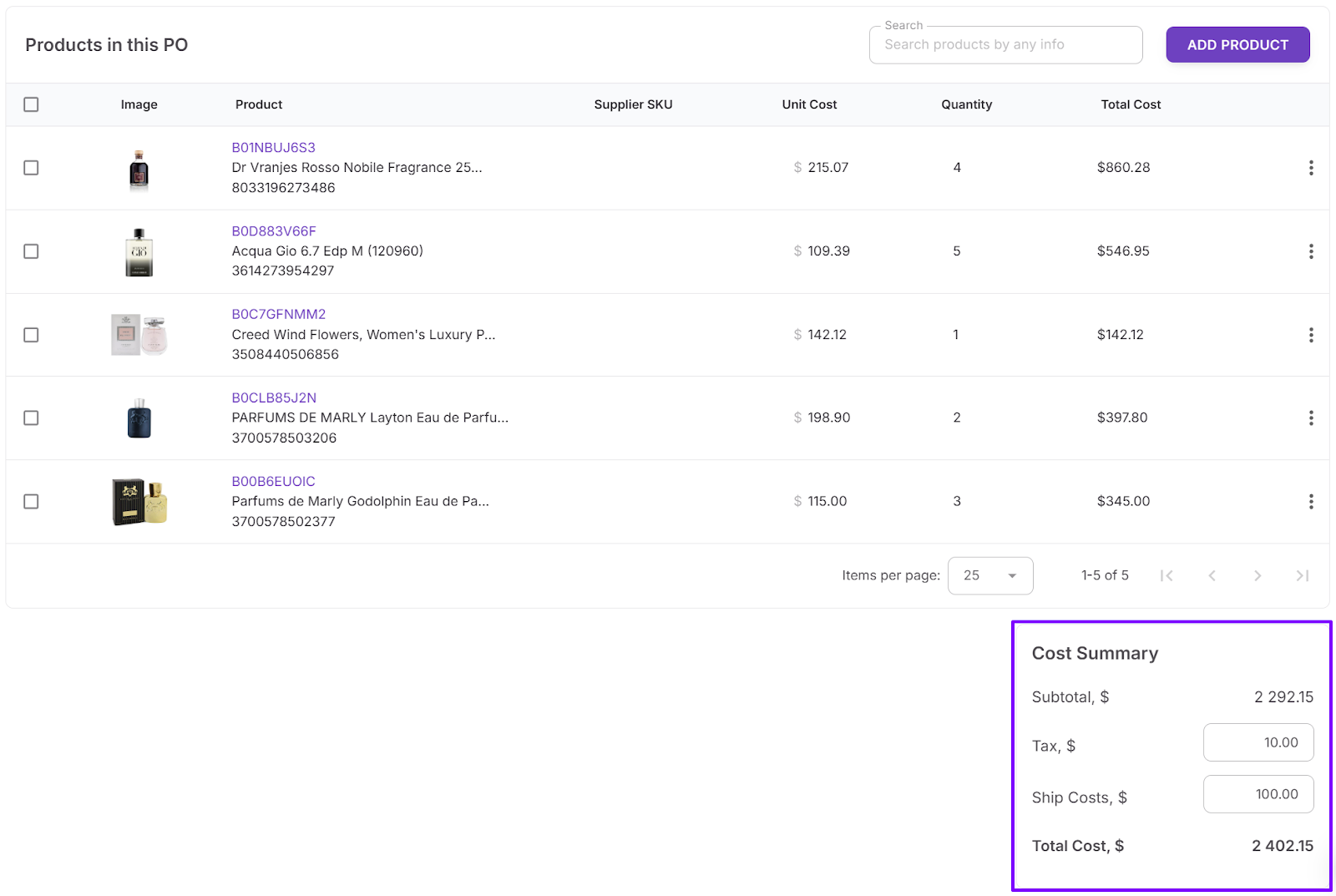
- Manage quantities, unit costs, shipping, and tax with live total recalculation
- View full cost summaries, including subtotal, shipping, tax, and total order value
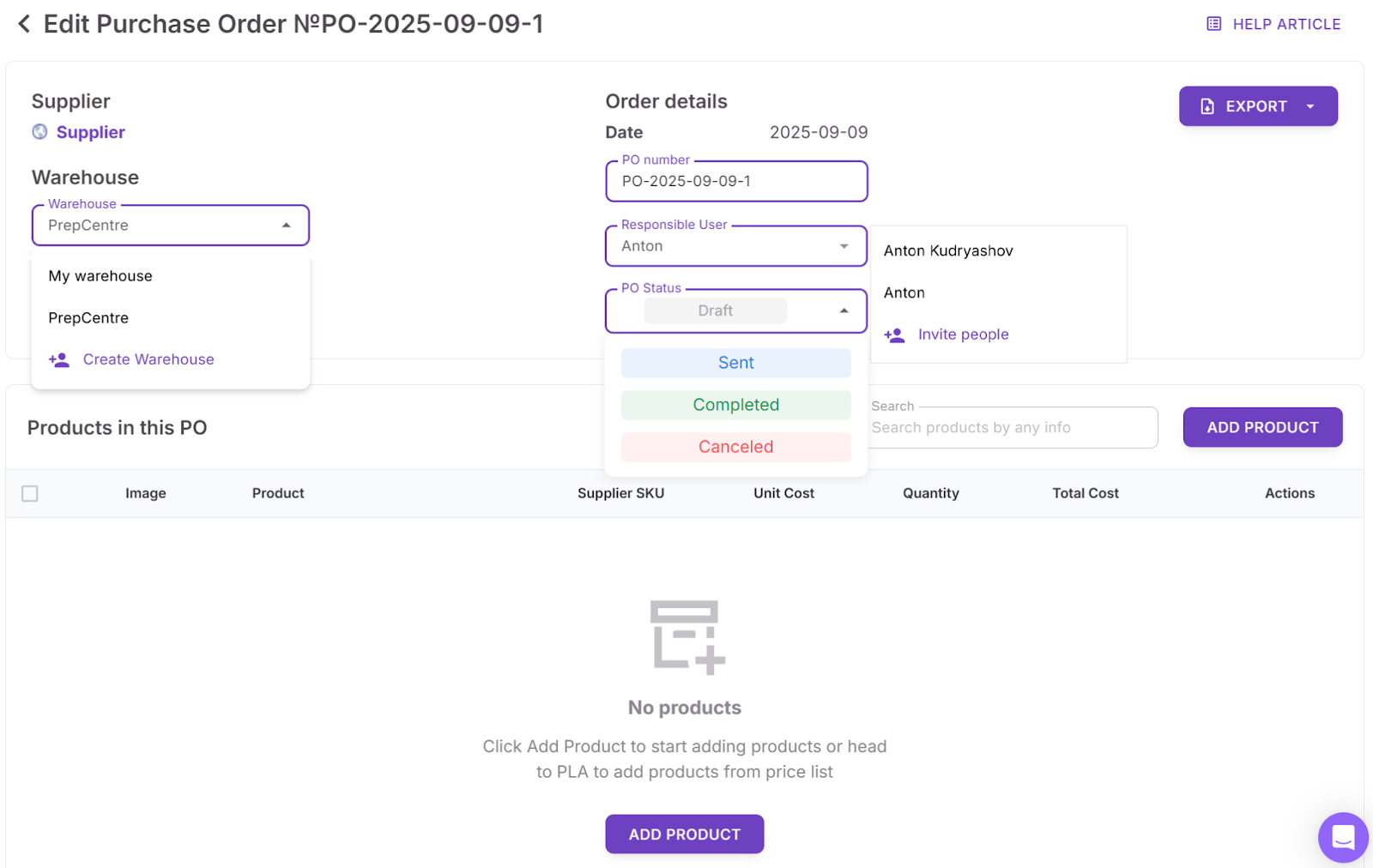
- Track purchase order status as Draft, Sent, Completed, or Canceled
- Lock completed or canceled POs to prevent accidental changes
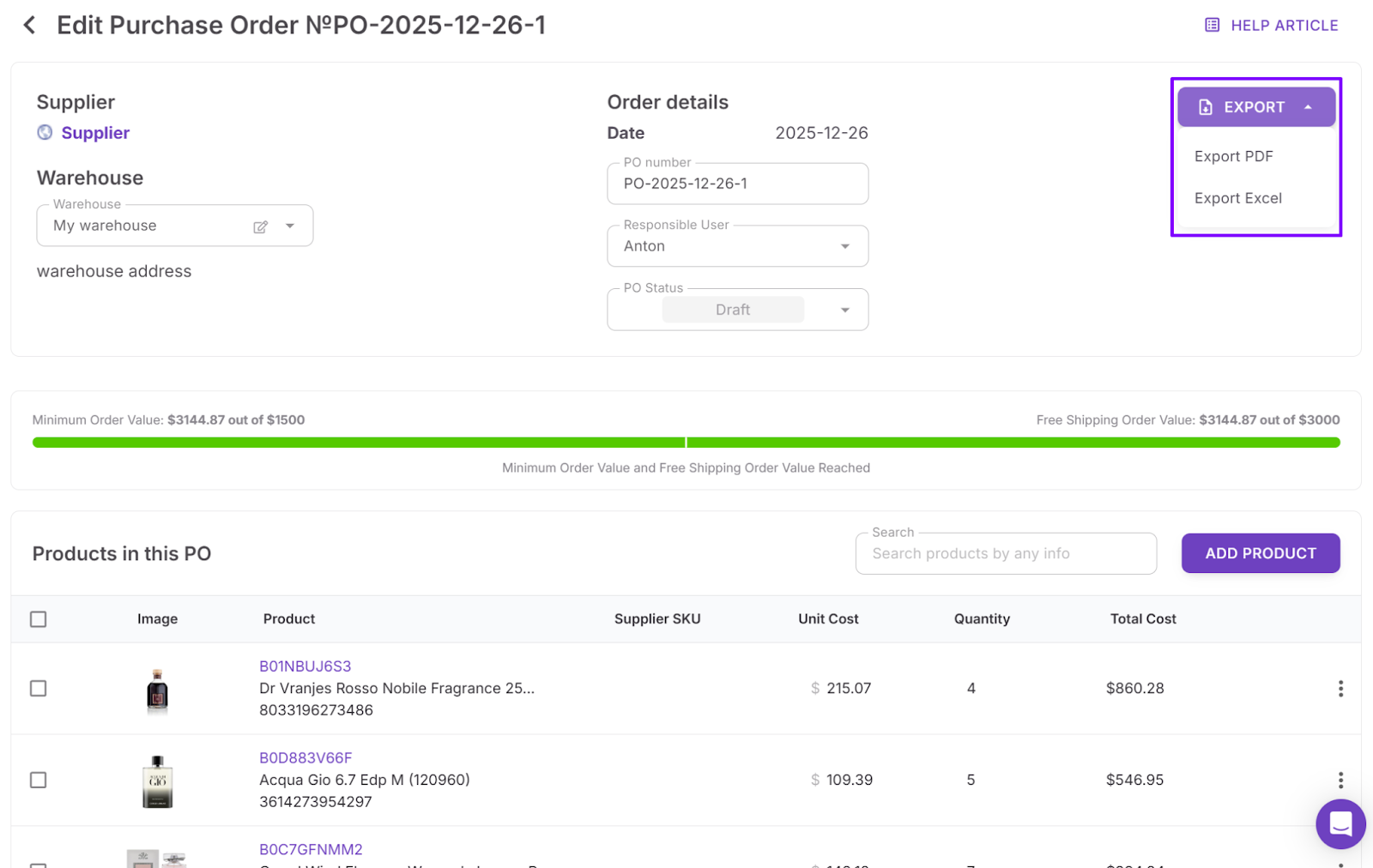
- Export finalized purchase orders in PDF or XLSX format
- Collaborate with team members and assign responsibility per order
- Validate orders automatically by flagging missing data or invalid warehouse assignments
- Maintain a searchable order history for audits, reorders, and forecasting
How Purchase Orders Module helps scale from online arbitrage to wholesale
Online arbitrage buying is often reactive and manual. Wholesale requires repeatable, controlled purchasing. Purchase Orders Module enables that shift by standardizing how orders are created and tracked. It ensures every PO is built from verified data, routed correctly, and documented consistently. This allows sellers to place larger orders, manage multiple suppliers, delegate purchasing tasks, and scale procurement without losing visibility or control.
How to use Purchase Orders Module
Step 1. Open Purchase Orders Module
Log in to your Seller Assistant account and open Purchase Orders from the Inventory section in the sidebar.
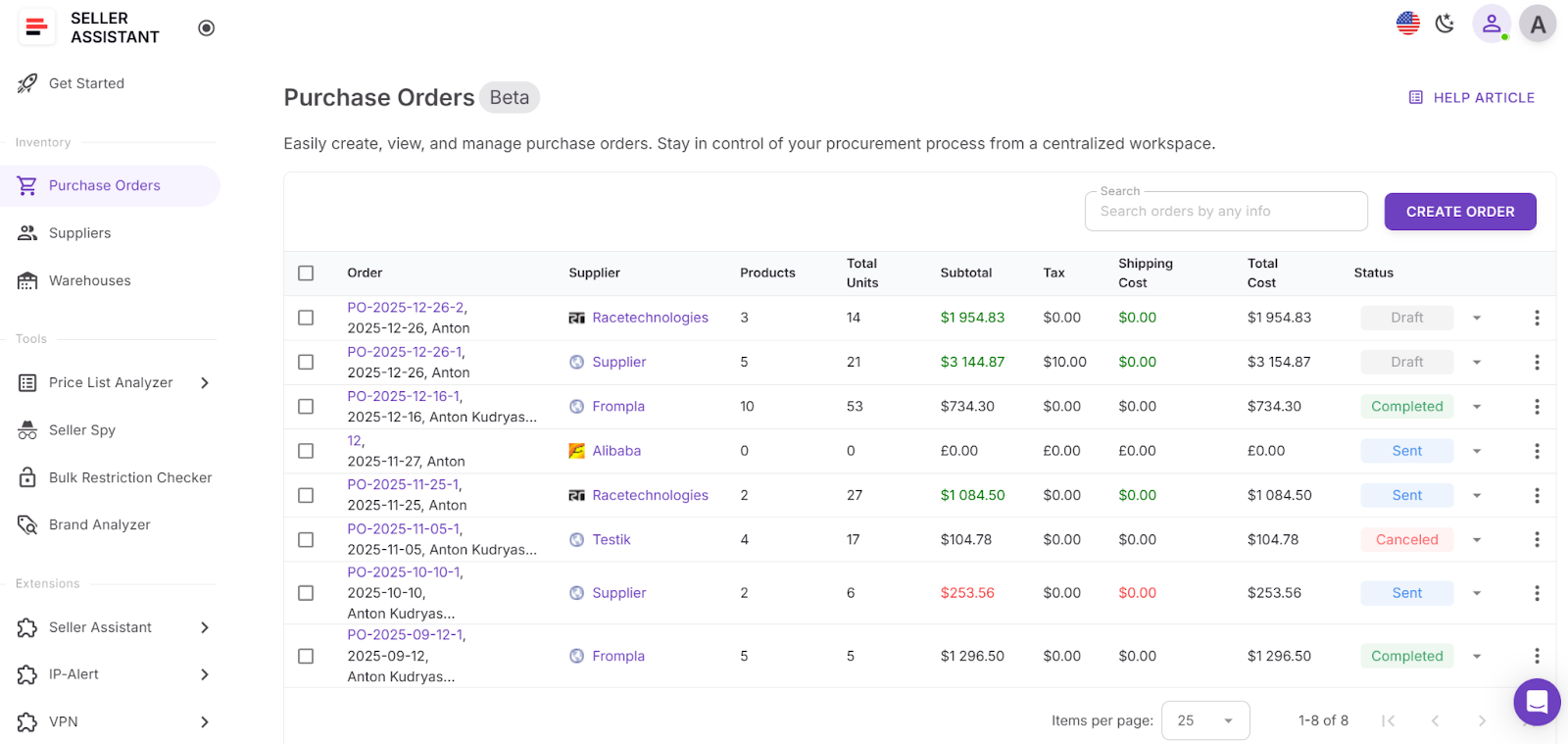
Step 2. Create a new purchase order
Click Create PO, select an existing supplier or add a new one, and confirm. A draft purchase order opens with a unique number and pre-filled supplier details.
Step 3. Review and adjust the draft
Assign a responsible team member, select the correct warehouse or prep center, and update the PO number or order date if needed.
Step 4. Add products to the PO
Add items from Price List Analyzer, supplier price lists, Keepa search, internal product data, or manual entry. Adjust quantities and unit costs as required.
Step 5. Set costs and totals
Enter shipping and tax values. The module calculates subtotals, total order cost, and landed cost instantly.
Step 6. Export and send the PO
Once finalized, export the purchase order as a PDF or XLSX file and send it directly to your supplier.
FAQ
Can I use Seller Assistant tools if I’m still doing online arbitrage?
Yes. The tools are designed to work for online arbitrage, wholesale, and dropshipping, making it easy to start with OA and scale into wholesale using the same workflows.
How do these tools help transition from online arbitrage to wholesale?
They replace single-ASIN research with bulk analysis, structured supplier management, and automated purchase order creation. This allows sellers to handle larger catalogs and supplier price lists without manual work or guesswork.
Do I need a large team to benefit from these tools?
No. Solo sellers benefit from automation and cleaner workflows, while teams can collaborate using shared data and defined processes without accessing Seller Central directly.
Can these tools help reduce costly buying mistakes?
Yes. Bulk restriction checks, risk alerts, and real-time cost calculations help prevent purchases of gated, restricted, or unprofitable products before capital is committed.
Are Seller Assistant tools only for wholesale sellers?
No. While they are built to support wholesale scale, the same tools work for online arbitrage and dropshipping sellers who want more structure and control as they grow.
Final Thoughts
Growing from online arbitrage to wholesale isn’t about finding more products – it’s about building systems that can handle volume without breaking. Manual checks, scattered spreadsheets, and ad-hoc buying decisions work early on, but they don’t scale.
Seller Assistant tools give Amazon sellers a structured way to analyze products in bulk, validate eligibility, manage suppliers, route inventory, and create purchase orders with confidence. By connecting every step of the sourcing and purchasing workflow, Seller Assistant helps resellers move from reactive OA sourcing to controlled, repeatable wholesale growth – without losing visibility, margins, or execution quality.
Seller Assistant automates and connects every stage of your Amazon wholesale and arbitrage workflow. It brings together in one platform: workflow management tools – Purchase Orders Module, Supplier Database, Warehouse Database, bulk research & sourcing tools – Price List Analyzer, Bulk Restriction Checker, Sourcing AI, Brand Analyzer, Seller Spy, Chrome extensions – Seller Assistant Browser Extension, IP-Alert Extension, and built-in VPN by Seller Assistant, and integrations & team access features – seamless API connectivity, integrations with Zapier, Airtable, and Make, and Virtual Assistant Accounts.